

Audio By Carbonatix
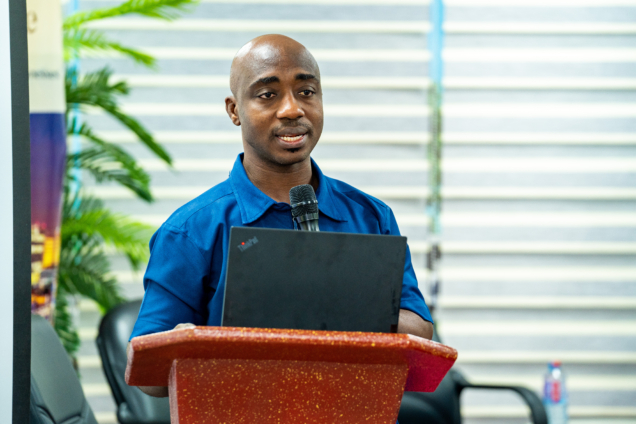
Africa Partner for Infrastructure and Partner, Strategy and Transactions at Deloitte, Yaw Appiah Lartey, has urged university lecturers and professors to refrain from their old methods of lecturing and instead teach students to question assumptions, deconstruct arguments, or apply knowledge in novel ways, because these are the very skills industries desperately need.
According to him, the conditioning of students to copy notes verbatim, memorise and reproduce in exams, with little need for deep understanding, critical analysis or original thought, is outmoded.
Speaking at a Management Seminar held for Registrars, Assistant Registrars and Administrative Staff of public universities at the University of Ghana, Mr. Lartey expressed worry that university examination system is overwhelmingly focused on final exams that test a student's ability to recall information under time pressure, adding, “This sends a clear message to students: Your ability to memorise is more valuable than your ability to do."
“Graduates are often passive recipients of information, rather than active problem solvers. They can tell you what the textbook says, but cannot tell you how to use that knowledge to solve a real business problem, lead a team, or innovate a process. They lack the intellectual agility required in a dynamic workplace”, Mr. Lartey alluded.
Students Culture of Only Acquiring Certificate
With regard to the students, he said, the primary goal for many has become obtaining the degree certificate itself, rather than acquiring in-depth skills. This leads to a culture of 'chew, pour, pass and forget,' where students can achieve an 'A' in a course yet be unable to apply its core concepts to a real-world problem.
“We must recognise that the mindset we often lament about in our students, that is, the 'teach me only for the exam' approach, is a rational, though ultimately limiting, response to a system we have designed. A high GPA does not guarantee problem-solving, communication or initiative”, he noted.
“But let’s be clear: this is our mirror. If we reward memorisation, students will memorize. If we reward creation, they will create”, he added.
He continued that the responsibility to break the cycle starts with everybody, adding, “The consequences are clear when students enter the workforce. Employers consistently find that a high GPA does not necessarily equate to problem-solving ability, clear communication, or a proactive work ethic”.
Citing an example, the Deloitte Partner said “I am proud to share the grade point (FGPA) that I graduated with some 20 years ago. I graduated with a GPA of 3.93, scoring straight As in the first and second semesters of my level 300 (3rd year) at the University. However, when I arrived at the University of Cambridge in October 2006, I was unfamiliar with Excel spreadsheets. I had to rely on the generosity and benevolence of my Asian classmates to help me solve advanced Excel problems using spreadsheets”, he explained.
He stressed that the student’s behaviour is a mirror of the educational system's own priorities. “If we do not create and incentivise practical experiences, students will not seek them out. If we do not model and demand critical thinking, we do not expect them to develop it”.
Therefore, Yaw Appiah Lartey said the call to action in this room is not for the students to change first.
“The responsibility lies with us to break this cycle. It is our duty to redesign a system that incentivizes the builder, the creator, the innovator, and the critical thinker, and not just the exam passer. When we change the system, we will change the student, and change society for good!", he concluded.
Latest Stories
-
Hawa Koomson pledges experienced and mature leadership of NPP women’s wing
46 minutes -
Young woman found dead at Kasoa Peace Town
1 hour -
Playback: The Law examined lawful arrest in Ghana
2 hours -
Mahama urges African governments to treat healthcare as an investment, not budget cost
2 hours -
Bawumia congratulates John Boadu and new NPP executives, pledges support ahead of 2028
2 hours -
‘No talent should be left out’ – Bawumia pledges inclusive NPP campaign for 2028
2 hours -
Prof. Mike Oquaye recounts how he blocked the Special Prosecutor’s attempt to arrest Bawku Central MP
3 hours -
Make health sovereignty a priority for Africa – Mahama
3 hours -
Dorimon Naa, Wa West DCE lead massive clean-up exercise; threaten sanctions against recalcitrant residents
3 hours -
Photos from Adom FM Y2K Jam
3 hours -
Praye Tiatia steals the show at Adom FM Y2K Jam [Watch]
3 hours -
Boakye Agyarko congratulates John Boadu, pledges support for NPP leadership
4 hours -
Antwi HiMight thrills fans with Antwi ne Antwi hits at Adom FM’s Y2K Jam [Video]
4 hours -
Amb. Edward Boateng congratulates Boadu, Kodua on election wins
4 hours -
John Boadu pledges to rebuild NPP from grassroots and restore ‘winning machinery’
4 hours