

Audio By Carbonatix
The US has formally left the 2015 Paris climate agreement. Future US participation in the international pact will depend on the outcome of the presidential election.
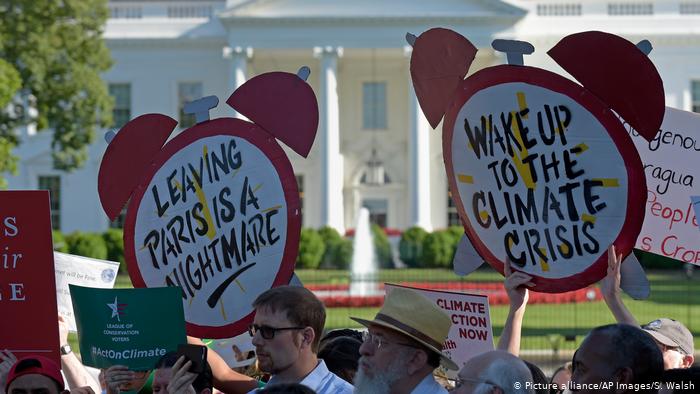
The United States formally left the Paris climate accord on Wednesday, becoming the first country in the world to withdraw from the international climate pact aimed at reigning in greenhouse emissions.
President Donald Trump's administration had notified the United Nations last year of the US withdrawal from the accord. The mandatory one-year waiting period required for it to exit ended on Wednesday.
The fate of the US participation in the Paris agreement now rests on the outcome of the presidential election.
Trump to keep US out, Biden wants back in
Trump, a staunch opponent of the international accord, had first announced his intention to withdraw the US from the landmark agreement in 2017, but the UN rules prevented countries from leaving in the first three years.
If Trump were to be reelected, the US — the world's largest economy and the second-biggest polluter after China — would stay out of the accord.
During his presidency, Trump has questioned climate science on multiple occasions, championed the fossil fuel industry, and weakened environmental protections.
His Democratic rival Joe Biden, in contrast, has vowed to immediately rejoin the Paris agreement if he wins the presidential election.
Biden has called climate change and global warming "an existential threat to humanity" and that the US has a "moral obligation to deal with it."
Biden has also proposed a $1.7 trillion plan to bring US carbon emission to net-zero by 2050.
'Make or break'
Regardless of how the election turns out, the United States will still be "outside the conversation" when the UK and the UN host a climate summit on December 12, on the fifth anniversary of the Paris accord.
Climate scientists have warned the unless drastic action is taken, global temperatures may rise more than 2 degrees Celsius above pre-industrial levels, triggering a series of catastrophic climate tipping points by the end of the century.
This could be averted if global emissions reached net-zero by mid-century, according to the UN's Intergovernmental Panel on Climate Change.
Dutch Climate Scientist Niklas Hohne backed Biden's plan in a tweet on Tuesday.
"This election could be a make or break point for international climate policy," he said. "Biden's climate plan alone could reduce temperature increase in the order of 0.1°C. Every tenth of a degree counts."
Latest Stories
-
We must account for every cedi entrusted to us as public officials – Ato Forson
23 minutes -
Supreme Court rejects Solomon Asamoah’s bid to overturn Sky Train ruling
38 minutes -
Nungua Traditional Stool, WT Plastics partner to establish factory, create 1,400 jobs
40 minutes -
Mahama describes Ghana’s religious diversity as its greatest treasure, defends fairness to all faiths
45 minutes -
Police to arrest motorists who use pedestrian footbridges – ACP Obeng
46 minutes -
KNUST announces revised reopening dates, lectures begin October 19
60 minutes -
GoldBod, military engineers partner to reclaim galamsey-damaged Tano Nimri Forest
1 hour -
NACOC educates 450 Koforidua SHS students on dangers of drug abuse
1 hour -
First-year students stranded as Obuasi SHTS remains closed over misconduct probe
1 hour -
Court halts promotion of 40 police officers pending IGP’s appeal
1 hour -
Gender Ministry deploys teams nationwide to monitor LEAP cash grant payments
1 hour -
GNFS contains Somoco warehouse fire; bushfire near TTU in Takoradi
1 hour -
Recurring teacher-student sexual abuse cases give cause for worry – Salaga South MP
1 hour -
D-Black shocked as only 16 radio and TV stations pay music royalties
1 hour -
Former SIC Savings and Loans MD Amma Frimpomaa Dwumah honours EOCO invitation
2 hours