

Audio By Carbonatix
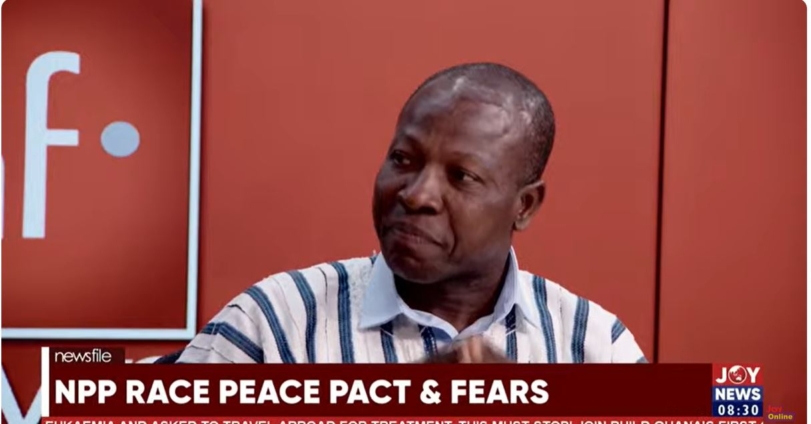
A Lecturer at the University of Professional Studies, Accra (UPSA), Dr Kwabena Bomfeh Jnr, has argued that Ghana’s system of governance is not truly party-based but instead revolves around the individual who occupies the presidency.
Speaking on JoyNews’ Newsfile programme on Saturday, January 24, Dr Bomfeh said there are fundamental flaws in the way politics is practised in Ghana, from party membership and leadership selection to how political authority is exercised once a party’s candidate assumes office.
“We need to accept that there is something fundamentally wrong with the way we have been doing politics in this country, in terms of how we join political parties, how people emerge into political party leadership positions and how they serve in their offices,” he said.
According to him, these weaknesses within political parties are directly transferred into government when a party-sponsored candidate either secures a majority in Parliament or wins the presidency.
“And then we transform that or translate that into government when the party’s sponsored candidate either forms a majority in Parliament or becomes the President,” Dr Bomfeh stated.
However, he stressed that Ghana does not, in reality, operate a system where governments are formed and driven by political parties as institutions.
“We don’t have party-formed governments in Ghana,” he said.
To illustrate his point, Dr Bomfeh cited the current administration, noting that while President John Dramani Mahama was elected on the ticket of the National Democratic Congress (NDC), governance is centred on the president as an individual rather than on the party as an institution.
“President John Dramani Mahama is the President of the Republic of Ghana elected on the ticket of the National Democratic Congress,” he said.
He added: “The government of the day is not the National Democratic Congress but the government of His Excellency John Dramani Mahama.”
Dr Bomfeh argued that this personalised nature of governance weakens party ideology, collective decision-making and institutional accountability, as policies and key decisions are driven more by presidential authority than by party structures and programmes.
He called for deeper reforms to strengthen political parties as institutions, improve internal democracy and redefine the relationship between parties and the executive.
According to him, without such changes, political parties would continue to function primarily as electoral vehicles for individuals, rather than as enduring institutions capable of shaping governance, ensuring accountability and delivering consistent policy direction.
Latest Stories
-
Extractive firms urged to strengthen cyber defences as digital risks grow
54 seconds -
Photos: Mahama engages Ghanaian diaspora in New York on Ghana’s economic recovery
4 minutes -
Man jailed 10 years for defiling 11-year-old girl at Kpandai
45 minutes -
At least 27 people killed in two shootings in South African township
1 hour -
Iranian minister says only negotiation can end conflict after Trump rejects Hormuz deal
2 hours -
Some Ghanaians use free speech to destroy reputations – Bobby Banson
2 hours -
Crowds, deals and home solutions as Republic Bank-JoyNews Habitat Fair enters final day
5 hours -
Fire Service finds only five functional hydrants in Ministries enclave
5 hours -
Government to sign 1,200MW gas power deal before end of 2026 – Mahama
5 hours -
West Mamprusi launches community-led WASH and livelihoods project across 100 communities
5 hours -
Iran says it will wait for official US response after Trump rejects Strait of Hormuz proposal
5 hours -
90 Oti communities to benefit from government electrification project
5 hours -
Floods leave 246 without shelter as 93 houses collapse in North East Gonja
6 hours -
Labour Minister wants SOEs to help shape new public pay system
10 hours -
IPEC will ensure Equity and Sustainability in SOEs Compensation
11 hours