

Audio By Carbonatix
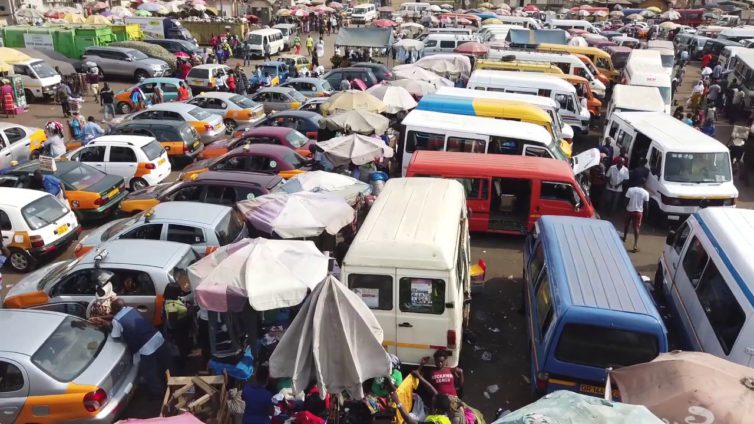
The Ghana Private Road Transport Union (GPRTU) has defended its decision not to reduce transport fares despite a slight drop in fuel prices, stating that fare adjustments depend on multiple cost factors beyond just fuel.
Speaking on Joy News’ PM Express on Tuesday, March 18, the Deputy PRO of GPRTU, Samuel Amoah, explained that spare parts, insurance, DVLA charges, and other operational costs play a critical role in fare determination.
“Before December, we had plans of increasing transport fares, first because of the high cost of spare parts, where the fuel price was also running to, the cost of lubricants, insurance, and DVLA taxes,” Amoah stated.
“But then we held it. We held on, thinking that things would come down because of the promises we had that going forward, things were going to get better.”
He acknowledged that fuel prices have seen a slight reduction but argued that it is not enough to warrant a fare decrease.
“Yes, we have seen that fuel prices are coming down a little bit. But what I can say is that it has not gotten to where it will call for a reduction in transport fares.”
Amoah stressed that fuel prices are just one of many variables considered when deciding on fare adjustments.
“We don’t only consider fuel prices to determine our transport fares,” he explained.
“We have some other components, like the cost of spare parts, as I earlier mentioned. We have the cost of lubricants, taxes, and other petroleum products as well.”
He outlined the process GPRTU follows before making any fare changes.
“We normally have a 10% threshold that we check on,” he said. “We compare where the fuel price was and where it has gotten to.
"Then, we send a team to the market to check where the prices of these other components have moved to. Based on their reports, we determine whether there should be a percentage reduction or an increment.”
According to Amoah, the last time transport fares were increased, fuel prices were around ¢12 per litre.
“If you check the previous time we increased transport fares, I believe the fuel price was around ¢12 per litre, thereabout—I stand to be corrected,” he said.
“Looking at it now, diesel is about ¢15.49, and petrol is about ¢14.99.”
He made it clear that until fuel prices drop significantly, fare reductions remain unlikely. “We are praying that fuel should come down to at least around ¢12 per litre,” he stated.
“If it comes down to that level, we will also check where the spare parts prices have gotten to. But with where the cost of spare parts is now, it will be difficult for us to reduce transport fares.”
His remarks highlight the complex nature of transport fare adjustments, reinforcing GPRTU’s stance that reducing fares is not solely dependent on fuel prices but also on other operational costs affecting transport operators.
Latest Stories
-
Walter Mosley visits W.E.B. Du Bois Centre in Accra: A New York Secretary’s homecoming story on where Du Bois spent his final years.
2 hours -
MTN set to deploy 5G services after winning spectrum licenses worth US$202m
4 hours -
NPP national elections: 3,000–4,000 police to handle security, traffic in Kumasi – Karbo
6 hours -
Atta Akyea fumes as Manhyia MP is to spend another night in EOCO custody
7 hours -
SSNIT says La Beach clearance was to protect hotel investments, beaches to remain public
8 hours -
APSU congratulates St Augustine’s College after back-to-back National Investment Quiz wins
8 hours -
Renewed flood intervention at Mallam Junction raises hopes among residents, businesses
9 hours -
St Augustine’s College retain National Investment Quiz title after nail-biting grand finale
9 hours -
Education infrastructure investment will drive Banda’s development – Ahmed Ibrahim
9 hours -
Teacher unions strike: Gov’t presents fresh proposals as talks end inconclusively
10 hours -
51,000 teachers’ promotion arrears to be validated for October payment – Education Minister
10 hours -
Kwabena Boamah appointed Board Chair for Impact Investing Ghana
10 hours -
Striking teacher unions to meet Fair Wages and Salaries Commission on October 6
10 hours -
EOCO working with AG to arraign Nana Baffour Awuah before weekend court
10 hours -
Duraplast reassures customers after fire, announces October 5 reopening
11 hours