

Audio By Carbonatix
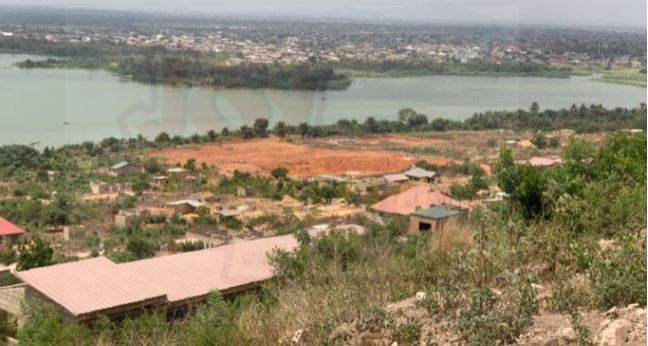
The Managing Director of the Ghana Water Company Limited (GWCL) Dr Clifford Braimah has disclosed that faecal matter has found its way into the Weija Treatment Plant in Accra.
He said he has observed the unwanted deposits that find their way into the river.
These deposits, he said compromise the quality of the water, hence the need for intensified efforts to sanitise Ghana's water bodies.
"If you go to Weija, that is an urban setting of Accra and look at the quality of the raw water there, you see it to be greenish. It means that organic material is being pushed into it. [And] one major organic material that is pushed in is people's faecal matter", he told host, Samson Lardy Anyenini on Newsfile on Saturday.
The GWCL boss made these comments while contributing to discussions about the contamination of water bodies, and their resultant effects on human lives and economies.
The issue of water contamination has been on the front burner over the last few weeks, following the re-arrest of galamsey kingpin, Aisha Huang.
Aisha and her accomplices were arrested on September 5, in Kumasi and currently facing prosecution for their illegal mining activities.
Touching on this development, Dr. Clifford Braimah advocated the involvement of the Water Resources Commission in the fight against illegal mining in Ghana.
According to him, this will strengthen the inter-agency efforts being employed to deal with the menace.
Speaking on NewsFile, he explained that, the Water Resources Commission is a critical agency, whose mandate cannot be ignored if the fight against ‘galamsey’ will succeed.
He however noted that the Commission is currently under-resourced, hence the need for it to be retooled.
“For us in Ghana Water Company, we take the resource itself to produce water for citizens. But we do not have the role or the power to monitor the water bodies. It is the Water Resources Commission.
In all these activities that we’re carrying out, at what position have we placed the Water Resources Commission? Have you gone to the Water Resources Commission to look at even the offices they work in?”, Dr Braimah quizzed.
Meanwhile, the sector minister for Lands and Natural Resources, Samuel Abu Jinapor, says he welcomes the numerous suggestions from stakeholders on how to combat illegal mining in Ghana.
According to him, his outfit has taken note of the various recommendations from the public and will factor them in addressing the menace.
Latest Stories
-
Tony’s Open Chain steps up child labour interventions in Ghana’s cocoa communities
2 minutes -
Missing newborn sparks tension at Salaga Hospital as police detain nurse
11 minutes -
Minority demands report of anti-flood taskforce for Parliamentary scrutiny
20 minutes -
GH¢50m recapitalisation: Microfinance Companies plead for more time as Dec. 2026 deadline looms
27 minutes -
Agenda 111 hospitals ready for operationalisation; gov’t must act – Dr Nsiah-Asare
31 minutes -
We couldn’t complete Afari Military Hospital due to contractual dispute – Ayew Afriyie
41 minutes -
Built environment professionals call for metropolitan governance reforms to address Ghana’s urban challenges
52 minutes -
NLA staff give management 14 days to resolve grievances or face strike
1 hour -
Previous gov’t prioritised Agenda 111 over completion of Afari, Sewua Hospitals – Health Committee Chair
1 hour -
Stock market jitters remain amid tech fears and renewed Middle East attacks
1 hour -
GPCC urges Parliament to restore original Anti-Gay Bill
1 hour -
Two women petition Mahama to sack Ashanti Regional Minister over sexually offensive post targeting Akosua Manu
1 hour -
SG Ghana reports strong 2025 performance as profit reaches GH¢397m
1 hour -
I will never get over watching my home of 13 years burn down
2 hours -
Manhunt under way in South Africa after 12 killed in mass shooting in Johannesburg
2 hours