

Audio By Carbonatix
The World Bank has expressed concern about Ghana's increasing reliance on its natural resources.
In its 2022 report on Country Climate and Development Report (CCDRS) on Ghana, the World Bank noted that Ghana has not been able to maintain its natural resources.
It said the country lags behind on most indicators of sustainable use of natural resources and environmental health.
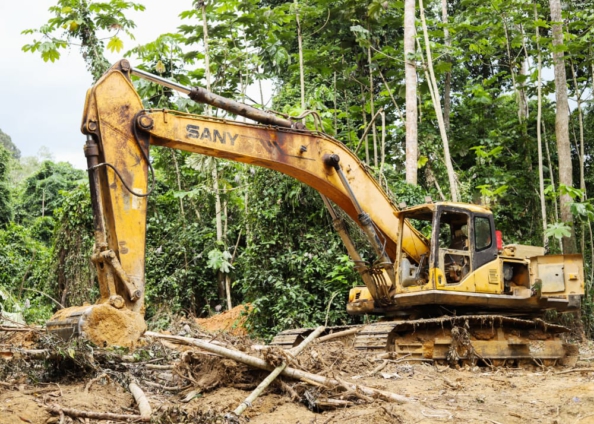
“First, Ghana’s economy has become more, not less, reliant on natural resources extraction…Ghana has been depleting its renewable natural capital, which is a key source of livelihoods… Deforestation is high and spatially concentrated in areas of high poverty, with land use change from forest to agriculture causing about 92 percent of deforestation,” the report stated.
According to the report, since 1997, Ghana’s demand per person for global natural resources has been exceeding the biocapacity causing a steady rise in the ecological deficit.
It explained that “Ghana’s high population growth and increased demand for natural resources makes the demand per person on global natural resource an increasingly pressing concern since a shrinking natural capital stock will need to be shared with larger future generations, hampering the capacity of remaining ecosystems to deliver their services.”
World Bank says Ghana’s over-reliance on natural resources has already affected the climate in the country.
“The average number of ‘hot’ days has increased by 13 percent, while the number of hot nights per year increased by 20 percent. This is highly significant for a country with a tropical climate, an average annual temperature of 28 degree Celsius (2020), and relative humidity between 77 and 85 percent.”
It added that rainfall has become more erratic, sea level has risen and there has been increased coastal erosion due to changes in hydrodynamics.
The report was published in the wake of Ghana’s plan to procure oil with gold for the Ghanaian market. This is expected to address the “dwindling foreign exchange reserves” to procure oil products.
Vice-President Dr. Mahamudu Bawumia disclosed this on his Facebook page last week Thursday.
“The barter of sustainably mined gold for oil is one of the most important economic policy changes in Ghana since its independence.”
He said the government expects “this new framework to be fully operational by the end of the first quarter of 2023.”
Latest Stories
-
Mobile Money Fintech LTD, UMB train hairdressers and beauticians
2 hours -
Asylum votes show people want help, says Kemi Badenoch
3 hours -
Badenoch welcomes expanded grooming gangs inquiry
3 hours -
GACL MD sues Samuel Buabeng over alleged Facebook defamation
3 hours -
Christa Pike in critical condition after surviving two lethal injections, lawyer says
3 hours -
Kemi Badenoch backs face covering ban at protest
4 hours -
Man City not ‘above the rules’, says No 10 after backlash to Burnham remarks
4 hours -
Real Madrid submit ‘substantial’ dossier in Barca payments case
4 hours -
Messi completes purchase of second Spanish club
4 hours -
Government must engage horticulturists on tomato crisis – GhIH
4 hours -
King Promise’s ‘Can’t Tame Us’ becomes official Chelsea anthem
4 hours -
Afenyo-Markin demands Baffour Awuah’s release from EOCO’s custody, end to alleged political intimidation
4 hours -
Rapper Rick Ross arrested on domestic violence charges
5 hours -
Minority demands security review of Ghana-Colombia visa waiver and port deals
5 hours -
Pursue drug kingpins, not persecute political opponents – Afenyo-Markin tells EOCO
5 hours