

Audio By Carbonatix
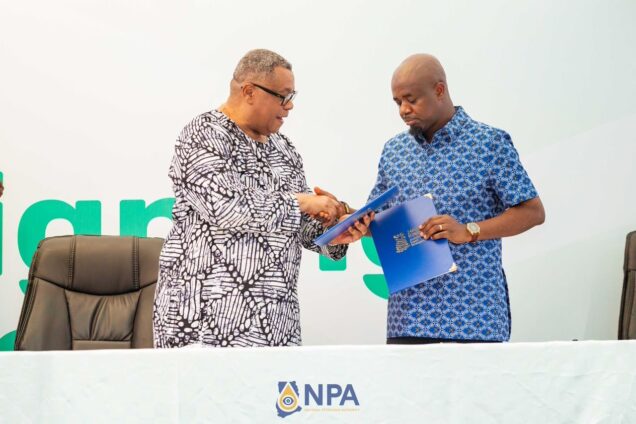
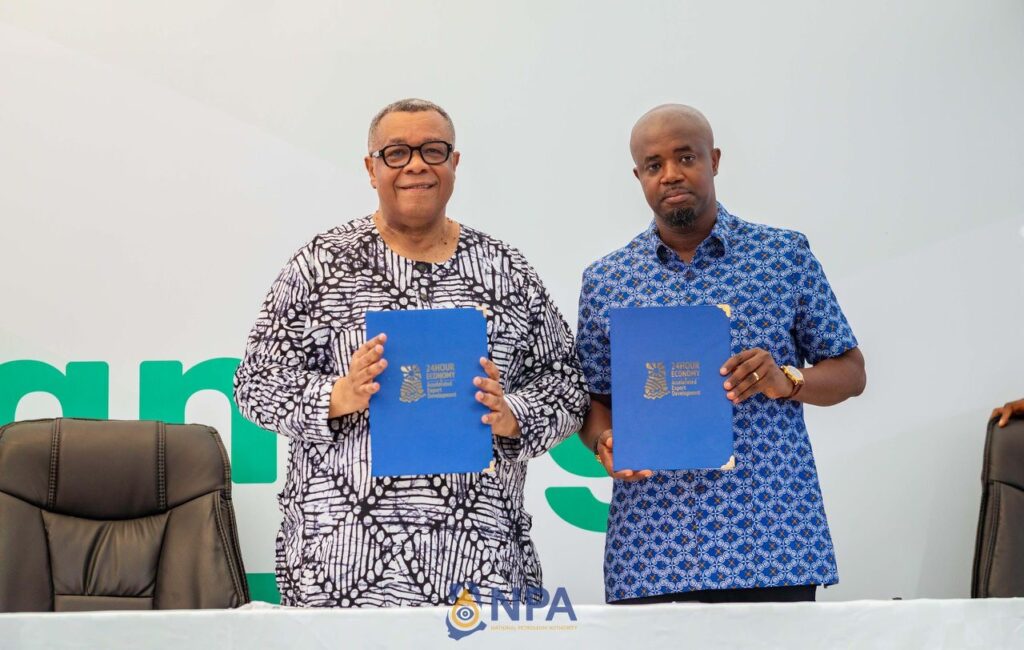
The 24-Hour Economy Authority and the National Petroleum Authority (NPA) have signed a Memorandum of Understanding (MoU) to support the expansion of 24-hour operations across Ghana’s downstream petroleum sector.
The agreement, signed in Accra on March 31, forms part of efforts to advance the country’s broader economic transformation agenda through reliable, round-the-clock fuel supply.
Under the terms of the MoU, the NPA will develop and enforce operational readiness standards for 24-hour service delivery across fuel stations, refineries, bulk storage depots, and bulk road vehicle operations.
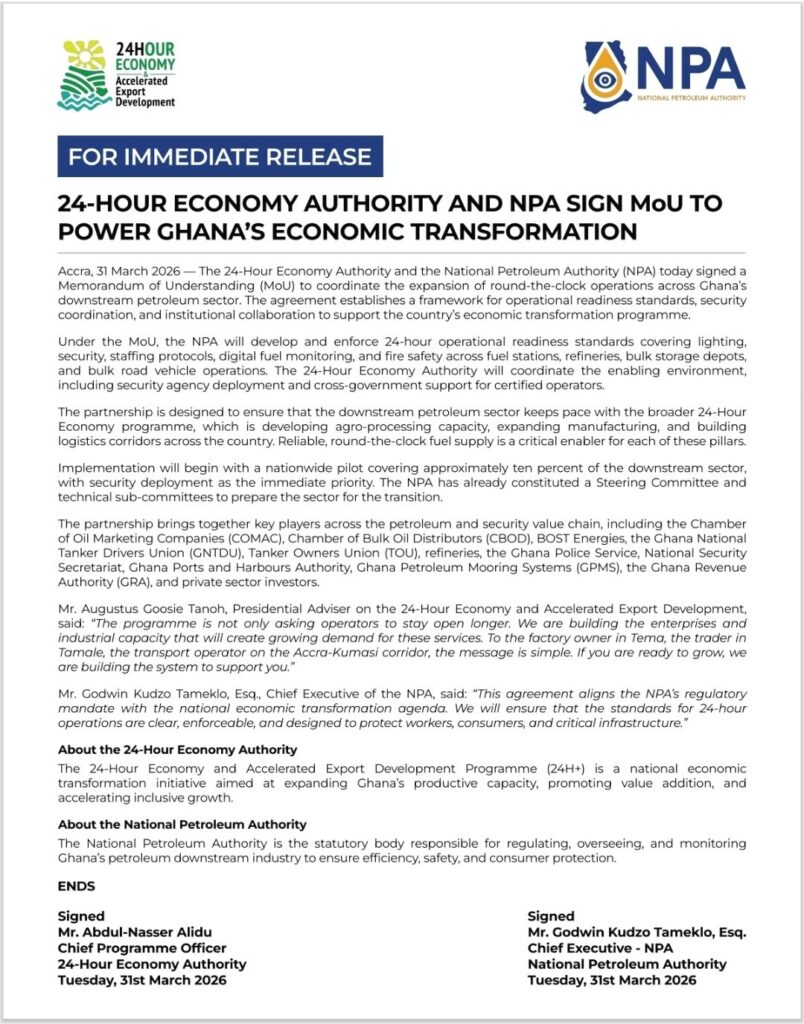
These standards will cover critical areas such as lighting, security, staffing protocols, digital fuel monitoring, and fire safety.
The 24-Hour Economy Authority, on the other hand, will coordinate the enabling environment, including the deployment of security agencies and cross-government support for certified operators.
The partnership is expected to align the downstream petroleum sector with the wider 24-Hour Economy programme, which seeks to expand agro-processing, boost manufacturing, and strengthen logistics corridors nationwide.
A reliable and continuous fuel supply is seen as a key enabler for these sectors, ensuring sustained productivity and economic activity across the country.
Implementation of the initiative will begin with a nationwide pilot covering about 10 percent of the downstream sector, with security deployment identified as an immediate priority.
The NPA has already set up a Steering Committee and technical sub-committees to oversee preparations for the transition.
The initiative will involve collaboration with key stakeholders, including industry players, security agencies, and regulators across the petroleum value chain.
Presidential Adviser on the 24-Hour Economy and Accelerated Export Development, Augustus Goosie Tanoh, described the programme as a strategic effort to build industrial capacity and stimulate demand.
Meanwhile, NPA Chief Executive, Godwin Kudzo Tameklo, said the agreement aligns the Authority’s regulatory mandate with the national transformation agenda, assuring that clear and enforceable standards will be implemented to protect workers, consumers, and critical infrastructure.
Latest Stories
-
I assure Otumfuo, Mahama will join him to commission KNUST Teaching Hospital by end of this year – Haruna Iddrisu
11 minutes -
Gov’t to roll out free special education for persons with disabilities from July 1 – Education Minister
32 minutes -
“We used it to test our officiating officials’ readiness” – Bawah Fuseini after CAA Athletics event
59 minutes -
Volleyball emerges as Ghana’s fastest rising sport
1 hour -
National Sports Fund needs strong leadership from the top – Administrator David Wuaku
1 hour -
JoySports Exclusive: Steve McLaren in talks with GFA after expressing interest in Black Stars job
2 hours -
Fire guts auto parts warehouse at Bubuashie, one fire officer injured
2 hours -
I owe my victory to coach Ofori Asare – Allotey after winning WBA Africa Gold Super Flyweight belt
2 hours -
Church of Pentecost supports over 2,000 BECE candidates in Obuasi with career guidance seminar
3 hours -
Brandon Asante and Coventry all but promoted to Premier League despite Sheffield Wednesday draw
4 hours -
GPL 2025/26: Late Kwartemaa strike downs Hearts in Tema
4 hours -
Ghana Faces Sierra Leone Moment as Prosecutorial Powers come under strain
4 hours -
Don’t consume fish or seafood from Tema Shipyard until further notice – FDA warns
4 hours -
Why volunteering might be Africa’s most underrated career accelerator
4 hours -
ActionAid Ghana raises concern over gender gaps in Feed Ghana Programme
4 hours