

Audio By Carbonatix
A post-election survey by the Ghana Institute of Management and Public Administration (GIMPA), in collaboration with the Konrad Adenauer Stiftung (KAS), has revealed that 81.6% of voters blame the New Patriotic Party’s (NPP) defeat in the 2024 general elections on economic mismanagement, with 47.3% specifically pointing to the high cost of living as the leading cause.
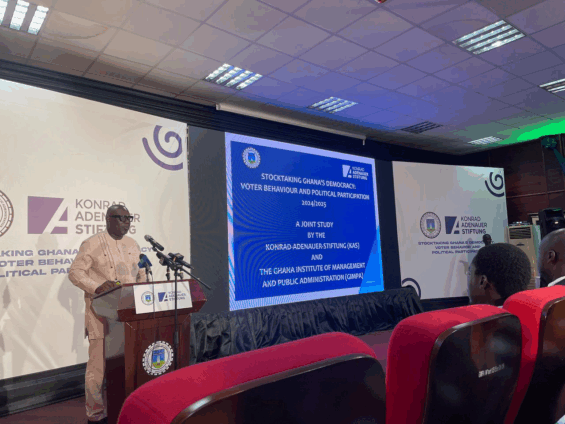
The findings were presented by Dr Joseph A. Darmoe, Director of Programmes at KAS and a Senior Lecturer at GIMPA, during the launch of the report titled “Stocktaking Ghana’s Democracy: Voter Behaviour and Political Participation”, held at GIMPA in Accra on 3 June 2025.
The nationwide survey, conducted between 8 and 20 May 2025, sampled 16,988 registered voters across all 276 constituencies using a multi-stage probability sampling method. The study was conducted through computer-assisted personal interviews (CAPI) and recorded a 99% confidence level with a 1% margin of error.
Key Findings:
Among respondents who blamed the NPP’s defeat on economic mismanagement, 47.3% identified the high cost of living as the dominant concern.
8.7% cited corruption as a key factor in their decision to vote out the party.
Other issues mentioned included the E-levy, arrogant or disrespectful conduct by party representatives, and the betting tax.
Concerns over LGBTQ+ matters were considered, but only by a small fraction.
The data also reveal that 73.5% of voters based their decision on party programmes and manifestos, rather than personal loyalty or ethnic affiliations.
When it came to reasons for choosing a presidential candidate:
46.2% voted based on personal admiration for the candidate.
16.7% were influenced by tribal or ethnic loyalty.
13.8% said their vote was intended to punish the NPP government.
11.6% admitted to voting in exchange for financial inducement.
Additionally, the survey showed that 90.5% of voters live and vote in the same constituency, suggesting that local conditions strongly shape electoral decisions.
The findings point to a maturing electorate increasingly driven by economic realities and policy impact rather than traditional political affiliations.
Latest Stories
-
Nigeria set to launch National Digital Address System 9 years after Ghana showed the way
2 minutes -
Policy rate decision takes time to reflect in lower lending rates – BoG
12 minutes -
Western Regional Minister applauds Karpowership’s role in Ghana’s power sector
37 minutes -
Livestream: Road safety crises: Where are we getting it wrong?
39 minutes -
Enterprise Life celebrates 25 years of protecting families and building trust
47 minutes -
ICC London rules in favor of Ghana against Tullow over $400m tax charge
57 minutes -
We are disappointed in ICC’s ruling over our corporate income tax assessment in Ghana – Tullow Oil
1 hour -
Cost of building inflation for August 2026 increases to 4.6% – GSS
1 hour -
Today’s front pages: Wednesday, September 30, 2026
2 hours -
Bawumia highlights agricultural, compulsory insurance reforms in IBAG engagement
2 hours -
Ghana will secure Tullow tax revenues while protecting Jubilee, TEN investments – Ato Forson
2 hours -
Ghana wins $393m Tullow tax arbitration as tribunal upholds GRA assessment
2 hours -
Gender Minister assures women’s group of action on Affirmative Action, Development Bank
3 hours -
Over 2,000 teachers in Dormaa comply with strike – GNAT Secretary
3 hours -
Food Buffer Stock seeks stronger liquidity buffer despite record profit
3 hours