

Audio By Carbonatix
Rickety and poorly maintained vehicles on roads across the country remains a major nightmare for commuters.
Despite efforts by the Driver and Vehicle Licensing Authority (DVLA), the Motor Transport and Traffic Department (MTTD) of the Ghana Police Service and other stakeholders to curb the situation, the roads are still full of these vehicles, which cause fatalities.
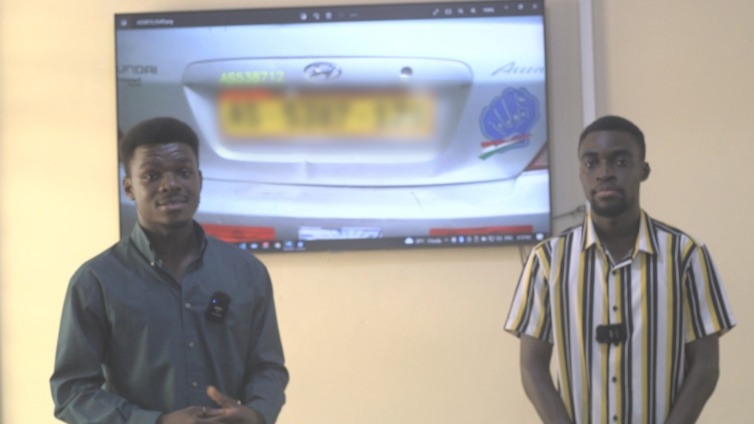
Fortunately, some computer science students of the Kwame Nkrumah University of Science and Technology, Theophilus Botchway and Markin Papa Kofi Korbah are using Number Plate Recognition to determine the road worthiness or otherwise of your vehicle.
Automatic Number Plate Recognition (NPR) has become part of our lives and promises to stay in future.
The system uses advanced computer vision technologies and artificial intelligence algorithms to identify vehicle licenses.
The system achieves approximately 98.22% accuracy on number plate detection and 78% accuracy on number plate recognition.
The project utilizes image processing technology in order to extract and recognize license plate information from an image or video frames.
Based on the extracted texts from the license plate, they are able to fetch information from the database to determine whether your vehicle is roadworthy.
The system is also tested with different condition complexities, such as rainy background, darkness and dimness, and different hues and saturation of images.
How it works
The first step of NPR is image collection. Images may be extracted from a video, collections of images and cameras. Usually, in the research area, image collections are provided from an open dataset.
The second step is detecting the license plate in the images. This phase usually takes place in the object detection step. Edge detection is commonly used for plate detection. In addition to edge detection, many algorithms have been proposed to solve plate detection.
After the plate is detected, the segmentation phase is conducted to divide the region into locations for detecting digits and letters. The last step is recognition of each segmented region into digits and letters to read the license plate.
To learn more about the App and join the waitlist for its release, partners, stakeholders, or investors can visit https://csapps.knust.edu.gh.
Latest Stories
-
Mahama returns from Angola after AU extraordinary summit
22 minutes -
Ghana qualifies for quarterfinals of Africa Volleyball Nations Cup after beating Zambia
33 minutes -
WAFU B WCLQ: Ampem Darkoa Ladies come from behind to beat Edo Queens
55 minutes -
Photos: National Youth Authority Festival
1 hour -
Bawumia commissions St Jude’s Catholic Church he funded to completion at Weija
1 hour -
Government defends new beer exercise rates; sliding scale has not been abolished
1 hour -
Bolgatanga Assembly denies blanket ban on events beyond 8pm
2 hours -
Photos: Ghana Immigration Service removes 1,055 street beggars from Accra, Kumasi streets
2 hours -
‘He always comes to our aid’ – Fr. Campbell recounts Bawumia’s support for Church, poor
2 hours -
Remittances drop marginally year-on-year to US$3.65bn in half-year 2026
2 hours -
T-bills: Government exceeds target by 139%, interest rates tumble
2 hours -
Why Chelsea need more than a new goalkeeper to be title challengers
2 hours -
Outlook of Ghana’s external sector remains positive for second-half of 2026 – BoG
2 hours -
Prisoners freed early are returning to jail at rapid rate, governors tell BBC
2 hours -
Two charged after €2.3 million worth of drugs seized in Dublin
2 hours