

Audio By Carbonatix
In the face of political pressure, South Korea's President Yoon Suk-yeol has declared martial law in the democratic country for the first time in more than 50 years - prompting protests near the country's parliament building.
The late-night pronouncement - made on national TV at 23:00 local time (14:00 GMT) had citizens immediately thinking it was related to North Korea - the South's nuclear-armed neighbour- or a critical matter of national security like a terrorism event or coup.
However, it became clear fairly quickly that Yoon had made this drastic move in response to a series of political events.
Having lost control of parliament earlier in the year, his government had been battling a series of opposition bills and motions which had sought to undermine his rule.
Political observers say he's now been driven to the point of invoking martial law - temporary rule by the military - as an undemocratic tactic to fend off the political attacks.
What was the immediate response?
Opposition leaders on Tuesday immediately condemned the move as unconstitutional.
South Korea’s main opposition party leader Lee Jae-myung called on his Democratic Party MPs to converge on parliament on Tuesday night to vote down the declaration.
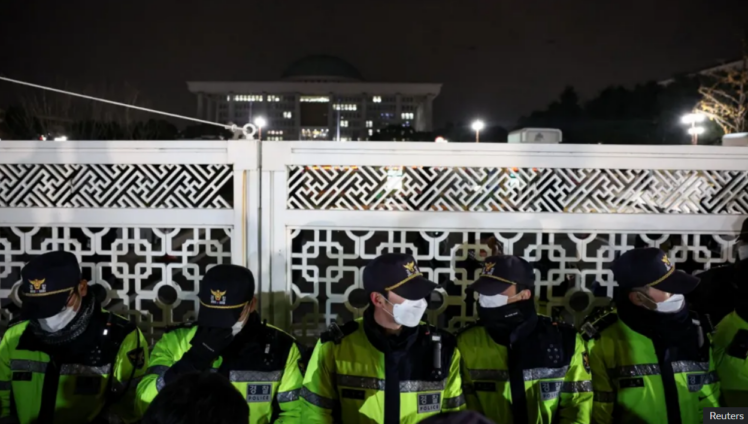
But in Seoul, police buses had already been moved in to block or barricade the entrance to the parliament building, local broadcasts showed.
Still, demonstrators have rushed to the National Assembly building, protesting and chanting "No martial law! No martial law". They have clashed with lines of police guarding the building.
How significant is martial law?
Martial law is temporary rule by military authorities in a time of emergency, when civil authorities are deemed unable to function.
The last time it was declared in South Korea was in 1979, when a long-term president had been assassinated during a coup.
It has never been invoked since South Korea became a parliamentary democracy in 1987.
But on Tuesday, Yoon pulled that trigger, in a national address saying he was invoking military rule over a threat from "anti-state forces".
Under martial law, extra powers are given to the military and there may be a suspension of usual rule of law protections and procedures.
What's the political context?
Yoon has been a lame duck president since South Korea's general election in April when the opposition won a landslide.
His government since then has not been able to pass bills they wanted and have been reduced instead to vetoing bills the opposition have been passing.
He has also seen a dive in his popularity with voters; having been mired in several political influence and corruption scandals - including one involving the First Lady accepting a Dior bag, and another around stock manipulation.
Just last month he was forced to issue an apology on national TV, saying he was setting up an office overseeing the First Lady's duties. But he rejected a wider or independent investigation, which opposition parties had been calling for.
Then this week, the opposition proposed slashing budgets for his government - and a budget bill cannot be vetoed.
At the same time, the opposition also moved to impeach cabinet members, including the head of the government's audit agency - for failing to investigate the First Lady.
What now?
Yoon's declaration caught many off guard - it's a fast-moving situation now.
The political opposition has called on the public to gather in protest outside parliament - peaceful mass demonstrations are common in South Korea and they have proven effective in changing governments before.
The main opposition Democratic Party on Tuesday night immediately called for all its lawmakers to assemble at the National Assembly.
Under South Korean law, the government must lift martial law if a majority in parliament - the National Assembly - demands it in a vote. The same law also prohibits martial law command from arresting lawmakers.
But police buses had already been moved into place in front of the building in what is being viewed as a barricade to stop lawmakers from reaching the assembly.
There is also discord within Yoon's own party, the People's Power Party leader.
Its leader Han Dong-hoon has called the declaration of martial law a "wrong" move, South Korean outlet Yonhap is reporting. He has vowed to block the law.
Latest Stories
-
Ecobank, Joy Business to host financial dialogue on green finance and inclusive agri-growth in Ghana
9 minutes -
Nkrumah’s vision remains relevant to Ghana’s future — Mahama
17 minutes -
Hitz FM announces Beach Rave for October 31
31 minutes -
CPP calls for protection and revival of state-owned enterprises to honour Nkrumah
49 minutes -
emPLE Life Insurance named Rising Brand of the Year at 6th CIIG Insurance Excellence Awards
50 minutes -
St Peter’s old boys to build 1,000-seater dining hall and modern kitchen for 70th anniversary
52 minutes -
St Peter’s old boys kick off 70th anniversary journey with ‘Run to 70’
1 hour -
Agyemang-Badu urges GFA, Sports Ministry to disclose Carlos Queiroz’s contract terms
1 hour -
Ghana and Panama sign MoU to deepen bilateral political consultations and cooperation
1 hour -
Black Stars: Mohammed Fuseini receives late call-up for September-October games after head injury
1 hour -
Traders reselling GH¢25k Kejetia phase one shops for up to GH¢120k — Local Government Ministry
2 hours -
Korle Bu begins work on 400-bed Mother and Child Block with IVF, NICU and theatres
2 hours -
Mahama discusses potential Open Society Foundations support for ECOWAS integration
2 hours -
IGP, Savannah Regional Minister visit Gbindabuor as 36 suspects assist police investigations
2 hours -
Carlos Queiroz sets 2027 AFCON qualification as Ghana’s immediate Black Stars target
2 hours