

Audio By Carbonatix
Former President John Mahama will be under enormous pressure to meet the expectations of voters following his landslide victory in Saturday's election.
He swept back to power after eight years in opposition, running what political analyst Nansata Yakubu described as a "masterclass" in campaigning.
He defeated Vice-President Mahamudu Bawumia by 56.6% of votes to 41.6% to notch up the biggest margin of victory by a candidate in 24 years.
But voter turnout was lower than in the 2020 election, especially in some of the heartlands of Bwaumia's New Patriotic Party (NPP), suggesting people there - disillusioned with its performance in government - stayed at home rather than switch sides.
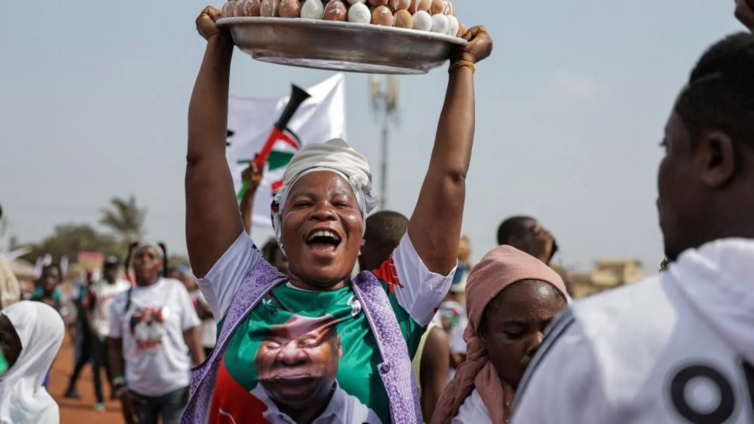
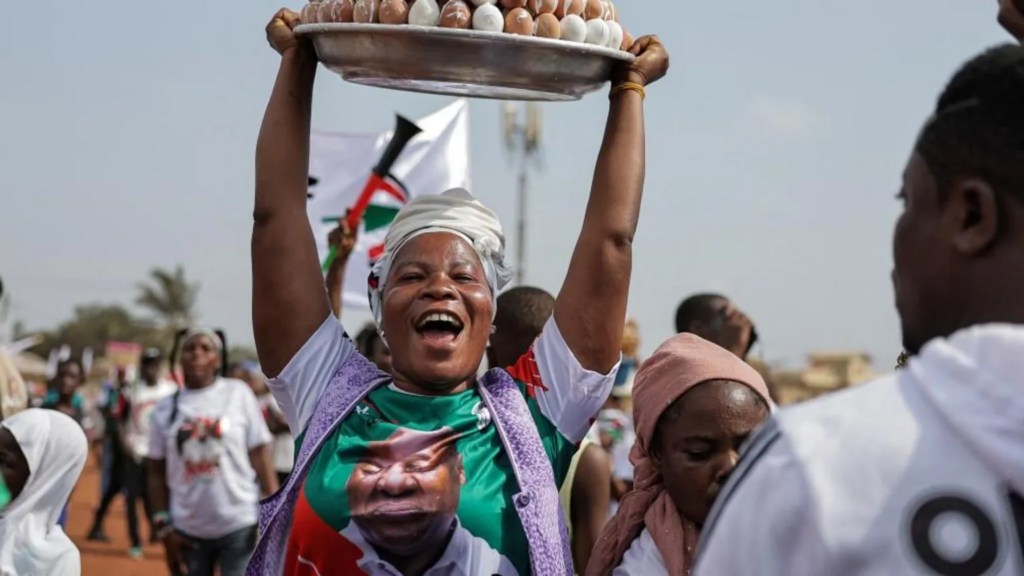
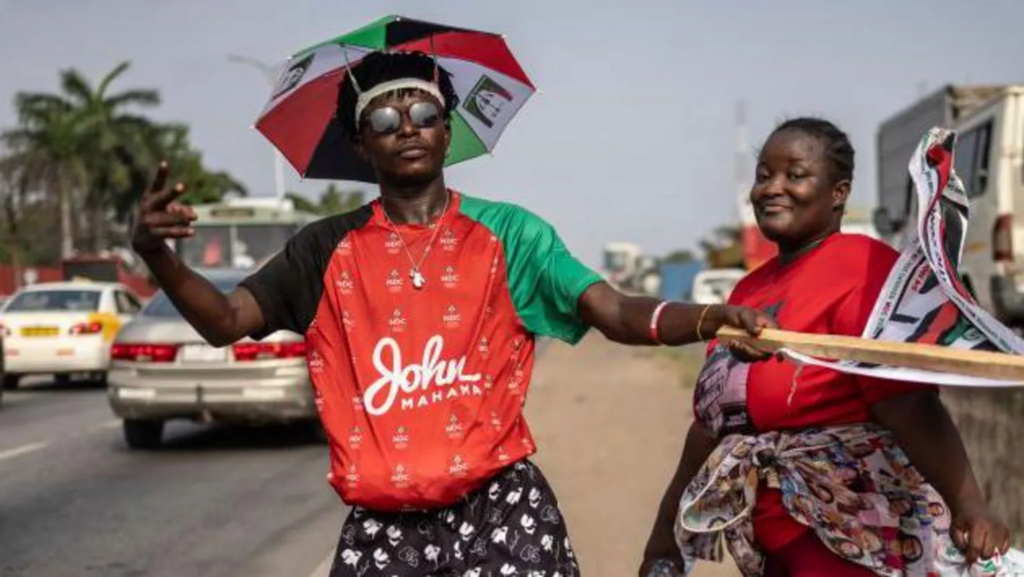
As Mahama's supporters celebrated his victory, Belinda Amuzu - a teacher in the northern city of Tamale, a stronghold of Mahama - summed up their hopes.
"I'm expecting the new government to change the economy, so that the hardship will come down. He should also prosecute corrupt officials so that it will be a lesson to others," she told the BBC.
"The hardship" has become a common phrase in Ghana since the economy hit rock-bottom in 2022, causing a cost-of-living crisis that shredded Bawumia's reputation as an "economic whizz-kid" - and led to his defeat at the hands of Mahama.
Ghanaian economist Prof Godfred Bokpin told the BBC the challenges facing the next government were huge.
"What Ghana needs right now is credible leadership, lean government and efficiency in public service delivery. Without that, there cannot be a future," he said.
Mahama has promised to bring down the size of the cabinet from more than 80 to around 60, but Prof Bokpin argued it should be smaller while political analyst Dr Kwame Asah-Asante stressed the need for appointments to be on merit rather than loyalty.
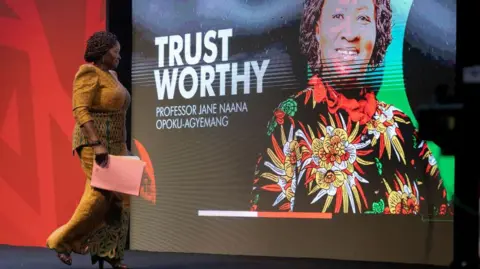
Mahama will be flanked by former Education Minister Prof Naana Jane Opoku-Agyemang, who is set to become Ghana's first female vice-president when the new government takes office next month.
Dr Yakubu said her appointment was not one of "tokenism" and she was not someone who could be "manipulated".
"We have a fantastic first female vice-president in Prof Naana Jane Opoku-Agyemang," she told the BBC Focus on Africa podcast.
Mahama served his first four-year term as president after winning in 2012 but lost his re-election bid in 2016 as Nana Akufo-Addo rose to power with Bawumia as his running-mate.
Dr Yakubu said Mahama contested the 2016 election on his track record in building roads, schools and hospitals but voters rejected him, as their mantra then was: "We don't eat infrastructure."
But, she said, during the Covid pandemic voters came to appreciate the infrastructure his government had built, especially hospitals.
This - along with the fact that the economy had plunged into a deep crisis under the current government, forcing it to seek a $3bn (£2.4bn) bailout from the International Monetary Fund (IMF) - led to Mahama being re-elected, Dr Yakubu added.
She told the BBC that Mahama would now be expected to fulfil his campaign promise to create jobs in order to bring down the unemployment rate of almost 15%, and to ease the cost-of-living crisis by scrapping some taxes - or what Ghanaians call "nuisance taxes".
Mahama has promised to make Ghana a "24-hour economy" through the creation of night-time jobs in both the public and private sectors. He said he would give businesses tax incentives to stay open at night and reduce electricity prices for them.
But his critics have doubts, pointing out that Ghana plunged into its worst electricity crisis during his first term and the power cuts were so bad that Mahama joked at the time that he was known as "Mr Dumsor" - "dum" means "off" and "sor" means "on" in the local Twi language.
He has also promised to abolish several taxes - including the much-criticised electronic levy on mobile transactions and the one on the carbon emissions produced by petrol or diesel-powered vehicles.
Prof Bokpin said he doubted the Mahama administration would be able to fulfil its promises.
"They have not done the cost-benefit analysis. There's no budgetary space to translate those promises into actuals," he said.
But Mahama is confident he will prove his critics wrong, saying he intends to renegotiate the conditions of the IMF loan so money is freed up for "social intervention programmes" in a country where 7.3 million people lived in poverty.
In an interview ahead of the election, Mahama told the BBC the IMF wanted "a certain balance" in government finances.
"And so if you're able to cut expenditure, and you're able to increase revenue and increase non-tax revenue coming in, you'll be able to create a balance," he said.
Dr Asah-Asante said Mahama's experience as former president held him in good stead to navigate Ghana through choppy waters.
"Of course, he is likely to encounter difficulties, but he has what it takes to turn things around," the analyst added.
Mahama's previous stint in government - as vice-president and president - was plagued by corruption allegations, but he has consistently denied any wrongdoing.
In 2020, a UK court found that aviation giant Airbus had used bribes to secure contracts with Ghana for military planes between 2009 and 2015.
An investigation then got underway in Ghana, but the Office of the Special Prosecutor, in a decision announced just months before the election, concluded there was no evidence that Mahama was involved in any corrupt activities himself.
The outgoing government has also been dogged by corruption allegations, including over the purchase of ambulance spare parts at a cost of $34.9m and a controversial national cathedral project in which $58m has been spent without any progress in building it.
Mahama promised his government would tackle corruption, and ensure that officials were prosecuted for wrongdoing.
"We are thinking about special courts," he told the BBC.
Dr Asah-Asante said Mahama should demand financial accountability from the outgoing government during a handover phase so that "whatever has gone wrong, he will be able to right" as soon as his government takes office next month.
The analyst added that Mahama, who will be inaugurated next month when President Akufo-Addo steps down after his two terms in office, had no choice but to meet the expectations of Ghanaians - or else they would "punish his government the way they have punished the NPP".
Mahama succinctly acknowledged this in his victory speech, saying: "Expectations of Ghanaians are very high, and we cannot afford to disappoint them.
"Our best days are not behind us; our best days are ahead of us. Forward ever - backwards never."
Latest Stories
-
Ghana needs a law to sustain constitutional reforms – CDD-Ghana
3 hours -
COVID fumigation audit: Auditor-General has a lot of questions to answer – Akwatia MP
3 hours -
Stranded Ghanaian medical graduates in Cuba appeal to Mahama for immediate return
3 hours -
GNFS contains fire outbreak at Teshie Lekma Road near Lekma Hospital
9 hours -
Samia Nkrumah rejects the narrative that Ghanaians were happy after Nkrumah’s overthrow
10 hours -
A Mother’s pain: Tribute by Ivan Baidoo’s mother
11 hours -
‘Forgive us for staying away’ — Samia Nkrumah leads family back to Nkroful, pledges to preserve Nkrumah’s legacy
11 hours -
Ernest Nuamah scores twice as Lyon beat Rennes
11 hours -
‘My dear Ivan’ – A father’s tribute to a son tragically killed
11 hours -
GNPC Explorco advances Voltaian Basin drilling preparations with 13.5km access road
11 hours -
Cabinet approves facility manager for Borteyman Sports Complex – Kofi Adams
12 hours -
Sanitation is improving; critics may be ‘living in another world’ – Salaga South MP replies Bekwai MP
12 hours -
Government must do more to tackle sanitation crisis – Bekwai MP
12 hours -
World Cleanup Day: GFF begins sanitation education in local communities
12 hours -
EU Ambassador, IGP discuss stronger cooperation on policing and security
12 hours