

Audio By Carbonatix
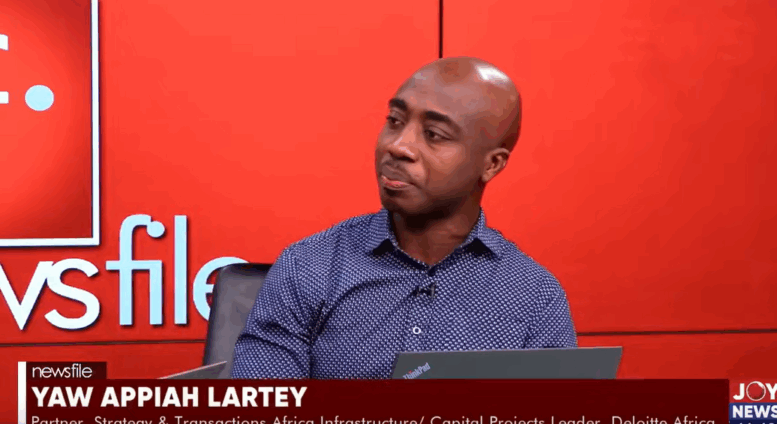
Partner and Africa Leader for Infrastructure & Capital Projects and Real Estate at Deloitte Africa, Yaw Appiah Lartey, has called for stricter enforcement of Ghana’s Public Financial Management Act to curb rampant financial irregularities documented in the latest Auditor‑General’s report.
He made the remarks during his appearance on Newsfile on Saturday, reacting to the substantial increases in public sector mismanagement revealed in the report.
Financial irregularities in the operations of public boards, corporations, and statutory institutions surged by 109%, rising from GH¢8.8 billion in 2023 to GH¢18.4 billion in 2024.
Speaking on the procurement and accountability shortcomings underlying the spike, Mr. Appiah Lartey stressed that "if you are running a procurement process where the exception to the rule, that is, single-sourcing, becomes the norm, you would have some of the problems that we are having.”
He noted that most projects were procured without sufficient value-for-money assessments, a shortcoming compounded by weak legal enforcement:
“We are procuring without doing adequate value for money assessment on the projects that we are procuring, you would have these issues, and then last is not strictly enforcing the laws.”
Mr. Lartey reminded viewers that Ghana already has a robust legal framework, thanks to the Public Financial Management Act passed in 2016 and amended in 2025.
“We have enough laws to enforce. The Public Financial Management Act we passed in 2016 empowers us to enforce sanctions such as surcharges.”
He posed pointed questions regarding the accountability of officials entrusted with public funds:
“So the people who are keeping this imprest, what are we doing with them? Are they still in the employment? Why can't we surcharge them? Are we still paying their salaries?”
To illustrate the gravity of the situation, he drew a comparison with private sector norms:
“Some of these things that are happening in the private sector — the person cannot even keep imprest for more than one month. He will account for it as soon as he returns from the trip... Somebody is keeping that imprest for one year.”
He also challenged why established sanctions were not being applied.
“So it means that we are not enforcing the law that we have passed."
"The Public Financial Management Act, we passed in 2016, and we further amended it in 2025 to enforce or bring stricter laws… Why are we not enforcing the laws?”
The 2024 Auditor‑General’s report revealed that out of GH¢18.4 billion in irregularities, GH¢15.57 billion (approximately 84%) is recoverable, with the remaining GH¢2.84 billion attributed to administrative infractions such as procurement breaches and procedural delays.
Latest Stories
-
Hawa Koomson pledges experienced and mature leadership of NPP women’s wing
48 minutes -
Young woman found dead at Kasoa Peace Town
1 hour -
Playback: The Law examined lawful arrest in Ghana
2 hours -
Mahama urges African governments to treat healthcare as an investment, not budget cost
2 hours -
Bawumia congratulates John Boadu and new NPP executives, pledges support ahead of 2028
2 hours -
‘No talent should be left out’ – Bawumia pledges inclusive NPP campaign for 2028
2 hours -
Prof. Mike Oquaye recounts how he blocked the Special Prosecutor’s attempt to arrest Bawku Central MP
3 hours -
Make health sovereignty a priority for Africa – Mahama
3 hours -
Dorimon Naa, Wa West DCE lead massive clean-up exercise; threaten sanctions against recalcitrant residents
3 hours -
Photos from Adom FM Y2K Jam
3 hours -
Praye Tiatia steals the show at Adom FM Y2K Jam [Watch]
3 hours -
Boakye Agyarko congratulates John Boadu, pledges support for NPP leadership
4 hours -
Antwi HiMight thrills fans with Antwi ne Antwi hits at Adom FM’s Y2K Jam [Video]
4 hours -
Amb. Edward Boateng congratulates Boadu, Kodua on election wins
4 hours -
John Boadu pledges to rebuild NPP from grassroots and restore ‘winning machinery’
4 hours