

Audio By Carbonatix
The Minority in Parliament has described the 2026 Budget as “growthless, jobless, and minimalist,” saying it falls short of addressing Ghana’s urgent economic challenges.
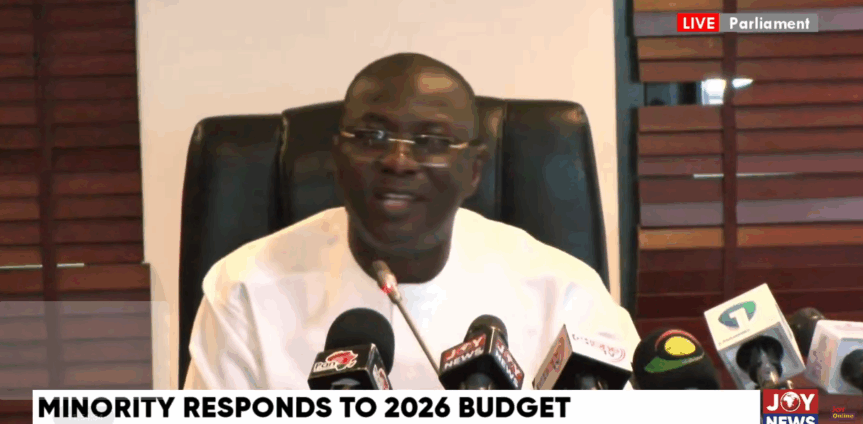
Speaking to the press on Friday, November 14, on behalf of the caucus, former Finance Minister and Member of Parliament, Amin Adam, criticised the budget for lacking substance and for offering only “cosmetic rhetoric” from what he called a “crawling government.”
“Ghana needs a better budget that strengthens revenue realism, expands productive investment, protects fiscal credibility, and enables the private sector to lead job creation. We can therefore describe the 2026 budget, the Galamsey budget, as growthless, jobless, and minimalist,” he said.
He further said that the budget structure does not reflect a major shift towards job creation, productivity, or economic transformation.
“Investment levels remain low, revenue projections are overly optimistic, and borrowing pressures are high. Key fiscal risks are under-discussed. Flagship programmes lack transparency and clear budget commitment,” he said.
He warned that the government’s approach of shrinking expenditure to create the appearance of fiscal prudence could backfire.
“The lower GDP base and revenue shortfalls mechanically raise the debt-to-GDP ratio, even if the cash deficit is narrow. Sustainability requires sustained growth and credible revenue mobilisation, not austerity that undermines both,” he explained.
The Minority also highlighted hidden fiscal risks, including uncovered government auctions, unattractive short-term debt maturities, and unquantified liabilities of state-owned enterprises beyond cocoa and energy. Climate and disaster risks, he said, are not sufficiently integrated into the macro-fiscal framework.
“Without addressing these risks, fiscal stability could be short-lived. Policies without clear budget risk are becoming slogans rather than deliverable programmes,” he added.
The Minority criticised the government’s broader economic management, saying, “The state of the economy cannot be as good as the minister wants us to believe. It is associated with empty pockets, vanishing customers, sophisticated investors avoiding government auctions, and ministries struggling to function due to lack of basic resources.”
He said the need for “genuine economic leadership rather than broken promises, real fiscal discipline rather than opportunistic austerity, and a government that delivers results rather than excuses.”
“What we need is economic transformation, which Ghanaians were promised. But what we see now is economic stagnation masquerading as progress. The 2026 budget does not offer the hope needed to take us out of this,” he added.
Latest Stories
-
2026 U-20 WWC: Sarah Nyarko targets knockout stages with Black Princesses after victory over South Korea
14 minutes -
President Mahama warns: Poor refereeing, match manipulation are destroying Ghana football
32 minutes -
Businessman rejects GH¢79.7m judgment windfall – He says actual claim was below GH¢10m
37 minutes -
Mahama calls on GFA, clubs to raise standard of domestic football
37 minutes -
Ghana’s Rahim Ibrahim makes Champions League debut in PSG thrashing
1 hour -
Tariq Lamptey suffers another injury setback at QPR
1 hour -
PRESEC, Augusco and Accra Academy battle for 2026 NSMQ crown today
2 hours -
GH₵12 addition to cement price: GPHA clarifies attribution to port congestion
2 hours -
Pythagoras won’t balance your books
2 hours -
Pay me by Sept. 11 or face the court – Kow Essuman demands salary, benefits from Finance Minister
2 hours -
Bawumia’s destiny lies in the hands of God; not you – Muslim Forum for Peace and Unity replies Rev. Owusu Bempah
2 hours -
NPP NEC meets today to discuss and approve party’s position paper on Constitution Review proposals
2 hours -
Today’s frontpages: Thursday, September 10, 2026
2 hours -
Ghana Garden and Flower Show returns on Sept 11 with focus on green jobs, business and wellbeing
2 hours -
Titus-Glover camp says Mustapha Salam wasn’t pressured to withdraw from National Organiser race
2 hours