

Audio By Carbonatix
The Minority in Parliament has criticised the government’s management of the cedi, arguing that despite billions of dollars spent on foreign exchange interventions, the currency remains weak.
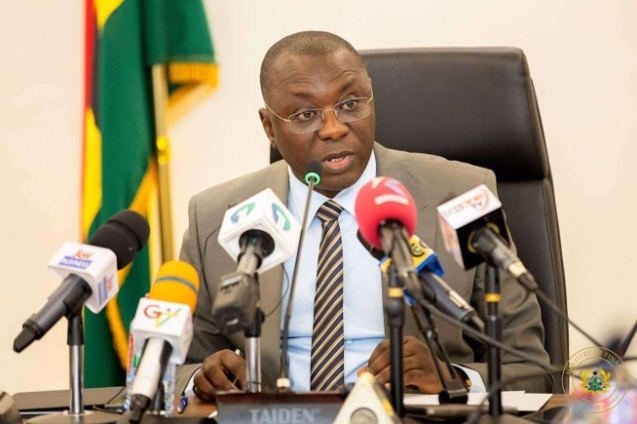
Addressing the press on Friday, November 14, former Finance Minister Amin Adam said, "With the significant billions of dollars of interventions, we expected the rate to be at GH₵8 to a dollar. The market's muted response reveals a sophisticated understanding that currency strength cannot be purchased; it must be earned through sound economic fundamentals."
He accused the government of relying on short-term market support rather than tackling underlying structural issues.
Dr Adam contrasted the current approach with the IMF-guided programme under the NPP administration, noting that foreign exchange interventions were strictly controlled.
“During the NPP administration, the IMF restricted the Bank of Ghana from intervening heavily in the forex market. The intervention budget was fixed at US$80 million per month, despite international reserves exceeding the IMF target. By the end of 2024, reserves stood at almost US$9 billion,” he said.
He argued that the cedi’s recent gains stem from reserves inherited by the current administration.
“The new Bank of Ghana management and the government began injecting massive sums of forex into the market from reserves they inherited. The performance of the cedi is therefore not by any magic or policy intervention; it is due to the hard work under the NPP administration.”
According to the Minority, the Bank of Ghana has injected roughly US$8 billion into the market since January, reducing the exchange rate from about GH₵14 per dollar on January 6, 2025, to nearly GH₵11.
“Despite these burdensome interventions, the gains remain disappointingly modest and fundamentally unsustainable,” Dr Adam added.
He also criticised what he called “propaganda management” of the economy, questioning the government’s use of the November 2024 exchange rate as a benchmark.
“Merely repeating an untruth does not make it the truth,” he said.
The Minority warned that aggressive interventions are weakening international reserves while key problems—low productivity, poor export performance, and weak forex inflows—remain unaddressed.
“These resources have been squandered on temporary cosmetic improvements that will inevitably reverse once intervention capacity is exhausted.”
Dr Adam noted that the Bank of Ghana has now adopted a new IMF-backed intervention framework, acknowledging that the cedi’s gains have been intervention-driven and the previous strategy was “non-transparent and unsustainable.”
He welcomed the shift, saying the Bank must now intervene “in a measured and transparent manner,” which he described as the responsible path the economy requires.
Latest Stories
-
‘I was waiting for the list to believe my Black Stars call-up was real’- Ronald Donkor
2 minutes -
Mahama has ordered NACOC back into port container inspections – Tanko-Computer
6 minutes -
Photos: Vice President joins ECOWAS Parliament, calls for stronger regional cooperation
6 minutes -
Two arrested over alleged GH¢30k bribe attempt in narcotics case
9 minutes -
Bodi, Juaboso and Bibiani SHSs qualify for 2026 National Public Speaking Competition
11 minutes -
Energy Committee Ranking Member backs TOR turnaround, urges government to sustain local crude supply
12 minutes -
Ghana Water ordered to pay $235m over Teshie desalination plant dispute
13 minutes -
Ghana overlooking therapeutic value of flowers despite $1.49m import bill – Parks and Gardens Administrator
19 minutes -
NPP demands immediate removal of institutional heads over cocaine trafficking cases
25 minutes -
Parliament’s Energy Committee commends TOR for using local engineers in ongoing development
37 minutes -
Share intelligence you have with authorities to deal with drug trafficking – NDC to NPP
44 minutes -
‘You promised 24-Hour economy not 24-hour cocaine trafficking’ – Nana B to Mahama
49 minutes -
Nana Konadu dedicated her life to community transformation — Yaa Asantewaa Agyeman-Rawlings
49 minutes -
Protect the customer by changing who owns the loss
58 minutes -
Counterfeit currency syndicates used churches to hide printing operations – National Security Council Secretariat
1 hour