

Audio By Carbonatix
President John Dramani Mahama has challenged Africans at home and abroad to reclaim control of their history and future.
He said lasting unity between the continent and its diaspora was essential to dismantling the enduring legacies of slavery, colonialism and systemic injustice.
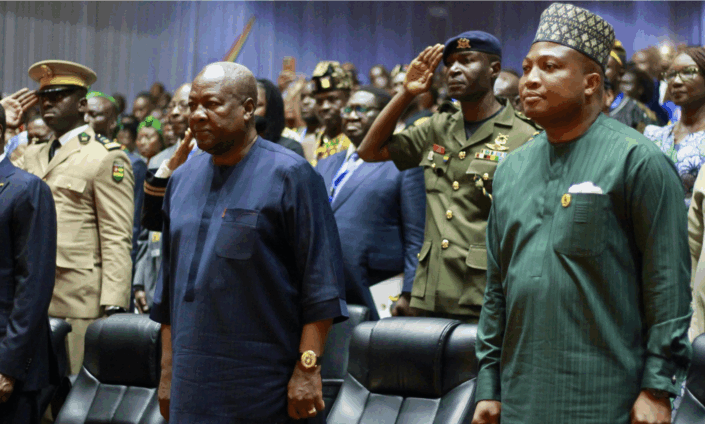
Opening the Diaspora Summit 2025 in Accra, President Mahama said the gathering was deliberately convened not merely to revisit the pain of the past, but to confront its consequences and chart a shared path forward anchored on truth, justice and self-determination.
Ghana is hosting the Diaspora Summit 2025 at a time when conversations around reparative justice, Pan-African solidarity and structured diaspora engagement have gained renewed global momentum.
Under the theme, “Resetting Ghana: The Diaspora as the 17th Region”, the two-day Summit seeks to reposition the African diaspora as a central stakeholder in Ghana’s national development agenda while advancing Africa’s collective quest for justice and healing.
President Mahama noted that Africa could not afford the “luxury of forgetting” the historical crimes that shaped global inequality, nor could it continue to allow others to define its narrative.
The President said Ghana’s forts and castles, which once served as holding points for millions of enslaved Africans, stood as stark reminders that the story of the diaspora was inseparable from the story of the nation.
He stressed that many Africans who were forcibly taken across the Atlantic passed through Ghana’s coast, making them as much a part of Ghana’s history as those who remained and later endured colonial rule.
President Mahama said the divisions that continue to weaken African peoples, whether along colonial borders, ethnicity, class or geography, were deliberately engineered to sustain domination.
He urged Africans and people of African descent to be “more intentional about unity than our oppressors were about division,” arguing that unity remained the continent’s most powerful tool for transformation.
He said reparative justice must be understood as a comprehensive process that went beyond financial compensation to include formal acknowledgement of wrongdoing, institutional reforms, debt relief, the return of stolen cultural artefacts and sustained investment in Africa’s development.
The President reiterated Ghana’s intention to table a motion at the United Nations General Assembly to recognise the transatlantic slave trade as the greatest crime against humanity, describing it as a necessary step toward global accountability and healing.
Mr Faure Gnassingbé, President of the Council of Ministers of the Togolese Republic, described the reparations movement as a forward-looking demand for justice and stability, not a nostalgic return to the past.
He said Africa was not a wounded continent seeking sympathy, but a collective force demanding equity, recognition and truth.
President Gnassingbé said slavery and colonisation did more than destroy lives; they structured the global economy by creating productivity gaps, trade asymmetries, technological divides and institutional weaknesses that persisted today.
Reparations, he said, were therefore as essential to Africa’s development as infrastructure, finance and industrial transformation.
He said truth must be the foundation of reparations, calling for formal global recognition of the transatlantic slave trade as a crime against humanity.
The Togolese leader described the diaspora as a strategic lever for African sovereignty, saying Africa’s future was shaped as much in cities like New York, London and Kingston as it was in Lomé, Kpalimé and Dapaong. Without fully mobilising the diaspora, he warned, Africa would be depriving itself of one of its most powerful assets.
He also emphasised collective healing as a political imperative, saying reparations could not be reduced to figures and transfers alone.
Dr Mohamed Ibn Chambas, African Union High Representative for Silencing the Guns, said President Mahama’s leadership had helped elevate reparations from moral advocacy to a structured continental agenda.
He said the African Union had embedded reparatory justice into its long-term development frameworks, including Agenda 2063, and was working with legal and policy experts to translate commitments into actionable outcomes.
Dr Ibn Chambas said the Accra Summit reflected the AU’s conviction that Africa’s future prosperity was closely tied to meaningful engagement with its diaspora, whose networks, skills and resources could accelerate trade, innovation and development across the continent.
The Minister for Foreign Affairs, Mr Samuel Okudzeto Ablakwa, said Ghana’s recognition of the diaspora as the 17th Region was a practical expression of Pan-Africanism and a rejection of artificial separations imposed by history.
He said the Summit was intended to move the reparations conversation from symbolism to coordinated global action, backed by diplomacy, policy reforms and strategic partnerships.
Mr Ablakwa said Ghana’s foreign policy remained rooted in solidarity, citing the country’s peacekeeping record and humanitarian interventions as evidence of its commitment to justice and human dignity beyond its borders.
Mr Benjamin Crump, U.S. civil rights attorney and advocate, described President Mahama’s message as one that resonated deeply with Africans in the diaspora who continued to live with the consequences of enslavement and racial injustice.
He said the Summit sent a clear signal that Africa and its diaspora were no longer waiting for justice but organising to claim it.
Mr Crump said reparations were essential to restoring dignity and addressing intergenerational trauma, noting that healing could only begin when truth was acknowledged and repair undertaken.
Latest Stories
-
Eric Adjei distributes free fertiliser to farmers in Jaman North
6 minutes -
Akufo-Addo urges NPP factions to unite behind Bawumia for 2028 victory
17 minutes -
NDC mourns Western Regional Elections Director Papa Assan
24 minutes -
Minerals Commission warns against fake job recruitment schemes
31 minutes -
10 recruits dismissed for defying phone ban – Interior Minister
37 minutes -
IEAG commends GoldBod, BoG for improving forex stability
47 minutes -
Bawumia donates GH¢50,000 to St Jude Catholic Church at Weija
54 minutes -
Mahama calls for faster mobilisation of AU Peace Fund resources
59 minutes -
Improved roads bring new vehicle options to Tumu-Bolga, Tumu-Tamale, Tumu-Wa routes
1 hour -
Cedi records 7.9% depreciation against US dollar in first half of 2026
1 hour -
GIS launches operation on anti-human trafficking and exploitative street begging
1 hour -
Awutu-Senya District Assembly organises clean-up ahead of Awubia Festival
1 hour -
Vice President Opoku-Agyemang receives Democracy Cup
2 hours -
Aid group MSF opens new Ebola treatment centre in eastern Congo
2 hours -
Eswatini receives two more third-country deportees from US, government says
2 hours