

Audio By Carbonatix
Brian Leonard did not expect to be queuing outside Hatton Garden Metals last week, but he was happy to wait anyway.
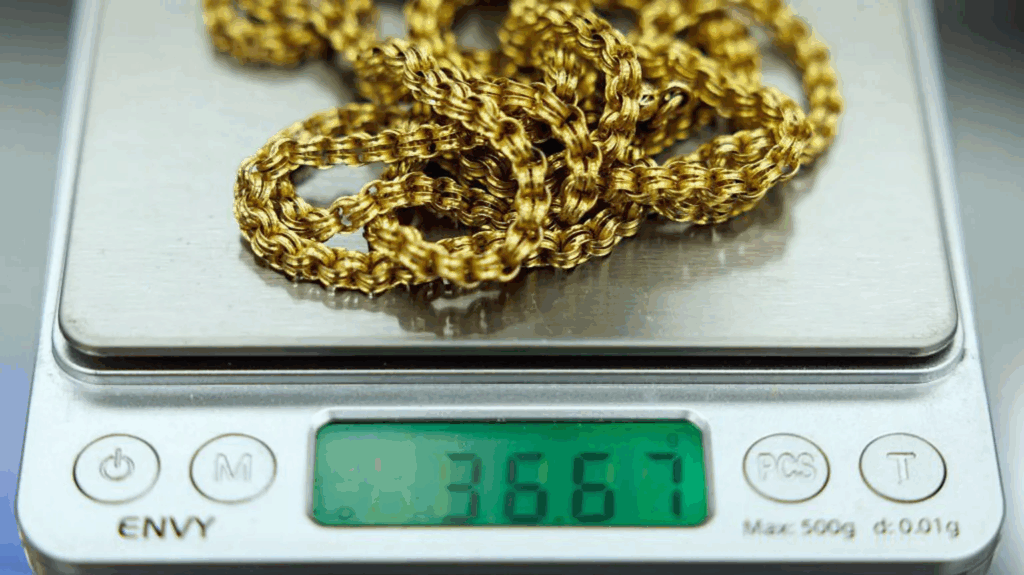
Like many others, he was at the family-run gold dealership in London to sell some precious metal - in his case, a silver plate which had been "lying around the house".
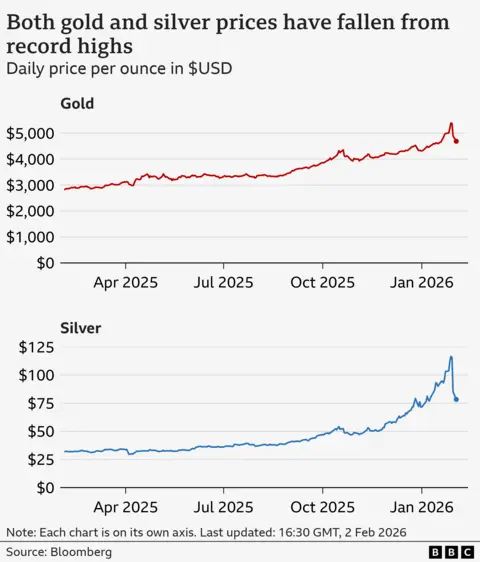
Gold, silver, and platinum prices were near an all-time high when Brian was selling, but last Friday the bubble in the market burst and prices slumped.
While precious metals remain much more valuable than at this time last year, the frenzy underscores how volatile commodity trading can be, with experts warning would-be sellers to be careful about being taken advantage of.
Gold and other precious metals are widely regarded by many investors as a safe haven for storing wealth during periods of economic instability. This centuries-old thinking is partly due to how rare these metals are and how limited their global supply is.
Over the past year, the price of gold soared alongside US President Donald Trump's attempts to take over Greenland and frantic trade policy. Previous surges have occurred during the 1980 oil crisis, the 2008 financial crisis, and the 2020 COVID-19 pandemic.
But the more recent price slump began late last week, after Trump named Kevin Warsh his pick for chair of the Federal Reserve, which gave investors some certainty. Deutsche Bank said this was "the clear catalyst for Friday's sell-off", which continued into Monday as prices fell further.
Other analysts have said it could simply have been a case of the market adjusting after precious metals' prices surged.
Due diligence and valuations
Gold and other precious metals trade in a very liquid market - that is to say, there are lots of people buying and selling all over the world at any given time.
This means their prices can change quickly, as they have over the last week. When markets move up and down like that, some people can end up selling too low or buying too high.
To avoid this, personal finance expert Fanny Snaith recommends conducting due diligence and obtaining no-obligation, free valuations rather than selling jewellery in response to a "just some advert".
She also says sellers should consider that the price of the jewellery might not be limited to the metal; it also includes the stones and design. This is why research and multiple valuations matter.
Financial advice charity National Debtline says anyone selling jewellery - or anything else - to pay off debt should make sure they own it first.
A person is not the owner of jewellery they are making payments for under a lease, rental, hire-purchase, or bill-of-sale agreement.
The charity says that, in some cases, a lender may agree to allow a sale, but you wouldn't receive the item's full value.
If a piece of jewellery is jointly owned by two people, the permission of both owners is usually required to sell it.
The charity also recommends exploring different sales channels to find the best way to sell the item.
The charity says it is important to consider the downsides to selling as well as the upsides.
The key upside is the ability to at least partially satisfy creditors. But selling jewellery now, it points out, also means no longer having that asset for the future, including retirement or as a family inheritance.
"If you have financial emergencies in the future, you may not have enough money or assets to deal with them," the charity adds.
Yellow is in, white is out
For jewellers on the ground, such as Harriet Kelsall, the founder of a bespoke jewellery business, the effect of all of this on items such as wedding rings has been "complicated".
On the one hand, she said she is seeing some customers reduce the amount of gold they are requesting in rings so they can pay the same price for the same style of ring.
Meanwhile, those who can afford to pay have gone in the other direction by looking to display what they have bought.
"Three years ago, everything we were making was white metal; people liked that low-key, less bright yellow look. I think customers thought it was underplaying it."
"And at the moment, it's reversed. Suddenly, we're seeing a big trend arriving for quite heavy, yellow-gold jewellery," she said.
One such owner of heavy gold jewellery is Brian Leonard. In his case, it's a watch he used to wear to work.
He could have sold it last week at gold's peak, but he decided not to, keeping it as "a memory of better days". It's a reminder that not all jewellery can be valued in pounds and pence.
Latest Stories
-
CJ’s remarks on SOEs were made in good faith, not to undermine judicial independence – Judicial Service
33 minutes -
This is an attempt to break the Minority caucus – Patricia Appiagyei on alleged GH¢70k payment
1 hour -
‘OSP hasn’t contacted me’ – Patricia Appiagyei assures cooperation if invited
2 hours -
I find it strange that this memo was purportedly written by me – Patricia Appiagyei
2 hours -
Ayariga calls for stronger church partnership to tackle sanitation, environmental challenges
2 hours -
I don’t think we have an industry – Patchbay Band manager
2 hours -
Patchbay Band questions recognition of live bands in Ghana’s music industry
2 hours -
Newsfile to discuss SOEs’ GH¢19.8bn profit, dissolution of 9 boards, CJ’s visits to SOEs, GH¢70k gift rejection
3 hours -
BoG warns against spraying, defacing and using cedi notes for decorations
3 hours -
Adwumawura: Selected applicants to receive notifications from today – NEIP CEO
3 hours -
‘Fake memo’ fabricated to smear me – Patricia Appiagyei
3 hours -
ATLF2026: Culture, investment and tourism take centre stage as Africa’s tourism leaders gather in Polokwane
3 hours -
TI-Ghana and GACC demand full disclosure over alleged GH¢70,000 Appointments Committee payment
4 hours -
UN approves resolution in support of map that shows Africa’s true size
4 hours -
Spring Agro Industries urges Ghanaians to choose local rice as imports dominate market
4 hours