

Audio By Carbonatix
New data from the Ghana Statistical Service (GSS) shows that education and gender are significant shields against food security, with uneducated and female-headed households bearing the heaviest burden.
The quarterly food insecurity report (from the first quarter of 2024 to the third quarter of 2025) noted that households headed by persons with no formal education faced a 50 percent insecurity rate, compared to just 15 per cent for those with tertiary education.
The data also showed that food insecurity prevalence among female-headed households reached a maximum of 44.1 per cent between the first and second quarters of 2025, compared with 38.7 per cent among male-headed households.
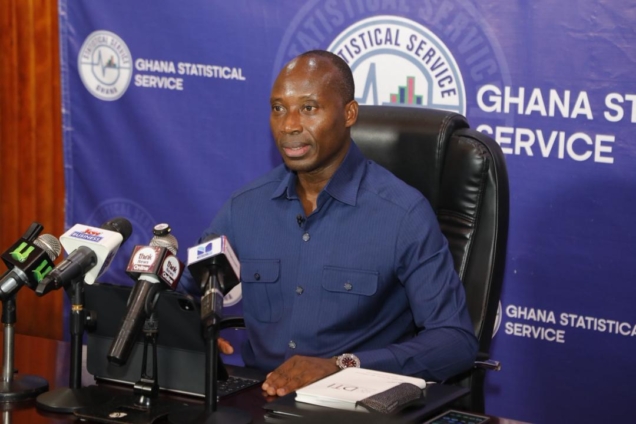
Dr Alhassan Iddrisu, the Government Statistician, speaking at the release of the report on Tuesday, emphasised that education served as a “protective shield,” providing better income opportunities and resilience against economic shocks.
“The link between food insecurity and child malnutrition is very striking. This is not just a food issue—it’s a human capital issue with long-term implications for learning, productivity, and health,” Dr Iddrisu said.
In quarters two and three of 2025, food insecurity was the highest among households with no education, at about 50 per cent, and lowest among those with tertiary education, at about 15 per cent, he said.
“Education matters a lot in addressing food insecurity, as it provides a protective shield for food insecurity…,” he said.
Dr Iddrisu recommended that the government invest in education and child nutrition to break the long-term vulnerability, focusing on skills development, youth employment, and rural income diversification.
He also called for expansion of nutrition-sensitive social protection, prioritising female-headed households and families with children and the elderly, instead of a one-size-fits-all social intervention.
He encouraged Metropolitan, Municipal, and District Assemblies (MMDAs) to use the data to identify vulnerable communities and align local development plans accordingly, while supporting community-based nutrition and livelihood programmes.
The Government Statistician urged development partners to align their financial and technical support with region-specific food insecurity patterns and nutrition risks in the data.
For civil society organisations, he said it was important to provide investment and interventions that supported livelihood diversification, food value chains, and affordable nutrition, particularly for vulnerable households.
Latest Stories
-
JoyNews gets results as listeners raise GH¢40,000 to help 17-year-old student with cerebral palsy attend SHS
9 minutes -
Vice President calls for stronger local pharmaceutical production to reduce medicine imports
24 minutes -
The brewing tension at KNUST; Beware the Ides of October….
46 minutes -
Health Ministry moves to integrate traditional medicine into mainstream healthcare
1 hour -
550 pupils in Kintampo South get educational lifeline as ‘Seeds of Hope’ reaches farming communities
1 hour -
Opoku Mensah urges Christian Council, House of Chiefs to speak up on democratic freedoms
2 hours -
Teacher unions’ strike: Minority demands immediate payment of teacher arrears, 20% deprived area allowance
2 hours -
The Accra-Kumasi Expressway: Building it right
2 hours -
Beyond gold exports: Building value and economic resilience from Ghana’s gold
2 hours -
2027 AFCONQ: Ghana under pressure as Gambia beat Somalia 2-1
2 hours -
Eastern NPP Women’s Organiser calls on AG, Police to secure bail for Salomey Baffoe
2 hours -
Poverty, illiteracy driving acceptance of vote-buying among women – Damongo Queen Mother
3 hours -
Photos: Democracy Is Not For Sale forum in Savannah region
3 hours -
GNFS launches 2026/27 National Anti-Bushfire campaign in Atebubu, records 62.8% reduction in bushfire cases
3 hours -
I’ll vote for a female president; women are less likely to steal from the state – Okyeame Kwame
3 hours