

Audio By Carbonatix
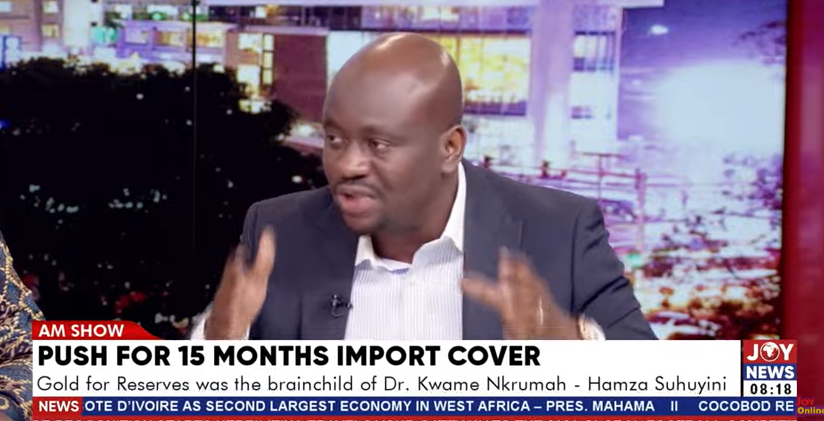
Lawyer and member of the NDC communications team, Hamza Sayibu Suhuyini, has dismissed claims that Ghana’s gold reserve policy was initiated by the New Patriotic Party (NPP), insisting the policy dates back to the era of Ghana’s first President, Dr Kwame Nkrumah.
Speaking on JoyNews’ AM Show on Thursday, February 26, Mr Suhuyini said the NPP cannot claim ownership of a policy that was introduced decades ago.
“Unlike the NPP, the National Democratic Congress understands that this is not a policy that was introduced by the New Patriotic Party,” Hamza stated.
According to him, the gold-for-reserve policy was first introduced between 1960 and 1961 when Ghana launched its national currency and sought ways to ensure its credibility and strength.
“It was launched to give strength and credibility to the Ghanaian currency. That policy has been there since 1961,” he stressed.
Mr Suhuyini explained that although the policy faced challenges and was temporarily halted in the early 1960s, it resumed later in the decade and continued until around 1980. From the 1980s onward, he said, Ghana continued to accumulate gold in measured quantities.
“It is never the brainchild of His Excellency Dr. Mahamudu Bawumia. These are the lies that have been peddled,” he said.
He added that the NDC is “humble enough to concede” that the policy was instituted by Dr. Nkrumah, and not any recent administration.
Addressing developments after 2020, Mr Suhuyini acknowledged that the NPP government intensified gold purchases but said the NDC raised concerns about the institutional framework under which the policy was being implemented.
“Bank of Ghana has been buying gold for years. Our concern was the institutional setup,” he explained.
That concern, he said, informed the NDC’s decision to propose the establishment of a Gold Board to provide regulatory structure and oversight for the sector.
“Ghana’s problem has never been ideas. It has always been the commitment to realistic transformation,” Mr Suhuyini noted.
He maintained that the Gold Board initiative has brought transparency and certainty to gold transactions.
“Today, we can comfortably track government’s transactions in the gold sector through Gold Board activities. We have brought some measure of certainty to gold dealers, unlike it used to be under the NPP regime. That transparency is critical if we are to reap the benefits of the sector,” he stated.
Mr Suhuyini further challenged the NPP to account for the outcomes of its economic policies during its eight years in office.
“For eight good years, Ghanaians gave them the mandate. What was the result of their economic policies?” he questioned.
He concluded that beyond political claims, the real issue remains the tangible impact of policies on the lives of Ghanaians.
Latest Stories
-
Central Regional Minister inspects projects in Assin South
6 minutes -
Mahama must show stronger leadership in galamsey fight – Prof. Bokpin
13 minutes -
Abu Jinapor defends Domestic Gold Purchase Programme, credits Bawumia with its introduction
14 minutes -
I’ll beat NDC for third time through my development record in Karaga – Amin Adam
18 minutes -
Denkyirahene hosts sixth Akwasidae, calls for unity, peace
25 minutes -
Edem Agbana outlines development gains, future projects at Ketu North accountability forum
31 minutes -
Let’s develop a culture of reading – Tourism Minister
39 minutes -
Kpone Kokompe records four confirmed measles cases
48 minutes -
Non-interest banking not religious doctrine – Governor Asiama
56 minutes -
Internet banking transactions hit GH¢383.82bn in 2025
1 hour -
State-Owned Enterprises’ revenue reach GH¢176.43bn in 2025 – SIGA report
1 hour -
NAIMOS arrest 10 illegal miners, seize equipment
1 hour -
Total value of payment transactions increased to GH¢9.45trn in 2025, but cheque transactions fall
1 hour -
Misinformation, deepfakes pose serious threat to Ghana’s democratic stability – NCCE
1 hour -
Mahama congratulates Hichilema on his re-election as President of Zambia
1 hour