

Audio By Carbonatix
Former Vice President, Dr Mahamudu Bawumia, has strongly advocated increased investment to accelerate Ghana’s AI readiness.
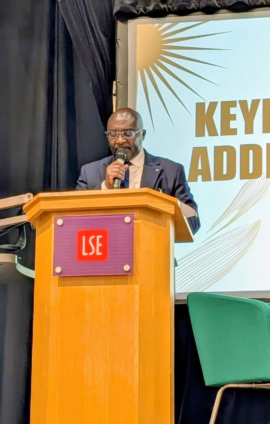
Delivering a keynote address at the 2026 Africa Summit at the London School of Economics and Political Science in London on Saturday, 28 March 2026, Dr Bawumia said Africa must be purposeful in its investment in digital transformation, including AI, if the continent is to catch up with the developed world.
While lamenting limited tech funding in Africa, Dr Bawumia noted that despite a recent report indicating a rebound in funding, such gains remain concentrated in a few countries, with Ghana outside this top tier.
“Partech, a venture capital firm, reports African tech funding rebounded to US$4.1 billion in 2025, but it remains highly concentrated: Kenya, South Africa, Egypt and Nigeria captured 72 per cent of total funding,” Dr Bawumia said.
“Outside the top tier, Ghana is cited at US$90 million in 2025, while most other countries recorded below US$50 million, underscoring the challenge of scaling innovation across the continent’s long-tail markets.”
As Ghana begins UNESCO AI Readiness Assessment Methodology consultations to evaluate its AI governance framework, identify gaps and inform a national AI strategy focused on ethics and inclusivity, among others, Dr Bawumia also called for a stronger focus on capacity building, which he described as the “binding constraint”.
“The AI Talent Readiness Index for Africa ranks digital skills with South Africa at 25.85, Kenya at 21.65, Rwanda at 19.7 and Ghana at 16.0. This confirms that skills gaps remain substantial even where connectivity is improving.”
“The implication is straightforward: Africa’s AI policy must be designed as a skills-and-standards agenda—modernising curricula and teacher training, expanding TVET and apprenticeships for applied data skills, and training public servants for responsible procurement, impact assessment and oversight.”
“And because both exposure and benefit can be uneven, especially along gender lines, the education strategy must deliberately include women and underserved communities. AI that excludes talent cannot deliver inclusive growth,” he said.
Latest Stories
-
Mankranso DCE laid to rest as Muslims hold final Juma’ah prayers
20 minutes -
Ghanaian professor Kofi Akamani shot dead in US; wife arrested
30 minutes -
Sammy Gyamfi says 2018 NACOC removal from port inspections weakened drug checks
40 minutes -
Greater Accra region accounts for 77% of total secured credit in half-year 2026 – BoG
43 minutes -
Founder’s Day: We face forward, but are we moving?
50 minutes -
Sheenah Naturals unveils Akuaba Collection at Beauty Inside Out Conference
59 minutes -
T-bills: 91-day, 364-day yields to trade slightly higher in second half of 2026
1 hour -
Black Stars: It’s our decision to leave Kudus to recover – Queiroz
1 hour -
Sammy Gyamfi backs Mahama’s directive to restore NACOC’s at ports
2 hours -
Queiroz provides insight into Kudus’ decision to withdraw from Black Stars squad
2 hours -
I’m not changing after 47 Years – Queiroz fires back at critics
2 hours -
Nkrumah Never Dies: Celebrating the visionary who awakened a continent
3 hours -
Hassan Ayariga calls for Ghanaian ownership in strategic investment deals
3 hours -
Black Stars: Thomas-Asante receives late call-up for September-October games
4 hours -
NPP Techiman South demands immediate release of detained Nurse Salomey Awiti Baffoe
4 hours