

Audio By Carbonatix
Stroke survivors and advocates have urged government to improve healthcare access and support systems to reduce disability.
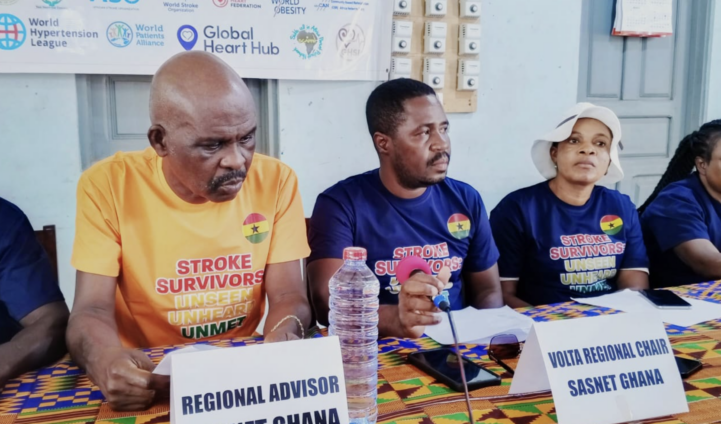
The call was made at a News conference in Ho to mark the National Stroke Survivors Day, observed annually on March 16.
The event, organised by Stroke Association SupportNetwork – Ghana (SASNET Ghana), brought together stroke survivors, caregivers, health professionals and stakeholders to highlight challenges confronting persons living with stroke.
Mr Callistus Edoh, Volta Regional Chairman of SASNET Ghana, said the day was set aside to raise awareness on stroke and advocate for improved care.
He explained that this year’s theme, “Stroke Survivors: Unseen, Unheard and Unmet,” reflected the invisible struggles, lack of representation and gaps in healthcare services.
“Many survivors face cognitive, emotional and financial challenges that are often overlooked, while access to rehabilitation and assistive technology remains limited,” he stated.
Mr Ebenezer Ad Adams, Executive Director of SASNET Ghana, said stroke survivors continued to struggle with unclear National Health Insurance Scheme (NHIS) coverage.
“Some pay for rehabilitation; others pay partially, while many cannot afford assistive devices like wheelchairs, which are essential for mobility,” he noted.
He called on the government to expedite action on the Assistive Technology Policy and expand support through the Livelihood Empowerment Against Poverty (LEAP) programme.
Mr Adams also urged authorities to clarify the provisions under the Ghana Medical Trust Fund, popularly known as “Mahama Care,” to ensure that stroke-related services are adequately covered.
He revealed that more than 16,000 stroke survivors were registered nationwide, with over 500 in the Volta Region alone, stressing that the actual figures could be higher.
Stakeholders noted that stroke remained a leading cause of disability and death in Ghana, with survivors often facing long-term physical and economic hardship.
They called for increased investment in healthcare infrastructure, including the provision of MRI and CT scan machines, and the training of more neurologists to improve diagnosis and treatment.
Mr Edoh cited a recent case, where a stroke patient was reportedly denied oxygen due to NHIS coverage issues, describing the situation as unacceptable.
Mr Samuel Sedodo, Vice President, SASNET GHANA, also emphasised the need for intensified public education on stroke prevention, early detection and management, urging the government to act swiftly to save lives.
Latest Stories
-
GNFS contains fire outbreak at Teshie Lekma Road near Lekma Hospital
4 hours -
Samia Nkrumah rejects the narrative that Ghanaians were happy after Nkrumah’s overthrow
6 hours -
A Mother’s pain: Tribute by Ivan Baidoo’s mother
6 hours -
‘Forgive us for staying away’ — Samia Nkrumah leads family back to Nkroful, pledges to preserve Nkrumah’s legacy
6 hours -
Ernest Nuamah scores twice as Lyon beat Rennes
6 hours -
‘My dear Ivan’ – A father’s tribute to a son tragically killed
6 hours -
GNPC Explorco advances Voltaian Basin drilling preparations with 13.5km access road
6 hours -
Cabinet approves facility manager for Borteyman Sports Complex – Kofi Adams
7 hours -
Sanitation is improving; critics may be ‘living in another world’ – Salaga South MP replies Bekwai MP
7 hours -
Government must do more to tackle sanitation crisis – Bekwai MP
7 hours -
World Cleanup Day: GFF begins sanitation education in local communities
7 hours -
EU Ambassador, IGP discuss stronger cooperation on policing and security
8 hours -
Africa Nations Volleyball Championship: Ghana set up quarterfinal clash with Cameroon after beating Chad
8 hours -
Meet Dr Benjamin Appiah Osei — Ghana’s three-time tourism awards winner
8 hours -
UEFA & CONCACAF demand Fifa pays $10m to all 211 members
8 hours