

Audio By Carbonatix
When illegality begins to generate revenue for the state, the question is no longer about enforcement—it is about direction.
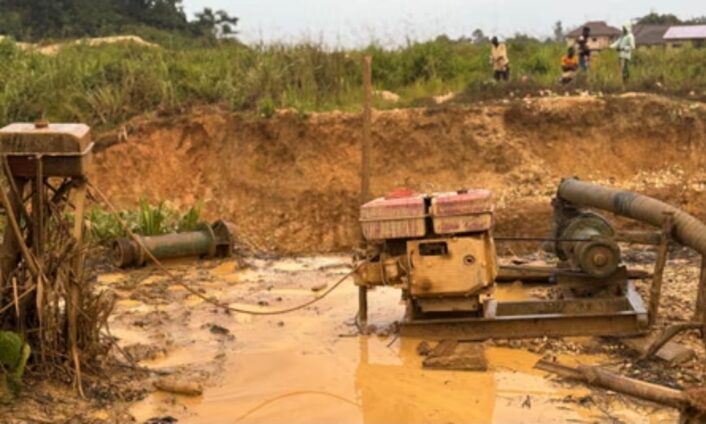
Recent developments following a JoyNews investigation into illegal mining activities have raised serious concerns about governance, environmental protection, and the rule of law. The exposé revealed that in some mining communities, operators of “changfan” machines—widely known to be used in illegal river mining—were not only active but allegedly making payments to local authorities.
These payments, reportedly collected by some District Chief Executives (DCEs), have been described as contributions toward Internally Generated Funds (IGF). That explanation, however, has triggered a national debate that goes far beyond revenue generation.
At its core, the issue is straightforward: can an illegal activity be legitimised through taxation?
Under Ghanaian law, illegal mining—particularly river-based operations involving changfan machines—is prohibited. District assemblies do not have the mandate to tax activities that are unlawful. Any such collection, therefore, exists outside the framework of legal revenue mobilisation and raises critical questions about accountability.
The implications are significant.
First, there is the matter of environmental sustainability. Ghana’s major rivers, including the Pra, Ankobra, and Offin, have suffered extensive degradation due to illegal mining. The continued operation of changfan machines accelerates this damage, threatening water security, agriculture, and public health. Allowing these activities to persist—under any form of financial arrangement—risks undermining years of effort to combat galamsey.
Second, there is a governance challenge. DCEs are representatives of central government authority at the district level. If they are perceived to be collecting money from illegal operators, it creates the impression of institutional complicity. Even if the intent is to raise revenue for local development, the method raises ethical and legal concerns.
Third, and perhaps most critically, is the issue of policy consistency. The state cannot simultaneously declare a war on illegal mining while appearing to tolerate, or indirectly benefit from, its proceeds. Such contradictions weaken enforcement efforts and erode public confidence.
It is therefore not surprising that civil society organisations have strongly pushed back against the development. Their position is clear: illegal activities cannot be regularised through informal taxation, and any attempt to do so sets a dangerous precedent.
The subsequent engagement between civil society groups and the President has provided some clarification, with a renewed emphasis on the government’s commitment to fighting illegal mining. However, the broader concern remains unresolved. Public perception has already been shaped by the initial interpretation of events, and restoring confidence will require more than reassurance—it will require decisive action.
This moment presents an important policy test.
If illegal mining is to be effectively addressed, enforcement must be consistent, transparent, and uncompromising. Any ambiguity—whether in communication or action—creates space for misinterpretation and weakens the credibility of the broader anti-galamsey agenda.
The question is not whether districts need revenue. They do. The question is whether revenue can be pursued at the expense of legality and environmental protection.
Because once illegality becomes a source of income, the incentive to eliminate it begins to diminish.
And that is a risk Ghana cannot afford.
Jimmy Aglah is a media executive and writer, and the founder of the Republic of Uncommon Sense, a platform dedicated to sharp thought-provoking commentary on governance, society and everyday logic.
Latest Stories
-
Companies that delay AI adoption risk losing market opportunities – ALX Enterprise
6 minutes -
‘The future is bright’ – Gyan backs Black Princesses squad after U-20 World Cup exit
12 minutes -
We should treat AI has an opportunity rather than a threat – ALX Enterprise
20 minutes -
Malta and Ghana set sights on practical AI partnership
23 minutes -
2026 U-20 WWC: ‘Not all wishes come true’ – Gyan inspires Black Princesses after elimination
28 minutes -
‘I am not a magician’ – Zdravko Logarušić on Nations FC exit from Africa
41 minutes -
Three nights. 28 titles. Ultimate history made
52 minutes -
Ghanaian delegates at IYF 2026 could become bridges for stronger Russia ties – John Aggrey
56 minutes -
Nigeria: Over 30 dead, 50 hospitalised after consuming alcoholic substance in Ondo State
58 minutes -
UK lawmakers demand new law to address AI threat to human rights
1 hour -
WAFU B U-17 Girls Cup: Black Maidens depart Accra for tournament in Yamoussokro
1 hour -
Sweden’s center-left bloc narrowly ahead as election remains too close to call
1 hour -
GPL 2026/27: ‘We won ugly’ – Kotoko head coach unimpressed after Lions victory
1 hour -
7 out of 10 human trafficking cases in Ghana never reach prosecution — JoyNews Research
2 hours -
Music, football to converge at Music Meets Football Summit 2026 in Lusaka
2 hours