

Audio By Carbonatix
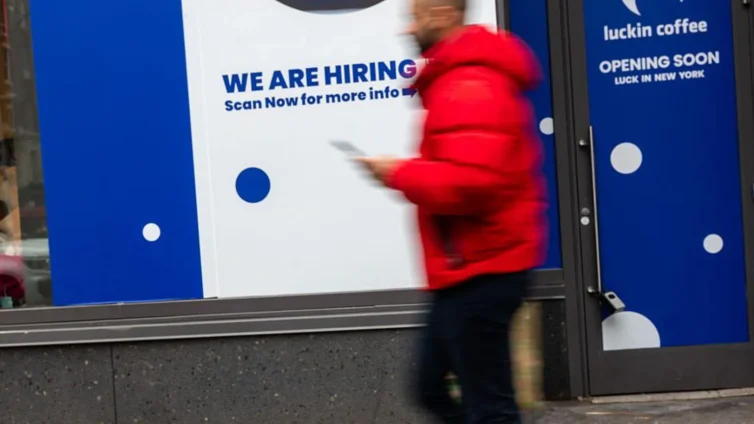
Hiring in the US surged last month, despite the energy shock and uncertainty stemming from the US-Israel war in Iran.
Employers added 178,000 jobs, far more than expected, while the unemployment rate dipped to 4.3%, the Labor Department said.
Analysts said the gains were likely lifted by the end of strikes in the health care industry which had led to steep losses in February. But the figures are still likely to increase confidence in the resilience of the job market, which has slowed sharply over the last year.
It is also expected to bolster the case for the US central bank to hold off on cutting interest rates, as it waits to see what impact the rise in oil prices has on the economy.
US President Donald Trump has pushed the Federal Reserve to lower borrowing costs aggressively, a move that would give the economy a boost.
But the bank has held off in recent months, citing concerns about inflation, which remains above its 2% target. Fed chair Jerome Powell has described the economy as being in a delicate balance, with muted job creation but also relatively limited job cuts.
The White House crackdown on immigration, and other policy changes such as tariffs have contributed to the static market.
The war in Iran could add to that dynamic, though it remains too soon to fully gauge its impact. The Labor Department typically surveys employers and households around the middle of the month, which was only a few weeks after the conflict had started.
Economists have warned that a sustained rise in oil prices could push up transport and food costs, pushing households and businesses to cut back spending in other areas and leading to a wider slowdown.
"The question now is how much blowback will come from the war in Iran and the associated uncertainty around energy prices," said Olu Sonola, head of US economics at Fitch Ratings.
The Labor Department report showed job gains in March were driven by the health care industry, but extended into other sectors, including construction and manufacturing.
Financial firms and those in the information sector, which includes film, publishing and tech posted losses, as did the government.
Sonola described the latest figures as "great" but cautioned that hiring has bounced up and down for much of the last year, reflecting business uncertainty. He said that was poised to increase due to the war.
"For the Fed, wait-and-see is the only sensible option at this point," he said.
Latest Stories
-
Advance ruling to give importers certainty before goods arrive – GRA
4 minutes -
VIDEO: Tension at High Court as lawyer escapes arrest attempt by suspected security operatives
5 minutes -
Photos: Parliamentary committee assesses recycling plant at Yabram in Dambai
9 minutes -
King Promise named brand ambassador for Dierre Ghana campaign
9 minutes -
Ghana must fund large-scale farms to drive industrialisation – Kojo Akoto Boateng
10 minutes -
Zanetor urges CSIR to turn research into commercial solutions
13 minutes -
President Mahama, Ato Forson clear path for Ghana’s US$9bn agro-industrial potential
13 minutes -
Poor standard morgue facilities shut down in Ashanti Region
14 minutes -
They came to UENR for a degree, they are leaving with skills for the real world
16 minutes -
AFCON 2027Q: ‘Semenyo’s leg is swollen’ – Kurt Okraku
21 minutes -
E.P. Church honours former GOIL CEO, Togbe Adza Nye IV for his philanthropy
21 minutes -
EducationUSA College Fair 2026 to offer Ghanaian students first-hand guide to U.S university admissions
32 minutes -
PBL welcomes new UCC Vice Chancellor, strengthening lasting partnership
40 minutes -
Global pressures weigh on cedi as US dollar strengthens – BoG
41 minutes -
BoG flags external-sector pressures ahead of MPC decision
50 minutes