

Audio By Carbonatix
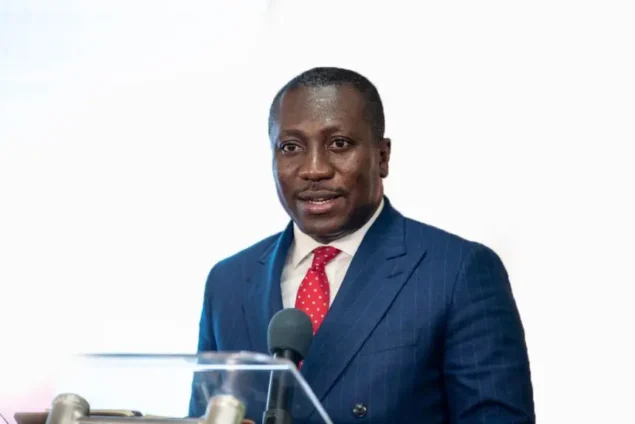
The Minority Leader in Parliament, Alexander Afenyo-Markin, has criticised government-linked contractors, accusing them of sabotaging Ghana’s agricultural backbone by importing rice in direct defiance of presidential orders.
Addressing the Kwahu Business Forum on Friday, 3rd April 2026, the Minority Leader described the sidelining of local farmers as a calculated subversion of national food security goals. He argued that while the state has publicly championed "Buying Ghana", the reality on the ground is a systemic preference for foreign grains that leaves local warehouses overflowing with unsold produce.
The controversy centres on the School Feeding Programme, a multi-million-cedi initiative intended to provide a guaranteed market for Ghanaian rice growers.
However, according to Mr. Afenyo-Markin, middlemen awarded these lucrative supply contracts are bypassing local silos in favour of cheaper, imported alternatives.
“Contractors engaged to supply the School Feeding Programme with locally produced rice instead of importing the grains [are] bypassing farmers who had prepared their produce following a direct presidential directive,” he stated.
The impact has been devastating for the rice value chain. Thousands of farmers, encouraged by government promises of market access, now face mounting debts and rotting harvests.
Mr Afenyo-Markin further condemned the lack of transparency at the National Food Buffer Stock Company (NAFCO).
He revealed that despite repeated petitions from agricultural unions, the identity of the contractors involved in this importation spree remains a closely guarded secret.
“The Peasant Farmers Association has repeatedly requested that NAFCO publish the names of those contractors. NAFCO has not responded,” the Minority Leader noted, adding: “What has been described is not a market failure. It is a procurement betrayal.”
The Minority Caucus has served notice that it will not let the matter rest. Mr Afenyo-Markin signalled a looming parliamentary inquiry intended to force the publication of all active supply contracts and the identification of every beneficiary involved in the procurement process.
He warned that such lapses do more than just hurt the economy but erode the fundamental trust between the state and the rural electorate.
Without immediate reforms to ensure that state-backed programmes genuinely support local producers, he argued, the nation's drive toward self-sufficiency will remain a mirage.
“Let us choose accountability over secrecy,” he concluded, urging the government to align its procurement actions with its political rhetoric to protect the livelihoods of Ghana's hard-working farmers.
Latest Stories
-
Prof. Kwofie urges publishers to use indigenous knowledge systems to decolonise AI
3 hours -
NDC’s two years of economic gains not enough to establish stability – Alan Kyerematen
3 hours -
AFCON 2027Q: Nine new call-up for Cote, The Gambia matches
3 hours -
Ghana’s MSMEs: Burdened by regulation and overtaxed; why the system isn’t working
4 hours -
Patience Akyianu, former Barclays Bank Ghana MD and Hollard Group CEO, reported dead
4 hours -
Mahama pushes ‘health sovereignty’ agenda, says Global South needs control over resources
4 hours -
Mahama: We are reforming systems, fighting corruption and improving use of public funds
4 hours -
Catholic Bishops welcome task force to tackle drug menace, acknowledge inter-agency efforts
4 hours -
Ghana Catholic Bishops demand urgent action against drug trafficking
4 hours -
Tamale: 5 arrested over suspected drug activities; police seize pistols, narcotics
4 hours -
We have lost a great developer – Mankranso residents pay tribute to late DCE
4 hours -
Ghana Law Society sets September 30 for maiden Bar Conference on legal reforms
5 hours -
GPL Week 3: Port City’s Gyetuah bags a brace as 9 outstanding players named NASCO Players of the Match
5 hours -
Visibility without substance is just noise; I don’t seek popularity—Dr Oppong-Fosu
5 hours -
The late Abubakar Sedik was an exceptional DCE – Ashanti Regional Minister
5 hours