

Audio By Carbonatix
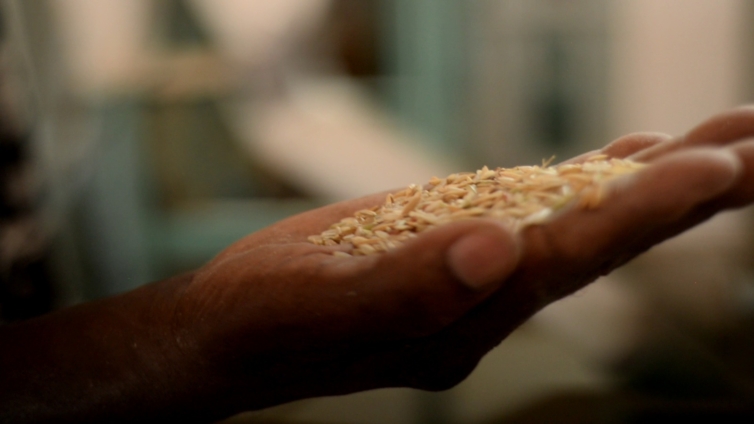
The United Nations World Food Programme (WFP) has begun transforming Ghana’s school feeding system with the introduction of fortified rice, a move expected to improve the nutrition of students while boosting livelihoods for local farmers.
The initiative, currently being piloted in seven regions, is designed to test the feasibility and economic benefits of scaling up rice fortification nationwide. Over 150,000 students in both basic and senior high schools are expected to benefit from the programme, which aims to enhance learning outcomes through better nutrition.

Available data indicate that most rice sold on Ghana’s local markets—both imported and locally produced—loses essential vitamins and minerals during milling and heat extrusion processes. As a result, polished rice grains often lack key nutrients needed for healthy body development.
The WFP’s rice fortification project seeks to address these micronutrient deficiencies, improve school enrolment and attendance, and enhance academic performance, particularly in underserved communities.
To support the initiative, the WFP has supplied four rice fortification equipment units valued at over $80,000 to millers across the country. These include BBN Cooperative in the Upper East Region, Max Industries in Greater Accra, Tamanaa Company Limited in the North East Region, and Franco Food Processing and Farms at Ejisu in the Ashanti Region.
Following the installations, 60 metric tonnes of fortified rice kernels, valued at more than $91,000, were distributed to the millers for production. The rice is then supplied to schools through caterers at the basic level and via the National Food Buffer Stock Company (NAFCO) for senior high schools.
“We are expecting the next contract, which is about 45,000 bags of 50kg rice to be supplied to the schools through the National Buffer Stock Programme,” Chief Executive Officer of Franco Food Processing and Farms, Franco Obour, said.
The pilot phase targets 157,510 students, including 111,247 pupils in basic schools and 46,263 senior high school students. A total of 360 basic schools and 35 senior high schools in 12 districts across six regions—Upper West, Upper East, Northern, Ashanti, Oti and Greater Accra—are participating.
One of the beneficiary institutions is the Ejisu Senior High Technical School in the Ashanti Region.
Ashanti Regional Coordinator for the School Health Education Programme, Rev. Emmanuel Addo, said the transition from polished white rice to fortified and unpolished rice was a welcome step.
“For their health and better growth, we accepted this programme,” he said, stressing the school’s commitment to student well-being.
He added that the initiative also holds economic promise, especially for rural communities, by encouraging local rice production.
Some students believe the programme could have broader social benefits.
“If the government can employ some of those in the villages, they can get vast land to produce rice. It would prevent the youth from engaging in illegal mining,” Assistant Boys’ Prefect, Christian Kwame Adjei, noted.
Other students praised the nutritional quality of the meals and called for the programme to be expanded.
“The rice served is rich in nutrients. Since nutrients are essential for our growth and health on campus, it is necessary that we have more,” one student said.
The WFP is currently conducting a cost-benefit analysis to guide a possible nationwide rollout of fortified rice under the Ghana School Feeding Programme, with the long-term aim of making it a staple in schools across the country.
Latest Stories
-
Prof. Kwofie urges publishers to use indigenous knowledge systems to decolonise AI
3 hours -
NDC’s two years of economic gains not enough to establish stability – Alan Kyerematen
3 hours -
AFCON 2027Q: Nine new call-up for Cote, The Gambia matches
3 hours -
Ghana’s MSMEs: Burdened by regulation and overtaxed; why the system isn’t working
4 hours -
Patience Akyianu, former Barclays Bank Ghana MD and Hollard Group CEO, reported dead
4 hours -
Mahama pushes ‘health sovereignty’ agenda, says Global South needs control over resources
4 hours -
Mahama: We are reforming systems, fighting corruption and improving use of public funds
4 hours -
Catholic Bishops welcome task force to tackle drug menace, acknowledge inter-agency efforts
4 hours -
Ghana Catholic Bishops demand urgent action against drug trafficking
4 hours -
Tamale: 5 arrested over suspected drug activities; police seize pistols, narcotics
4 hours -
We have lost a great developer – Mankranso residents pay tribute to late DCE
4 hours -
Ghana Law Society sets September 30 for maiden Bar Conference on legal reforms
5 hours -
GPL Week 3: Port City’s Gyetuah bags a brace as 9 outstanding players named NASCO Players of the Match
5 hours -
Visibility without substance is just noise; I don’t seek popularity—Dr Oppong-Fosu
5 hours -
The late Abubakar Sedik was an exceptional DCE – Ashanti Regional Minister
5 hours