

Audio By Carbonatix
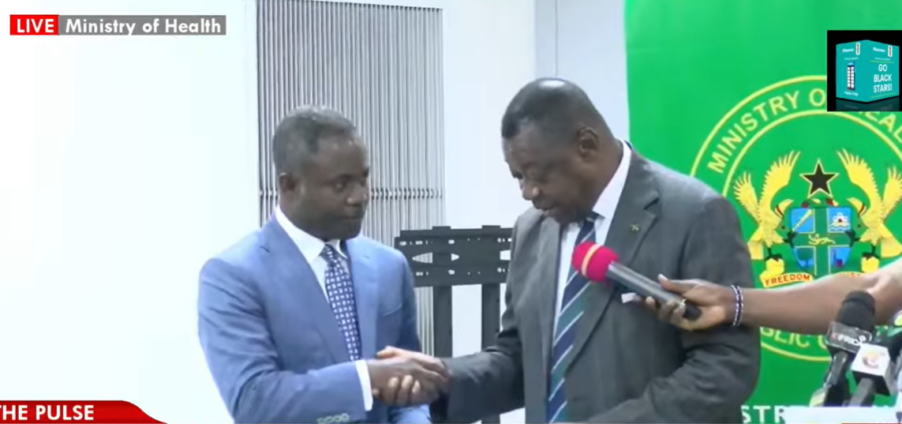
The three-member committee set up to investigate the death of Charles Amissah has presented its report to the Minister of Health, concluding that his death could have been prevented with timely medical intervention.
Chairman of the committee, Agyeman Badu Akosa, said the team was tasked with two main objectives: “to conduct a comprehensive and independent investigation into the circumstances leading to the death of Charles Amissah” and to examine “the alleged denial of emergency care… at the Police Hospital, the Greater Accra Regional Hospital and Korle Bu Teaching Hospital.”
Presenting the findings, Prof. Akosa explained that the committee reviewed national policies, legal frameworks and emergency care protocols, including the 1992 Constitution of Ghana, the Patients’ Charter and guidelines on accident and emergency services.
He said the team also visited key locations linked to the case, including the accident scene at the Circle overhead, ambulance bays, and emergency units at several hospitals.
“We needed to do these site visits to virtually follow through on the emergency procedures and to see whether there were any problems,” he said.
According to the report, Charles Amissah suffered severe injuries in a road traffic accident and later died from excessive blood loss.
“The significant postmortem findings were that there was a deep laceration injury… and severe loss of blood,” Prof. Akosa said, adding that “the pathology confirms a slow death from medical neglect and was not from the instant trauma.”
He said that the victim was alive when he was taken to multiple health facilities, but did not receive the required care.
“What it means is that if at any of these facilities there had been medical intervention, Charles Amissah could have survived,” he said.
The committee found that the patient was first taken to the Police Hospital, then to the Greater Accra Regional Hospital, and later to the Korle Bu Teaching Hospital, but was not treated at any of the facilities.
“At the time they got to the hospitals, the patient was alive,” he said. “The hospital failed to triage the patient and initiate stabilising interventions.”
He added that the patient was eventually pronounced dead after being moved between facilities for over an hour.
The report also raised concerns about the actions of the ambulance team. Prof. Akosa said there was “a lack of documentation of critical vital signs” and that the emergency medical technicians lacked essential skills.
“In other words, they were just carriers really and could not… maintain life whilst in the ambulance,” he said.
The committee further identified lapses among health professionals at the various hospitals.
It concluded that several doctors and nurses “failed to exercise ethical and professional judgment prudently by not attending to Charles Amissah in a life-threatening condition.”
The report therefore described the death as avoidable.
“The medical staff on duty… failed to attend to Charles Amissah when he was in a life-threatening condition, and this led to his avoidable death,” Prof. Akosa stated.
The committee has recommended disciplinary action against the health workers involved and referred their cases to their respective institutions and regulatory bodies.
It also proposed a number of reforms to improve emergency care delivery in Ghana. These include the establishment of a national electronic emergency bed management system, the creation of a national emergency care fund, and the compulsory triage of all patients in emergency situations.
Prof. Akosa also called for broader training in life-saving skills.
“It is important that basic life support and advanced cardiac life support training [are provided] for all health workers… and the general public,” he said.
He said that the report must lead to real change. “This is not the first time such an incident has happened. We do not want a report that will just gather dust without any proper implementation,” he added.
The committee believes that implementing these recommendations will help prevent similar incidents and strengthen Ghana’s emergency healthcare system.
Latest Stories
-
Gov’t to upgrade all rural telephony networks to 4G capability – Sam George
2 minutes -
‘We’ve never seen a CJ in our judiciary system who is everywhere like MTN’ – Janet Nabla
3 minutes -
Lawyers, prosecutors fume over abandoned 26-year-old Upper West High court project
8 minutes -
At least two dead in blast at Bolivia military barracks
40 minutes -
Tate brothers officially indicted with trafficking and sex crimes in Romania
42 minutes -
US envoys arrive in Moscow ahead of Ukraine talks
47 minutes -
Health Minister to brief media on Free Primary Healthcare programme on Monday
60 minutes -
‘It was inappropriate to make that comparison’ – Dr Pumpuni Asante on CJ’s SOE comment
1 hour -
Photos: Final-day shopping continues at Joy FM Back-to-School Discount Fair
2 hours -
Darkey and Frimpong set up J30 Accra boys’ doubles final
2 hours -
When war takes more than territory: The human cost of conflict
2 hours -
Review SHS placement policy to give more BECE candidates access – Kwesi Kwarteng
2 hours -
Tano South Municipal Assembly moves to curb road carnage with speed ramps
2 hours -
Duvor Klu, Gakpo win J30 Accra girls’ doubles title
2 hours -
ITF Juniors Tournament: Duvor Klu claims with straight-sets victory over Gakpo
2 hours