

Audio By Carbonatix
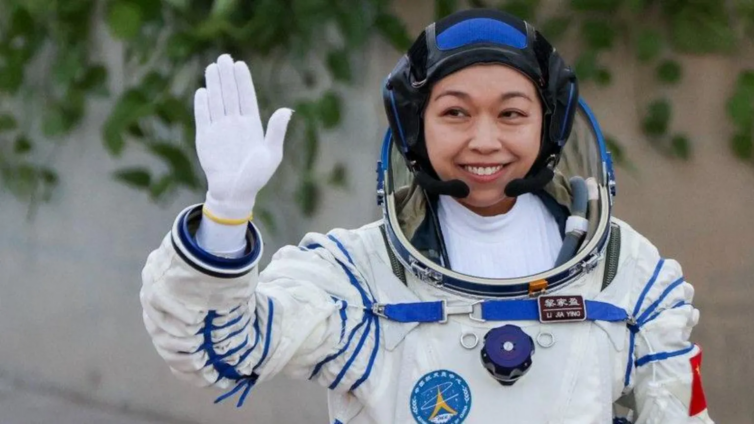
A Hong Kong astronaut has been launched into space for the first time, aboard China's Shenzhou-23 spacecraft.
Li Jiaying, a 43-year-old police officer and mother of three, serves as the payload scientist in the three-member crew who made their way to China's Tiangong space station on Sunday night.
At least one member of the crew will spend a full year in orbit as part of a key experiment. Authorities will determine who that will be at a later date.
The mission is the latest in China's ambitious space program to send humans to the moon by 2030. It comes amid an accelerating race with the US, which is looking to achieve a crewed lunar landing by 2028.
The Shenzhou-23 is tasked with studying the effects of microgravity on the human body, among many experiments.
Apart from Li, the two other astronauts on the mission are Zhu Yangzhu, a 39-year-old space engineer and Zhang Zhiyuan, a 39-year-old former air force pilot.

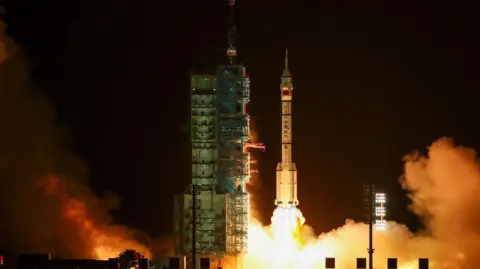
Large crowds waved Chinese flags as the rocket launched from the north-west Gobi desert on the Long March 2-F rocket at 23:08 local (15:08 GMT) Sunday. A few hours later, it docked on the Tiangong space station.
Hong Kong Chief Executive John Lee said Li's inclusion in the mission was a "historic" moment.
Li said she was inspired by Yang Liwei, the first person sent to space by China's space programme.
"This is a rare chance. Why not try?" Li said, according to Xinhua news agency.
As she made her way to the launch on Sunday, Li said, according to state broadcaster CCTV: "How high our Chinese spacecraft flies, that's how high we can hold our heads high".
Stories of successful Hong Kong figures like Li could help Chinese authorities stir patriotism, especially among the youth, analysts told BBC Chinese.
Since 2021, China has been sending astronauts to its Tiangong space station on six-month stays.
The year-long stay will be among the longest in history, just shy of the 14-month record set by a Russian cosmonaut Valery Polyakov in 1995.
"A year in orbit pushes both hardware and humans into a different operational regime compared with the shorter Shenzhou missions of the programme's earlier phases," Richard de Grijs, an astrophysicist and professor at Macquarie University in Australia, told AFP news agency.
This shows how China is building its expertise in long stays in space as well as deep space exploration, de Grijs said.
In 2024, China's Chang'e-6 craft recovered rock samples from the far side of the Moon for the first time and brought them back to Earth.
Later this year, China is set to mount an orbital test flight for its Mengzhou spacecraft, which is designed to carry astronauts to the moon.
Latest Stories
-
2025 was a turning point, says Abradu-Otoo as NAFCO posts record GH¢91.7m profit
11 minutes -
Today’s front pages: Friday, September 25, 2026
29 minutes -
‘FA President has four clubs; what do you think he would do?’ – Nana Baffour Awuah fires back
45 minutes -
Kurt Okraku doesn’t like criticism, but Ghana football is beyond him – Nana Baffour Awuah
60 minutes -
Ghana’s Liquidity Paradox: Why capital is not reaching productive businesses
1 hour -
Ghana football has collapsed under Kurt Okraku – Manhyia South MP
1 hour -
Mr John Blankson Adu Otu
2 hours -
Prof. D. K. Yeboah-Amankwah
2 hours -
AFCON 2027Q: Queiroz ‘proud’ of Black Stars performance despite defeat to Cote d’Ivoire
2 hours -
Your next home could be here: 3rd JoyNews Republic Bank Habitat Clinic opens at Junction Mall today
2 hours -
GCAA assures safety won’t be sacrificed to attract more airlines
2 hours -
AFCON 2027Q: Queiroz furious with ‘joke’ penalty awarded Cote d’Ivoire in Black Stars defeat
2 hours -
GCAA backs more domestic airlines to drive down airfares
3 hours -
SHC launches nationwide audit, gives occupants 21 days to regularise property interests
3 hours -
Manhyia South MP describes EOCO arrest attempt as ‘provocation’
3 hours