

Audio By Carbonatix
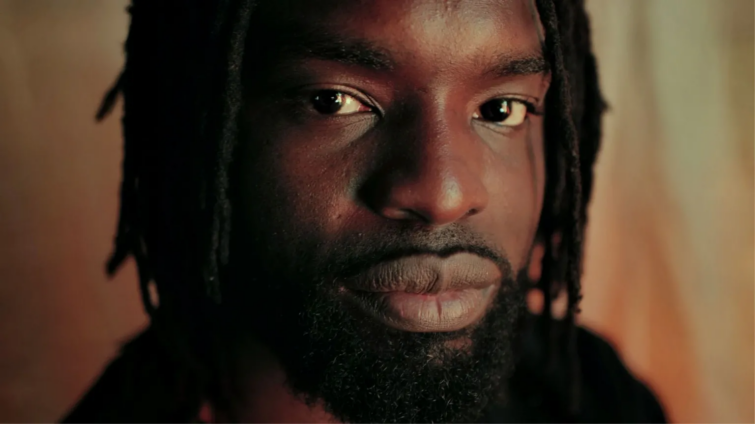
Meji Alabi has directed some of the biggest-selling music artists on the planet: Beyoncé, Burna Boy, Davido and Stormzy. But nothing prepared the Grammy Award-winning director for his new documentary on Nigeria's civil war.
Warning: This article contains details some readers may find disturbing.
Surviving Biafra: Voices from the Nigerian Civil War, produced by BBC Africa Eye, includes previously unseen footage taken on the front line of the devastating war that lasted from 1967 until 1970, when ethnic tensions threatened to tear apart the young West African nation.
"It was very much an eye-opener for me. I just grew up not knowing much about the war at all, or who was fighting who," said the 37-year-old, who was born in London to Nigerian parents before moving to Texas in the US to go to school.
A high point in his career came five years ago when he won a Grammy for co-directing the music video for Beyoncé's hit Brown Skin, Girl.
It was not until he teamed up with his uncle Leke Alabi-Isama, who is also a filmmaker and co-founder of their Lagos-based production company PriorGold Pictures, for the history documentary project that they both began to realise the depth of Nigeria's traumatic past.
The little they did know was learnt from Leke's father and Meji's grandfather, Godwin Alabi-Isama, a former army commando who fought on the side of the federal army against ethnic Igbo separatists fighting in the south-east of the country for a breakaway state called Biafra.
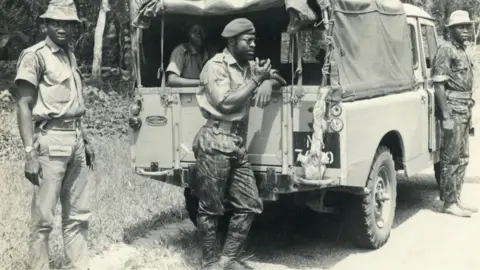
"I only just saw it from a Nigerian [federal army] perspective," said Leke. "I never knew of the horrors. I never knew of the suffering and the pain of the other side."
Throughout the Africa Eye documentary, survivors, now in their 70s and 80s, recount their experiences of living and fighting during a period that shaped the lives of millions and remains relevant today.
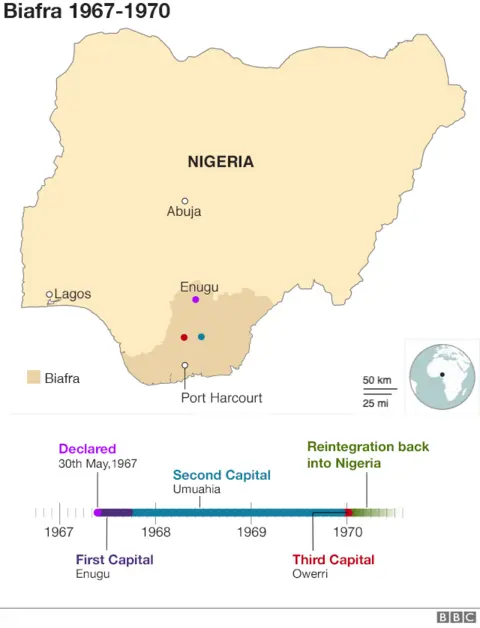
The conflict, also known as the Biafran war, began after a series of military coups and months of massacres against Igbo people living in the north in Nigeria.
Around a million Igbos then returned to their traditional home region in the south-east of the country, where three states broke away to form the independent Republic of Biafra.
The Nigerian government declared war - one of the bloodiest and most divisive conflicts ever fought on the continent.
It is estimated that between 500,000 and three million people died, many of them children, and it became the world's first televised humanitarian disaster.
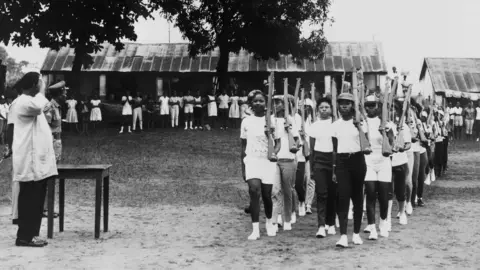
Graphic footage of starving children was broadcast into living rooms for the very first time. After 30 months of fighting Biafra surrendered.
Most Nigerians learn about this chapter of their history through stories handed down through generations. For more than a decade before September 2025, history was not formally part of Nigeria's national school curriculum.
For 44-year-old Leke, who was born and grew up in Abeokuta, Ogun state in south-western Nigeria, it was "a line or two lines in a book".
"It's still not fully covered, you know, the extent of the suffering. And I think, for me, Nigeria is just scared to confront its own truth," he said.
Leke and his 23 siblings grew up hearing war stories from their dad, Godwin Alabi-Isama, who served as chief of staff to Brigadier Benjamin Adekunle of the 3 Marine Commando during the conflict.
"It just felt like my dad was known for helping liberate this town and these villages. I saw him as a war hero," he said.
It was not until his early 30s that Leke started to research what happened during the war that he learnt of the mass starvation in Biafra, of his father's controversial role in the conflict and the true extent of the suffering.
The federal army, including 3 Marine Commando, have faced allegations of war crimes for their conduct in Biafra, including executing civilians.
"The first time I saw those clips of people, children starved… it was horrific. And I think that was a moment of truth for me," Leke said.
"That was the moment for me where the horrors of the war then became facts. Like, OK, something really terrible happened and my dad was on the other side of it.
"When you find out that, you know, your truth is not the only truth, it was a humbling moment."
Leke and Meji said they could not understand why there were not many films about the civil war made by Nigerians, describing how difficult it was to find a truthful account of what happened.
This is one of the many reasons the duo, who usually work with international music stars, wanted to make this documentary.
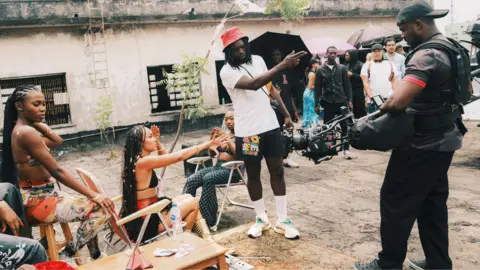
"It's a topic that, you know, is whispered," said Meji, whose music video productions have played a significant role in bringing Nigeria's music scene to the world's attention, with their characteristically complex choreography and colour attracting tens of millions of online views.
"It hasn't been attacked head on and, you know, presented from an inquisitive younger generation like this before," he said.
The documentary pulls together talent from across the region - with Meji convincing Ghanaian composer Ray Michael Djan Jr, who worked on the soundtrack for Black Panther: Wakanda Forever, to do the music.
It also relied on the expertise of the BBC's Igbo service, Igbo historians and features first-hand accounts from survivors, some of whom have never spoken publicly about their trauma before.
"This generation is slowly fading, and if we do not preserve their testimonies now, we risk losing not only their memories, but the chance to fully document this history in a way that can contribute to understanding and healing," said Leke.
Two of the central characters are former female soldiers, who fought on opposite sides. There are also interviews with an aid worker and former BBC correspondent Martin Bell, who both voice criticism about the international response to the crisis.
While Leke and Meji had heard many war stories from Godwin Alabi-Isama before, they had never been in a position to ask the tough questions.
The BBC editorial team led the interview to ensure the former commander was pushed on the war crime allegations made against the 3 Marine Commando.
During the conflict, the Nigerian government also blocked food from entering Biafra - cutting the region's access to seaports, airfields and foreign supplies.
The blockade led to famine, and it is thought that starvation is how hundreds of thousands of people died.
Leke described the moment where he showed his dad the black-and-white footage of emaciated children and said until then in his "43 years of existence" he had never heard his father's voice shake.
"Even every time I watch it back, when it gets to that point, I get, goosebumps," he said.
During the interview, his father also described how, unbeknownst to him at the time of the conflict, he ate human flesh. The moment of cannibalism happened when his unit was served food by villagers in occupied Biafran territory.
In response to the forthcoming documentary, Nigeria's government said it hoped it would serve as a reminder of how far the country had come in the last 59 years "and of the enduring importance of dialogue, reconciliation and shared purpose in building a stronger nation for generations to come".
Both Leke and Meji would like that - and more.
"My hope is that this film encourages Nigerians to confront the darker parts of our shared history with honesty, reflection, and empathy," said Leke.
Meji agrees: "We really hope this documentary encourages more survivors to tell their stories and document our history further. It's up to us to do it."
Additional reporting by Charlie Northcott, Izzy Fleming and Adline Okere
Latest Stories
-
The Traffitech-GH SMS spot-fine system: The good, the sad, and the funny – Bright Simons writes
8 minutes -
Hawa Koomson pledges experienced and mature leadership of NPP women’s wing
1 hour -
Young woman found dead at Kasoa Peace Town
2 hours -
Playback: The Law examined lawful arrest in Ghana
2 hours -
Mahama urges African governments to treat healthcare as an investment, not budget cost
3 hours -
Bawumia congratulates John Boadu and new NPP executives, pledges support ahead of 2028
3 hours -
‘No talent should be left out’ – Bawumia pledges inclusive NPP campaign for 2028
3 hours -
Prof. Mike Oquaye recounts how he blocked the Special Prosecutor’s attempt to arrest Bawku Central MP
3 hours -
Make health sovereignty a priority for Africa – Mahama
3 hours -
Dorimon Naa, Wa West DCE lead massive clean-up exercise; threaten sanctions against recalcitrant residents
4 hours -
Photos from Adom FM Y2K Jam
4 hours -
Praye Tiatia steals the show at Adom FM Y2K Jam [Watch]
4 hours -
Boakye Agyarko congratulates John Boadu, pledges support for NPP leadership
4 hours -
Antwi HiMight thrills fans with Antwi ne Antwi hits at Adom FM’s Y2K Jam [Video]
4 hours -
Amb. Edward Boateng congratulates Boadu, Kodua on election wins
5 hours