

Audio By Carbonatix
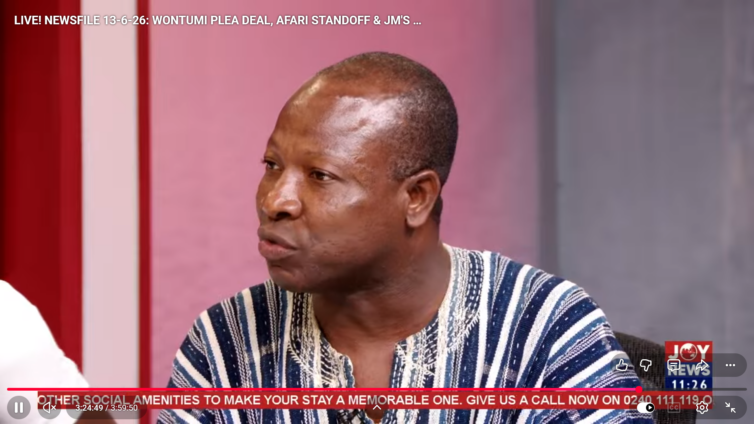
The Chief Executive Officer of the Centre for Citizenship, Constitutional and Electoral Systems (CenCES), James Kwabena Bomfeh, has called on the President to make greater use of cabinet reshuffles as a tool for improving governance efficiency, while also urging renewed political commitment to completing stalled health infrastructure projects across the country.
Speaking on Newsfile on Saturday, June 13, Mr Bomfeh argued that periodic reshuffles within the executive arm of government remain an important mechanism for refreshing leadership, improving performance, and addressing complacency among public officials.
He suggested that repositioning ministers and senior officials could help strengthen government responsiveness and improve coordination across key sectors.
“The President has always got the opportunity to bring some renewal into his administration by way of reshuffling. The reshuffle is necessarily about the people you are moving about. It helps in the responses you put out there,” he said.
Mr Bomfeh further warned that when officials become “too comfortable” in their positions, performance and accountability tend to decline, stressing the need for stronger executive oversight.
He also raised concerns about what he described as instances of avoidable administrative lapses within government, arguing that many internal issues could be resolved through timely communication and stronger leadership discipline.
“A simple phone call could have solved some of the issues we are hearing about in the media,” he noted, while urging the presidency to take lessons from institutional research, including findings from the Institute of Economic Affairs Ghana, to help reposition governance structures.
Mr Bomfeh emphasised that no official within government should be considered indispensable, adding that firm leadership is essential to maintaining discipline within the public service.
“The President must let everybody in his administration understand that no one is indispensable and that he is in charge,” he said.
Turning to infrastructure development, Mr Bomfeh stressed that governance should be viewed as a continuous process that transcends changes in political administration.
He referenced ongoing discussions around major health infrastructure projects, including the Eurojet hospital initiative, which comprises several facilities originally planned under successive governments.
He noted that the programme was initially intended to deliver nine hospitals in total—comprising a military hospital, two regional hospitals, and six district hospitals—with several already commissioned under the previous administration of Nana Akufo-Addo.
Mr Bomfeh devoted particular attention to the long-running Afari hospital project, part of the military health infrastructure programme, which has undergone multiple site changes over the years.
He explained that the project was initially intended for Sofo Line, before being moved to Tamale, then Accra (37 Military Hospital area), and later returned to the Ashanti Region following further consultations and public pressure, including involvement of traditional leadership.
He noted that the final site at Afari was secured after the original Sofo Line land had reportedly been encroached upon, complicating earlier plans.
According to him, repeated relocations contributed to delays and cost variations, as contractors continued mobilisation work throughout the changes.
Despite these challenges, he expressed the view that significant progress has been made on the project, with most structural works reportedly completed and only the sewage system—estimated at around 70 per cent completion—remaining outstanding.
He argued that completing the project would help ease pressure on existing facilities, particularly the Komfo Anokye Teaching Hospital.
Mr Bomfeh also referenced the Sewua Regional Hospital project, which he said is reportedly around 90 per cent complete.
He suggested that completing such facilities would help improve healthcare delivery and reduce congestion at major referral hospitals.
He further recalled past tensions involving labour actions by medical professionals, noting that timely completion and operationalisation of health infrastructure could help prevent industrial disputes and improve morale within the health sector.
Mr Bomfeh criticised what he described as a tendency for political actors to frame infrastructure delivery in partisan terms, arguing that public projects are ultimately financed by taxpayers and should not be treated as political favours.
“Governments or leaders initiate policies and programmes through their vision, but the funding is done by us. We need to get this right,” he stated.
He urged authorities to prioritise completion of inherited projects rather than allowing them to stall across successive administrations, warning that such delays undermine public trust and service delivery.
While acknowledging challenges across successive governments, Mr Bomfeh maintained that Ghana must move beyond political blame games and focus on completing critical national projects.
He called on the current administration to demonstrate stronger leadership, improve coordination, and ensure that ongoing health infrastructure projects are completed to enhance healthcare access nationwide.
“Let us go ahead and finish them,” he concluded.
Latest Stories
-
Ballon d’Or Power Rankings: Lamine Yamal leads race for Golden Ball ahead of Rodri and Kane
2 hours -
‘Nothing worked for us’ – Gideon Mensah takes responsibility for Gambia defeat
2 hours -
2026 Women’s Super Cup: FC Savannah beat Epiphany Warriors to win trophy for first time
4 hours -
Fifa accuses Uefa of ‘misinformation campaign’
4 hours -
Kane and Gordon give England victory over Czech Republic in Nations League
4 hours -
AFCON 2027Q: ‘The last time Ghana won was eight games ago’ – Carlos Queiroz
4 hours -
AFCON 2027Q: Gambia defeat doesn’t make me a loser – Carlos Queiroz
4 hours -
Yamal inspres Spain to homecoming victory over Croatia
4 hours -
2027 AFCONQ: Late goals seal 2-0 for Côte d’Ivoire against Somalia
4 hours -
I’d stick my Man City medals in bin – Keane
4 hours -
AFCON 2027Q: My resignation won’t solve Ghana football issues – Queiroz
4 hours -
Morocco call off Ghana friendly after Black Stars’ AFCON setback
4 hours -
It is time for Tuchel to offer Alexander-Arnold some trust
5 hours -
‘We have to say sorry’ – Queiroz apologises after Ghana’s humiliating defeat to Gambia
5 hours -
New Yorker identified as Yaw Boahene, 57, killed after bag was caught in subway train doors
5 hours