

Audio By Carbonatix
Ghana's government spent barely three quarters of what it had planned for the first three months of 2026, the widest gap between budget and actual spending in at least a decade, according to official data analysed by JoyNews Research. Figures from the Ministry of Finance show the money was held back mostly on capital expenditure, goods and services, debt repayment and support for the poor.
Counting arrears and debt principal, spending came to about GH¢66 billion between January and March, against a plan of GH¢90 billion. That is roughly 73 percent of the target, leaving some GH¢24 billion unspent. Even on the narrower measure that leaves out debt principal, the government got through only about GH¢63 billion of a planned GH¢81 billion, or 78 percent.
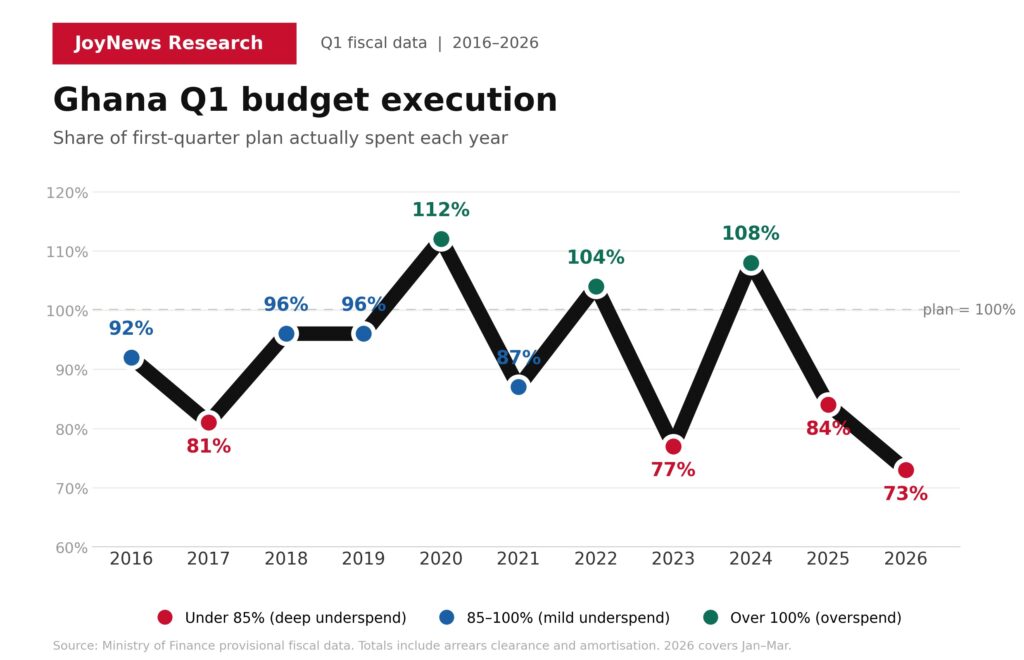
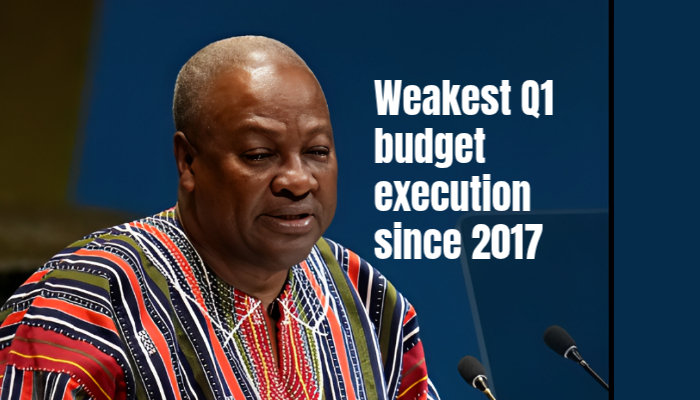
Not since 2017 has a first quarter looked this weak. That was the year after John Mahama's first election defeat, when spending also fell to around 81 percent of plan. Mahama lost office in 2016 and again in 2020 before winning it back in January 2025, and his government is now running further behind its own budget than any administration in the years under review.
This time the gap shows up almost everywhere. Capital spending, the money for roads, schools and other projects, reached about GH¢7.3 billion against a planned GH¢12.6 billion. The GH¢5.3 billion difference is the single biggest miss on any line in any year in the data. Foreign-funded projects barely moved at all, spending around GH¢0.6 billion of GH¢5.3 billion set aside. Interest came in at about GH¢17.2 billion against GH¢21.7 billion budgeted, and the government paid down only about GH¢3 billion of the GH¢8.8 billion of debt principal that fell due.
The squeeze reached services people rely on. Transfers to the state bodies that fund health, education and the districts came to about GH¢12.3 billion, short of the GH¢15.2 billion planned. Money for goods and services, which keeps schools, clinics and government offices running day to day, reached only GH¢1.3 billion of a planned GH¢2 billion. And social benefits, the cash that goes straight to vulnerable households, were almost untouched, with next to nothing spent of a GH¢0.5 billion budget.
One thing was kept whole: the public payroll. Wages came in at about GH¢21 billion against GH¢23 billion planned, or 93 percent, close enough to plan to stand out against everything else.
None of this is new but the size of variance is. Going back to 2016, the government has spent less than it planned in the first quarter in seven of the past eleven years, and the cuts have tended to land in the same places each time.
In 2016 it managed about 94 percent of plan, a small miss with the largest gap in transfers to government bodies. The following year brought the first deep underspend in the series. In 2017 the government managed only about 83 percent of plan, and the squeeze was broad, with capital spending at 72 percent, wages at 89 percent and goods and services collapsing to just 18 percent of budget. It was the first full year of a new government and a fresh IMF programme, the kind of stop-start year that tends to follow a change of power.
Spending recovered to about 94 percent in 2018, then slipped again to 88 percent in 2019, when capital projects ran at barely half of plan. The pandemic turned everything upside down in 2020, the one year of the early stretch when the government actually overspent, pushing total spending to around 108 percent of plan as it rushed out emergency and health money.
The strain returned with the debt troubles. In 2021 the government spent about 88 percent of plan, dragged down by goods and services at under a fifth of budget. The next year, as the crisis deepened, total spending hit about 89 percent, with goods and services again the weak spot at just 10 percent. The one line that ran over in 2022 was interest, an early warning of the debt burden that would soon push the country into default.
Then came the lean years. In 2023 the government spent about 82 percent of plan, more than GH¢8 billion short, with capital projects at 58 percent and interest reshaped by the debt restructuring. The 2024 election year was the exception, with spending running a little above plan as wages and day-to-day costs climbed. But even then capital spending came in almost GH¢4 billion below target, a reminder that investment gets trimmed even when the rest of the budget is running hot. By 2025 the shortfall was back and wider, around GH¢10 billion, with capital, interest and social benefits all falling well short.
Checks indicate a few patterns hold across the whole period. Capital spending is almost always the first thing to give, running at somewhere between half and two thirds of plan in most weak years. Goods and services is wildly unpredictable, swinging from 10 percent of budget one year to several times its budget the next, which points to shaky cash planning. And wages are nearly always paid in full. When revenue falls short, in other words, it is projects, day-to-day running costs and help for the poor that pay the price, not salaries.
Social benefits stand out most of all. The cash meant to reach vulnerable households was barely spent in most years of the series, including 2016 through 2019, 2021, 2022 and now 2026, and reached only about 23 percent of plan even in 2025. Year after year it is the worst-performing line in the budget, which is hard to overlook given how stretched households have been through the recent crisis.
Ghana is still working through reforms under its IMF programme, agreed after the 2022 crisis forced it to default on most of its foreign debt. The programme is expected to come to an end in July with authorities opting for a Policy Policy Coordination Instrument (PCI) which does not come with any additional funding support.
Latest Stories
-
Western Regional Minister applauds Karpowership’s role in Ghana’s power sector
16 minutes -
Livestream: Road safety crises: Where are we getting it wrong?
18 minutes -
Enterprise Life celebrates 25 years of protecting families and building trust
26 minutes -
ICC London rules in favor of Ghana against Tullow over $400m tax charge
36 minutes -
We are disappointed in ICC’s ruling over our corporate income tax assessment in Ghana – Tullow Oil
47 minutes -
Cost of building inflation for August 2026 increases to 4.6% – GSS
48 minutes -
Today’s front pages: Wednesday, September 30, 2026
1 hour -
Bawumia highlights agricultural, compulsory insurance reforms in IBAG engagement
1 hour -
Ghana will secure Tullow tax revenues while protecting Jubilee, TEN investments – Ato Forson
1 hour -
Ghana wins $393m Tullow tax arbitration as tribunal upholds GRA assessment
2 hours -
Gender Minister assures women’s group of action on Affirmative Action, Development Bank
2 hours -
Over 2,000 teachers in Dormaa comply with strike – GNAT Secretary
2 hours -
Food Buffer Stock seeks stronger liquidity buffer despite record profit
3 hours -
LPG investments key to achieving 50% access target by 2030 – Energy Minister
3 hours -
Jinapor: New LPG terminal strengthens Ghana’s energy security
3 hours