

Audio By Carbonatix
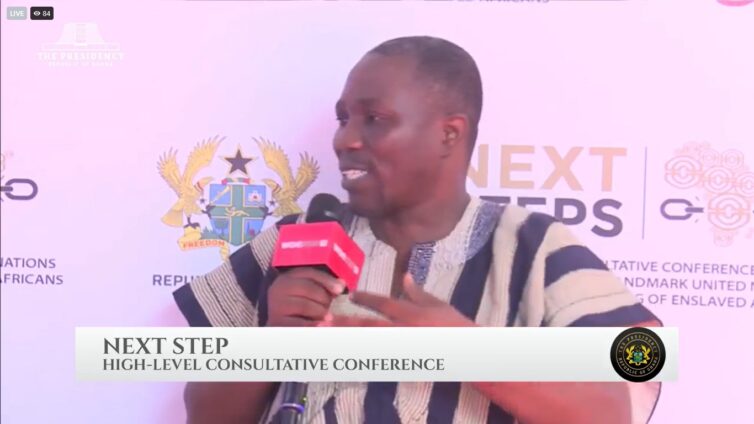
A researcher and historian at the University of Ghana, Kweku Darko Ankrah, has argued that Africa’s economy was more advanced before European contact, particularly before the onset of the transatlantic slave trade and subsequent colonial exploitation.
Speaking on the sidelines of the ongoing Next Steps Conference on Reparatory Justice in Accra, he said historical evidence suggests that Africa’s economic systems were robust and capable of sustaining households, contrary to long-standing colonial-era narratives.
Mr Ankrah noted that archival materials, including what he described as Gold Coast-era newspapers, documented comparative accounts of Africa and Europe before colonisation, indicating that African societies were, in several respects, economically ahead of their European counterparts.
He explained that historical records point to a period in which African communities were largely self-sufficient, with families able to meet their basic needs and maintain stable livelihoods before external disruption.
In contrast, he said Europe at the time reportedly faced significant social and economic challenges, including widespread child homelessness and labour shortages, which he argued contributed to its later drive for external resources and labour.
"If you go back to history when Europeans came for trade, the economy was not far more advanced than that of Africa," he said.
"If you read a book by any of the Gold Coast scholars, they wrote that 'Here in Elmina, you cannot find a child who is an orphan on the streets as we see it on the streets of Amsterdam, as we see it in European capitals. Here, everybody is taken care of, and families take care of everybody. This shows you that indeed when we talk about social economic aspect of Africa at that time, Europe was not more advanced than Africa," he added.
According to him, this economic imbalance shifted dramatically with the advent of the slave trade, during which millions of Africans were forcibly transported to work on plantations and in households abroad, forming part of what he described as a system that underpinned European industrial and agricultural expansion.
"When the slave trade occurred, what happened was that the African strong men who ought to work in the agrarian sector, because Africa's economy was highly propelled by the agrarian sector, were taken to Europe, that labour was used in the farms and plantations in Europe, and as a result, it boosted the economy of these Western places while they were able to get the consumable outcomes from their sweat," he noted.
Mr Ankrah made the remarks in the context of growing global discussions on historical justice, which have gained momentum following the adoption of UN Resolution A/RES/80/250, a landmark decision that has intensified international debate on the legacy of slavery and reparatory justice.
The Accra conference, convened under the auspices of President John Dramani Mahama, continues to bring together global leaders, scholars and policymakers to explore pathways for addressing historical injustices linked to the transatlantic slave trade.
Latest Stories
-
Central Regional Minister urges traditional leaders to hold public officials accountable
17 seconds -
Ada Traditional Council suspends four members for defying cancellation of 2026 Asafotufiami durbar
7 minutes -
Association of Small-scale Industries, GEA strengthen artisans through mentorship, coaching
12 minutes -
Two arrested over alleged galamsey activities in Tanoso
17 minutes -
Ghana rises to sixth-largest gold producer globally after record 2025 output
24 minutes -
Five injured in road crash at Ahwerase
28 minutes -
Ghana needs copyright protection for Kente designs – Agortime-Ziope MP
34 minutes -
BDCs lobby NPA for regional fuel depots amid concerns over BOST’s role
40 minutes -
Green means Business: How Ghana’s garden revolution is growing jobs, wealth and hope
42 minutes -
Ahafo Regional Minister cuts sod for 24-hour market project in Tano North
48 minutes -
PURC resolves over 97 per cent of complaints lodged during first half of 2026
53 minutes -
New DVLA office opens in Asuogyaman to improve access, fight licensing fraud
59 minutes -
Ga-Dangmes urged to preserve lands, culture for future generations
1 hour -
Organised Labour pledges support for IPEC establishment
1 hour -
South Africa returnees form ‘Evacuation Boys’ to support sanitation in Ghana
1 hour