

Audio By Carbonatix
The United Nations Population Fund (UNFPA) has called for increased investment in health workers and life-saving reproductive health commodities as part of efforts to reduce maternal deaths in Ghana.
UNFPA Regional Director for West and Central Africa, Sennen H. Hounton, said Ghana and other countries in the region needed to address gaps in the availability and distribution of health workers while ensuring that essential reproductive health commodities were consistently available.
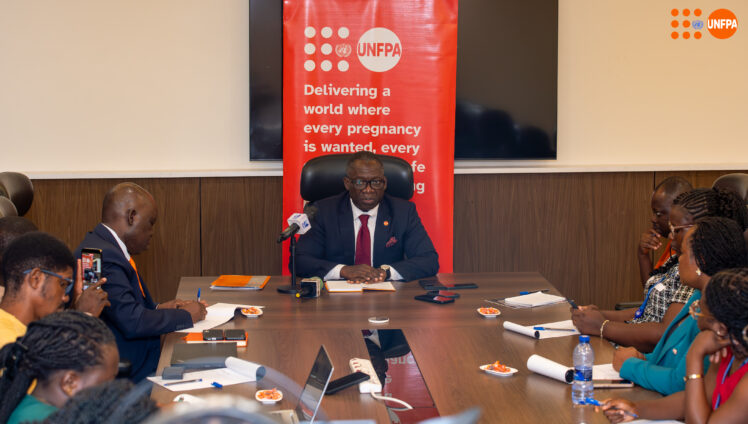
Speaking during a media engagement on Monday, September 14, on the Presidential Initiative on Maternal Emergency Response, Mr Hounton said the first priority was human resources for health, saying that many countries, including Ghana, produced trained health professionals but were unable to recruit or distribute them adequately.
“We produce a lot in many of the countries, including in Ghana,” he said.
However, he said fiscal constraints often prevented governments from recruiting enough health workers or ensuring that those available were distributed according to the needs of different communities.
“But through fiscal constraints, we don't recruit enough, or we don't distribute adequately,” he said.
According to him, improving the distribution of existing health workers could help address some of the gaps without necessarily requiring additional funding.
“The good redistribution of human resources for health is just a better use because it's not asking for more, but just better distribution,” he said.
He said governments needed to assess the number of health workers available against the populations they served and ensure a more equitable distribution.
“No one is preventing us from looking at how many we have and look at the population being served and do an equitable distribution,” he said.
Mr Hounton also called for increased investment in reproductive health commodities, including contraceptives, which he described as life-saving.
“The second, I mentioned the life-saving drugs, the commodities. The reproductive health life-saving drug. Contraceptive is a life-saving drug,” he said.
He said reproductive health commodities remained largely dependent on donor funding in many countries, while government contributions were not sufficient to meet the needs of the population.
“I mentioned to you that it is donor-driven mostly in most of our countries,” he said.
“Government contribution is just not at the level of the needs of the population.”
Mr Hounton said governments therefore needed to increase their budgetary allocations to ensure that essential reproductive health commodities were available.
“That’s critical. Without that, you will have more teenage pregnancy. You have more risk of them coming with pregnancy and more death.”
The third area identified by Mr Hounton was social mobilisation, which he said should become a broader movement involving different sections of society.
“The third in my mind is what I will call a social mobilisation. It's a movement. Where you have a role to play,” he said.
He said traditional leaders, including chiefs and kings, as well as human rights watchdogs and other community actors, had important roles to play in addressing maternal health challenges.
Mr Hounton said communities should also have regular access to information on maternal health outcomes so that they could see whether the situation was improving or getting worse.
He suggested that communities could receive the figures every three or six months, allowing them to monitor progress and demand action where necessary.
He also acknowledged that some people might question the accuracy of the figures but said making the information visible would bring communities closer to the reality of maternal deaths.
“Some will say, ‘Oh, no, no, no. Your figures are not right.’ But we will get close to the reality,” he said.
“And having it visible, we drive everyone to try to do something about it.”
Mr Hounton said addressing the three areas would also require countries to improve how existing resources were coordinated and used.
He said better coordination among government and development partners could reduce duplication and wastage in the health sector.
“Better coordination will also address the wastage,” he said.
Mr Hounton said that countries needed to develop solutions based on their own circumstances rather than applying a single approach across the region.
“Each country is different,” he said.
He said Ghana was in a comparatively better position than many other countries in the region but still needed to identify the areas where investment would have the greatest impact.
“If you look at the scale of the issue as I mentioned, Ghana sits in a better place than many others in the region. But you need to be looking at what are the top investment, but you also need a differentiated approach,” he said.
“I have full confidence when I see the drive and the commitment of the Ministry of Health, the Minister of Health, the Deputy Minister of Health, and they know their sectors, nd they are experts in the field. I have no doubt that they will find those bottleneck and address them,” he said.
The call comes as the government rolls out a five-year Presidential Initiative on Maternal Health Emergency Response (PRIMER), with UNFPA among the partners supporting efforts to reduce maternal mortality and improve emergency care for pregnant women and newborns.
Latest Stories
-
India faces 100% tariff threat over Russian oil after US House vote myjoyonline
3 minutes -
The importance of World Tourism Day celebrations in Ghana and across the globe
5 minutes -
Over 100 pupils cram into one classroom as Amantin Basic School battles congestion
21 minutes -
Techiman South MP distributes school supplies to ease burden on parents of SHS freshers
28 minutes -
GCB’s Helmet On, Life On campaign targets motorcycle safety in Accra CBD
35 minutes -
Tourism Minister calls for stronger policies, data to grow Ghana’s creative sector
52 minutes -
GQAA to host International Quality Assurance Convention and AI Masterclasses in October
53 minutes -
NIA marks Identity Day with public education float and mass registration exercise in Accra
56 minutes -
NaCCA denies partnering UCC Confucius Institute to train teachers for Chinese language curriculum
58 minutes -
Kpebu backs broader consultation on constitutional review but questions NPP’s proposed Consultative Assembly
1 hour -
Builsa South MP Clement Apaak allocates GH¢370,000 for road rehabilitation
1 hour -
Kumawu MP Ernest Yaw Anim supports 500 fresh SHS students with school items
1 hour -
Civil society platform demands greater citizen involvement in constitutional reforms
1 hour -
Better distribution of health workers could help cut maternal deaths – UNFPA
1 hour -
Advocacy group raises concerns over environmental damage from Big Push road projects
1 hour