

Audio By Carbonatix
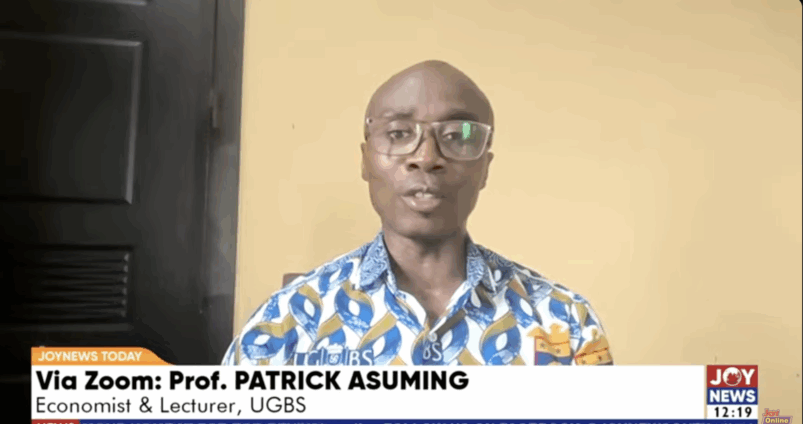
Economist and University of Ghana lecturer, Professor Patrick Asuming, has questioned attempts by state institutions to downplay the International Monetary Fund’s (IMF) assessment that Ghana recorded a $214 million loss under the Gold for Reserves Programme, insisting the information originated from the government itself.
Speaking on JoyNews on Monday, Prof Asuming said the IMF’s position on the reported loss was clear and should not have come as a surprise to authorities, including the Ghana Gold Board and the Bank of Ghana.
“I think the IMF was absolutely clear on the $214 million. And they said it’s a loss. It’s important to understand that the IMF doesn’t make up this information,” he said. “It is the government of Ghana that reports this information to the IMF.”
His comments come amid a heated political debate over the performance of the Gold for Reserves Programme, following claims by the Minority Caucus in Parliament that the Ghana Gold Board incurred a $214 million loss from gold trading activities. The Majority Caucus has since rejected the claim, arguing that the figures have been misrepresented and should not be described as a loss.
However, Prof Asuming maintained that once the government submits financial data to the IMF, it should expect the Fund to analyse and publish its findings as part of the ongoing IMF-supported programme.
“The government of Ghana would have been aware that this information was going to be published. So to turn around and try to re-categorise whether it is a loss or not is somewhat surprising to me,” he noted.
He explained that the IMF’s primary concern is not about halting Ghana’s economic programme but about ensuring that any losses associated with the domestic gold purchase initiative are not borne by the Bank of Ghana, as this could weaken the central bank’s operational capacity.
“The IMF concern is that the loss should not be on the books of the Central Bank because it affects its operational capacity,” Prof Asuming said, stressing that the Fund has not called for the programme to be suspended.
Addressing arguments that the loss should only be confirmed after audits by the Ghana Gold Board, he dismissed that position as unfounded, noting that reporting under IMF programmes happens at different intervals.
“Some information is reported monthly, some quarterly, half-yearly or yearly. If the government has reported this and the IMF has analysed it, I don’t think the response should be denial,” he added.
Prof Asuming acknowledged that the Gold for Reserves Programme has helped boost Ghana’s reserves and achieved some positive outcomes, but urged authorities to accept the IMF’s concerns in good faith and focus on addressing the cost challenges.
“They are simply flagging that these costs should not be pushed onto the central bank. I think we should accept it in good faith and find ways to minimise the loss,” he said.
The Gold for Reserves Programme was introduced by the Bank of Ghana as part of efforts to shore up foreign reserves, stabilise the cedi and reduce reliance on foreign exchange markets, particularly during Ghana’s ongoing IMF-supported economic recovery programme.
Latest Stories
-
Five-member committee to search for new Black Stars coach after Sports Ministry-GFA meeting
22 minutes -
Pinktober: Breast cancer survival exceeds 90% when detected early – Breast Society of Ghana
29 minutes -
TCDA to adopt Upper West’s MATCO mango farm as northern prototype, issues warning against felling shea trees
39 minutes -
Fear delegates tag: Afoko touts genuineness among delegates ahead of NPP delegates conference
42 minutes -
John Boadu: The leader our party needs at this time – Amb. Edward Akwasi Boateng
48 minutes -
Baffour Awuah: EOCO effected an arrest, detained MP after hours of waiting, questioning – Afenyo-Markin
1 hour -
EOCO court warrant authorised search of Baffour Awuah’s law firm, not residence – Afenyo-Markin
1 hour -
NPP delegates conference: 3,000 to 4,000 police personnel deployed for security in Kumasi – Anthony Karbo
1 hour -
KGL Foundation commits $200,000 to support juvenile football for the next two years
2 hours -
UNDP invites Mahama Ayariga to Northern Peace Conference in Tamale
2 hours -
Afoko can give NPP ‘new identity’ ahead of 2028 to overcome NDC – Political scientist, Dr Amakye-Boateng
2 hours -
2 injured amid gunshots during raid at Nawara Mining office at Nsuapemso
2 hours -
St Augustine’s College retains 2026 National Investment Quiz title
2 hours -
KNUST Nursing and Midwifery School staff recognised at 2026 Health Ministry Excellence Awards
2 hours -
JoyNews’ Esther Esi Nkrumah selected for UK Media Excellence for Emerging Technology Fellowship
2 hours