

Audio By Carbonatix
Minister for Trade, Agribusiness and Industry, Elizabeth Ofosu-Adjare, has called for a deliberate effort to add value to Ghana’s cotton before it is exported, arguing that the country stands to gain significantly by developing a strong domestic textile and apparel value chain.
According to Minister Ofosu-Adjare, Ghana and other African countries continue to lose substantial economic value by exporting raw cotton while importing processed textile products.
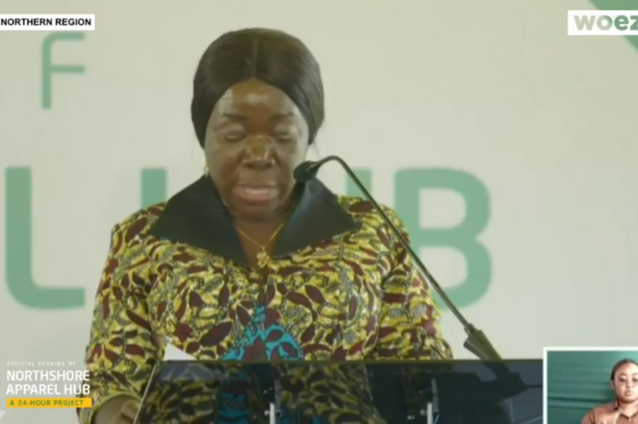
Speaking at the launch of the Northshore Apparel manufacturing hub in Savelugu, she highlighted the need for stronger linkages between agriculture and manufacturing.
“Africa's place in that picture, however, remains far smaller than our raw material base would suggest,” Minister Ofosu-Adjare said.
She noted that Africa supplies close to a tenth of the world's traded cotton, but exports about 90 per cent of its raw cotton to Asia.
“This is a clear sign of value leaving our shores before it is even spun into thread, let alone sewn into a garment,” she said.
Minister Ofosu-Adjare said the situation presented an opportunity for Ghana to expand cotton production while developing industries capable of processing the crop into yarn, fabric and finished garments.
She pointed to the vast agricultural potential of northern Ghana, saying the country has more than four million hectares of northern savannah zones, much of which remains uncultivated despite being suitable for cotton production.
“Our country has more than 4 million hectares of northern savannah zones, much of it within which we stand remains uncultivated, even though it's suitable for cotton cultivation,” she said.
The Minister also disclosed that she had visited Bente Energies Limited at Zugali, where the company is undertaking experimental cotton cultivation.
“They are cultivating cotton. And it's doing so well,” she said.
Minister Ofosu-Adjare added that the company had indicated that, if the current cultivation proved successful, it planned to expand production to more than 5,000 hectares next year.
She described the development as positive news for Northshore Apparel and Ghana’s broader apparel industry, particularly as the country seeks to strengthen local sourcing of raw materials.
“This is good news for Northshore and the apparel industry,” she said.
The Minister said Ghana needed to move away from the traditional practice of exporting raw materials and importing finished products, stressing that greater value must be retained within the country.
She cited China, Bangladesh and Vietnam as examples of developing economies that have captured significant portions of the global apparel market through deliberate investment in manufacturing and export capacity.
Minister Ofosu-Adjare said Ghana could similarly position itself as a competitive player if it developed the necessary infrastructure, skills, raw material supply and market access.
She said the newly commissioned Northshore Apparel facility demonstrated the potential of indigenous Ghanaian businesses to invest in large-scale manufacturing outside the traditional industrial centres of Accra and Tema.
The facility, she noted, was designed to produce competitively for both local and international markets while creating employment opportunities for young people in the Northern Region.
Minister Ofosu-Adjare said stronger collaboration between farmers and manufacturers would be critical to building a sustainable cotton-to-garment industry in Ghana.
She stressed that producing and processing cotton locally would not only create opportunities for farmers but also support job creation, industrialisation and export growth.
“Every garment that leaves this facility for a customer abroad is a step towards Ghana we are building,” she said.
“A Ghana that produces, that adds value, and that exports with pride.”
The Minister reaffirmed the government's commitment to supporting manufacturers, improving the ease of doing business and opening export markets through Ghana's trade agreements.
She said the ultimate goal was to build an economy that produces more, adds value to its resources and competes effectively in global markets.
Latest Stories
-
CXP urges businesses to localize AI to improve customer experience
13 seconds -
TUC calls on government to urgently address striking teachers’ grievances
6 minutes -
GHIMA sounds alarm over unlicensed practitioners handling health data, warns of threat to patient safety
26 minutes -
Old Edubiase pupils turn to trading, farming as teachers’ strike disrupts schooling
29 minutes -
Energy Minister commends NPA CEO for maintaining petroleum market stability amid global shocks
34 minutes -
Armah-Kofi Buah, Sam George, other MPs among newly qualified lawyers
42 minutes -
Ghana exporting eggs to Burkina Faso amid local surplus – Agric Minister
42 minutes -
Governance failure in Ghanaian football and a presidential reform agenda
48 minutes -
IJM Ghana welcomes country’s upgrade to Tier 1 in 2026 Trafficking in Persons report
50 minutes -
REAC urges stakeholders to comply with Real Estate Act or face sanctions
50 minutes -
‘Nkoko Nketenkete’ boosts local poultry production from 4.6% to 22% in one year – Agric Minister
1 hour -
ARK Foundation boss warns against stigmatisation of abuse victims
1 hour -
Health investment beginning to improve access to care – Akandoh
1 hour -
“It is meaningless” – Parent laments as teachers’ strike leaves boarding school students idle
2 hours -
Austin Gamey predicts possible end to teachers’ strike, urges better negotiation
2 hours