

Audio By Carbonatix
Journalists have been urged to maintain their professional ethics as they promote issues involving human rights, peace, and democracy in the country.
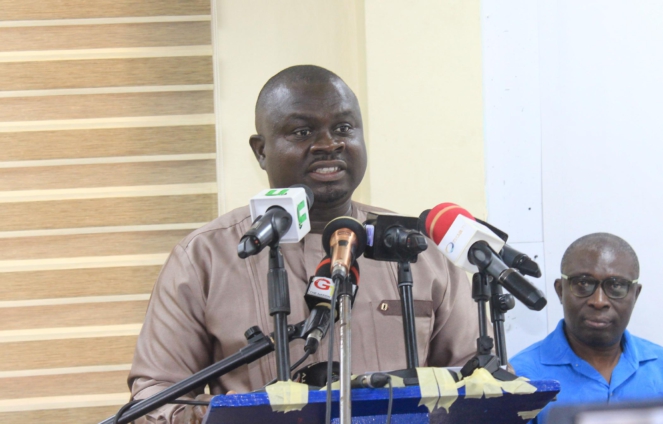
Mr. Albert Kwabena Dwumfour, President of the Ghana Journalists Association (GJA), noted that while Ghana's Constitution guaranteed media freedom, journalists should not carry out their duty in a way that threatens the country.
“Freedom of the media does not mean discharge your duties in a manner that poses threat to the country. Let us all work together to promote human rights, peace, and democracy in the country.”
Mr. Dwumfour, speaking at the opening of a two-day training for selected journalists in Accra, said the country depended on them to maintain peace and democracy before, during, and after the December polls.
The training program aimed to increase media actors' capacity to report on human rights issues, prevent hate speech and violence, as the country prepares to vote in December.
The training was organised by the Commission for Human Rights and Administrative Justice (CHRAJ) and the Office of the High Commissioner for Human Rights (OHCHR) West Africa Regional Office, UNFPA, UNWOMEN and UNESCO.
Mr. Dwumfour said the media were protectors of truth, watchdogs of democracy, and voices for the voiceless.
He said that journalists should carry out their duties objectively, and that failing to do so would be a breach of their responsibility.
According to the GJA President, the issue of human rights concerned everyone, and if any group had suffered abuses in the recent past, it was the media.
“Attacks on journalists and other forms of abuse of journalists are issues the GJA takes seriously… so I expect you all to take the tutorials and presentations seriously and leverage on it to be better in that field,” he said
Madam Fatimatu Abubakari, Minister of Information, remarked in a speech read on her behalf that her ministry recognizes the crucial role journalists play in holding governments accountable and pushing for human rights.
“Your work is essential in shaping public discourse, exposing injustices and amplifying marginalized voices.”
Madam Abubakari described the training as timely because journalists would be navigating complex challenges in Ghana’s democracy.
“It is crucial for journalists to have knowledge and skills to effectively report on human rights issues, uphold ethical standards, and maintain the trust of the public,” she said.
The Minister said that the government had demonstrated its commitment to a free, independent, and responsible press by facilitating the establishment of the Africa Office of the Independent Funds for Public Interest Media in Accra, as well as enacting the Right to Information (RTI) Act of 2019 and the Whistleblowers Act.
“We believe that a vibrant media landscape is essential to our democracy,” she added.
Madam Abubakari urged journalists to continue holding politicians accountable by advocating for the truth and justice, adding that "this mandate must be carried out in the spirit of fairness, equity, and honesty."
Dr. Joseph Whittal, Commissioner of the CHRAJ, said that severe human rights concerns exist in Ghana and that collective action must be taken.
He said that, in terms of protecting the rights of vulnerable groups, journalists had unfortunately contributed to fuelling public resentment toward migrants and sexual minorities.
Dr. Whittal expressed concern with skewed reporting of "Fulanis" as accountable for every highway robbery.
He said that at the height of the recent LGBT discussion in the country, some people identifying as "Journalists Against LGBT" tried to encourage the prosecution of gay and lesbian individuals in the country.
“That approach in the considered view of CHRAJ was problematic as it was not informed by a proper understanding of human rights,” he said.
Dr Whittal said the workshop sought to deepen participants' understanding of human rights norms and the SDGs.
It was also intended to broaden journalists' knowledge base by investigating how human rights principles intersect with journalism, ethical considerations in reporting, and dealing with challenges faced by the media working in an environment where human rights and fundamental freedoms were constantly under threat.
Mr. Robert Kotchani, a Representative of the OHCHR West Africa Regional Office, noted that hate speech remained a source of concern in Ghana and urged for an end to divisive utterances and incitement to hatred or violence.
Latest Stories
-
Ghana eyes stronger trade ties as Australia hosts multicultural trade and investment forum
3 minutes -
Margaret-Marie Krakue
6 minutes -
Ayariga announces plans for live broadcast of MMDAs’ meetings on local radio stations
9 minutes -
Mrs Anna Tackie
11 minutes -
Ghana links Afghan heroin and Brazilian cocaine to global drug markets – Global Organised Crime Index
18 minutes -
NHIA launches nationwide inter-school quiz to deepen students’ knowledge of NHIS
24 minutes -
Political protection could be masking Ghana’s cocaine trade – Global Organised Crime Index
29 minutes -
AFCON 2027Q: ‘We have to dissolve the GFA’ – Effia MP after Black Stars lose to Gambia
31 minutes -
NPP announces voting schedule and ID requirements for October 3 national elections
33 minutes -
Lupus can mimic HIV symptoms and damage kidneys if untreated – KNUST expert
36 minutes -
Focus on Sickle Cell Foundation seeks to introduce sickle cell education through comics in Ghanaian schools
42 minutes -
NPP rewrites the campaign playbok as opposition reality shapes National Executive contest
44 minutes -
Road safety education will fail without enforcement – NRSA boss
45 minutes -
Daily Insight for CEOs: Finishing Q3 strong and entering Q4 with purpose
46 minutes -
National Ambulance Service begins ‘Operation Restore Fleet’ to restore grounded ambulances
46 minutes