


Audio By Carbonatix
A leader of Cameroon's separatist movement, Sisiku Ayuk Tabe, and nine of his followers have been given life sentences by a military court in the capital, Yaoundé.
They were convicted of rebellion, among other charges.
Their lawyers accused the judge of bias and withdrew from the proceedings.
The English-speaking separatists argue they are marginalised by the bureaucracy and school system in the majority French-speaking country.
The defendants had been arrested in Nigeria in January 2018 and deported back to Cameroon.
The court session on the verdicts, which started on Monday, went on until 05:30 (04:30 GMT) local time Tuesday morning, reports the BBC's Leocadio Bongben.
By that time the defence lawyers had already withdrawn from the proceedings but continued to stay in the court as spectators.
Defence barrister Joseph Fru said there were irregularities in the proceedings, including the judge's biases, but the military court rejected his evidence.
The long list of charges included rebellion, complicity in terrorism, financing terrorism, revolution, insurrection, hostility against the state, propagation of fake news and lack of identification.
The court also ordered the 10 to pay a fine of 250bn CFA francs ($422m; £359m) to the government for civil damages and 12bn CFA francs for court costs.
Among the 10 who were convicted was Sisiku Ayuk Tabe, the leader of the so-called Governing Council of Ambazonia - the name separatists have given to Cameroon's Anglophone North-West and South-West regions.
Cameroon's English-speakers say they have been marginalised for decades by the central government and the French-speaking majority.
The current crisis started in 2016 when lawyers and teachers went on strike over the use of French in courts and schools.
In October 2017, activists declared autonomy over the two English-speaking regions - a move rejected by Cameroon's President Paul Biya.
Some took up arms in 2017 and the crisis has forced more than 500,000 people from their homes.
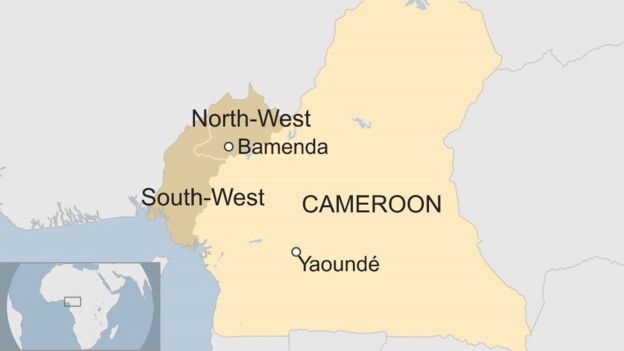 English-speaking Cameroon are marked in the darker colour
Why does Cameroon have both English and French-speakers?
English-speaking Cameroon are marked in the darker colour
- On 1 January 1960, the French colony of Cameroun gained independence and became Cameroon.
- On 1 October 1960, Nigeria gained independence from the UK.
- The UK also controlled the former German colony of Cameroon. At independence, its citizens were given a choice of joining either Nigeria or Cameroon.
- Southern Cameroonians opted to unite with Cameroon, while Northern Cameroon joined Nigeria.
DISCLAIMER: The Views, Comments, Opinions, Contributions and Statements made by Readers and Contributors on this platform do not necessarily represent the views or policy of Multimedia Group Limited.
Tags:
DISCLAIMER: The Views, Comments, Opinions, Contributions and Statements made by Readers and Contributors on this platform do not necessarily represent the views or policy of Multimedia Group Limited.
Latest Stories
-
Walter Mosley visits W.E.B. Du Bois Centre in Accra: A New York Secretary’s homecoming story on where Du Bois spent his final years.
57 minutes -
MTN set to deploy 5G services after winning spectrum licenses worth US$202m
3 hours -
NPP national elections: 3,000–4,000 police to handle security, traffic in Kumasi – Karbo
5 hours -
Atta Akyea fumes as Manhyia MP is to spend another night in EOCO custody
6 hours -
SSNIT says La Beach clearance was to protect hotel investments, beaches to remain public
7 hours -
APSU congratulates St Augustine’s College after back-to-back National Investment Quiz wins
7 hours -
Renewed flood intervention at Mallam Junction raises hopes among residents, businesses
7 hours -
St Augustine’s College retain National Investment Quiz title after nail-biting grand finale
8 hours -
Education infrastructure investment will drive Banda’s development – Ahmed Ibrahim
8 hours -
Teacher unions strike: Gov’t presents fresh proposals as talks end inconclusively
8 hours -
51,000 teachers’ promotion arrears to be validated for October payment – Education Minister
9 hours -
Kwabena Boamah appointed Board Chair for Impact Investing Ghana
9 hours -
Striking teacher unions to meet Fair Wages and Salaries Commission on October 6
9 hours -
EOCO working with AG to arraign Nana Baffour Awuah before weekend court
9 hours -
Duraplast reassures customers after fire, announces October 5 reopening
9 hours