

Audio By Carbonatix
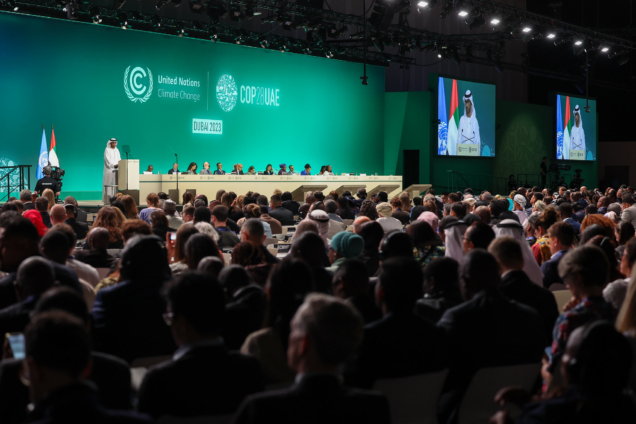
On the second day of COP28 in Dubai, more than 130 world leaders have endorsed the ‘‘Emirates Declaration on Sustainable Agriculture and Food Systems’’, putting food at the centre of the climate talks.
This one-of-a-kind declaration is a product of one year of negotiations that were spearheaded by the COP28 Presidency on the one hand and the push from farmer groups and civil society organisations (CSOs) from Africa on the other.
“This declaration marks a significant step towards sustainable food systems in the world, especially in Africa where food security is a big concern. A COP has finally recognised the urgency of transforming and adapting our food and agriculture systems to the climate crisis. To attain this sustainability, it is important to urgently increase access and scale of finance to agriculture and to provide technical support to farmers,” said Amy G Thorp, Senior Climate Adaptation and Resilience Policy Advisor at Power Shift Africa.
“The value of integrating local and Indigenous knowledge in agriculture cannot be overstated. By establishing social support programmes for vulnerable groups such as smallholders, women, youth, the fisherfolk and Indigenous groups, we make our food systems more inclusive and resilient.
“While the declaration is commendable, its omission of key aspects such as smallholder land rights, particularly for female farmers, the phase-out of toxic inputs, and the imperative just transition to agroecology and food sovereignty is dangerous. We must seal these gaps as a matter of priority. This is key to fostering inclusivity, social justice and steering towards a genuinely transformative global food system, noted Amy.
The declaration comes days after African Civil Society Organisations (CSOs) called for ambitious commitments to boost security at COP28. In a paper titled African Civil Society Common Position Paper on Climate Adaptation and Loss & Damage for COP28, the CSOs implored the presidency to push for progress towards resilient and just food and agriculture systems.
The paper also emphasises the need to shift to farmer-led, rights-based food and agriculture models that promote gender equity, agroecology and protection of rights of Indigenous Peoples.
In many African countries, food is a sociocultural, economic, political and even security issue, placing it at the centre of social stability, and sustainability and development. Unprecedented adverse impacts of climate change have, however, drastically threatened resilience of agriculture and food systems, eroding the ability of vulnerable populations to produce and access food in the face of mounting hunger, malnutrition and economic stresses.
Several studies show that an estimated 149 million Africans face ‘‘acute food insecurity’’ as of this month. This is an increase of 12 million people from this time last year. Of these people, 82 percent, or 122 million, are in conflict countries, which underlines that conflict continues to be the primary driver of Africa’s food crisis.
Countries have committed to incorporate food and land use fully into their Nationally Determined Contributions (NDCs) and National Adaptation Plans (NAPs) by 2025.
In the declaration, the leaders specifically called for:
1. Scaling-up of adaptation and resilience activities and responses in order to reduce the vulnerability of all farmers and fisherfolk through financial and technical support for solutions, capacity building, infrastructure, and innovations, including early warning systems, that promote sustainable food security, production and nutrition, while conserving, protecting and restoring nature.
2. Promoting food security and nutrition by increasing efforts to support vulnerable people through social protection programmes and focusing on the specific needs of women, children and youth, Indigenous Peoples and smallholder farmers.
3. Supporting workers in agriculture and food systems, including women and youth, whose livelihoods are threatened by climate change, to maintain inclusive and decent work.
4. Strengthening the integrated management of water in agriculture and food systems at all levels to ensure sustainability.
5. Maximising the climate and environmental benefits associated with agriculture and food systems by conserving, protecting and restoring land and natural ecosystems, enhancing soil health, and biodiversity, and shifting from higher greenhouse gas-emitting practices to more sustainable production and consumption approaches.
Food experts and other interest groups are now asking multilateral financial institutions to focus on shifting finance in the direction of sustainable food systems even as they hope for policy reforms on agriculture as part of the just transition.
Mwandwe Chileshe, the Director for Food Security, Agriculture and Nutrition at Global Citizen, remarked that the “ambition must translate into action to break the common pattern of unfulfilled commitments. We are well aware of the alarming statistics, regarding smallholder farmers who receive meagre percentages of climate financing. For African farmers whose livelihoods depend on this declaration, it's a starting point, not the final destination”.
Food campaigner at Haki Nawiri, Leonida Odongo, noted “the food system that is urgently required by the world in the midst of the climate crisis is one that is sustainable, people-centred, respects food producers and protects nature.”
Latest Stories
-
Asantehene plants trees to commence Jimi Watercourse Rehabilitation destroyed by galamsey
17 minutes -
15 arrested, 6 trucks impounded over sandwinning activities on Kumasi-Accra Expressway
18 minutes -
OFFICIAL: Vinicius will miss El Clásico, suspended four games
21 minutes -
Prayer vigil held after four arson attack murders
28 minutes -
GRA fully recovers $154k legacy debt owed by foreign entities between 2022 and 2024
30 minutes -
Kwesi Pratt Jr warns bus preachers are adding to passengers’ stress with accident prophecies
31 minutes -
MTN Ghana to spend $1.1bn in 3 years, build 500 new sites as MoMo hits 44% Growth
32 minutes -
I have no regrets joining Assemblies of God – Mahama
33 minutes -
Starlink restrictions in Ukraine war linked to political situation, Zelensky aide says
36 minutes -
Furniture boost for Techiman North schools as MP donates to 20 institutions
36 minutes -
Assemblies of God to loan 10,000-seater dome for Ghana@70 celebrations
36 minutes -
Government to audit 2,016 community network sites – Communications Minister
37 minutes -
Heritage Series notes: BoG promises more inclusive cedi with improved sizes, tactile features
54 minutes -
‘We want answers’ – Family seeks probe into 14-year-old’s death 12 days after starting SHS
1 hour -
No preacher has the right to impose beliefs on bus passengers – Kwesi Pratt Jr backs preaching ban
1 hour