

Audio By Carbonatix
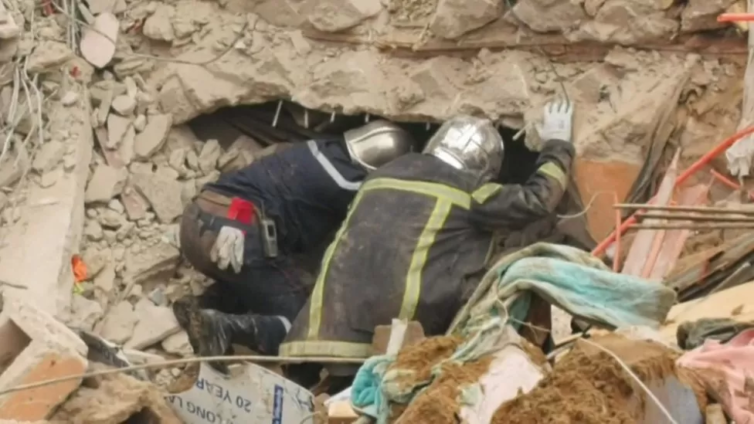
Thirty-three people are now known to have died in Cameroon's biggest city, Douala, after a four-storey building collapsed and fell onto another residential block.
It happened early on Sunday morning in the city's Ange Raphaël neighbourhood and the cause is still not clear.
At least 21 people have been injured, many of whom are receiving treatment at the nearby Laquintinie Hospital.
A three-year-old girl who was taken to hospital on Sunday later died.
Distressed neighbours have been searching the rubble for survivors along with emergency services.
The regional governor, Samuel Dieudonné Ivaha Diboua, has sought to reassure people - saying the situation is under control and rescue teams will make sure nobody is left beneath the wreckage.
A top official tells the BBC he is bitterly disappointed that lives have been lost despite strides made in recent years to improve safety.

"We'd been happy not to have had any such disasters for a while now - especially in Douala where the mayor is really trying to bring order," says Kizito Ngoa, the head of Cameroon's Order of Civil Engineers which regulates housing in the country.
Since Douala's last big building collapse in 2016, the city council has been knocking down homes deemed at risk from flooding or landslides, but the four-storey block that collapsed on Sunday was not earmarked for demolition.
Residents told journalists that it looked dilapidated but local officials have not confirmed what caused the accident.
In a statement on Sunday they reminded anyone wanting to build homes in Douala that they must first get an official permit and then "stick rigorously to the approved design".
Mr Ngoa tells the BBC that the failure to follow planning rules is one of the biggest causes of building collapses across the country, and says the true cost of a construction project should be made clear to the public.
"There is a widespread feeling that everyone can just do what they want" and "there is obviously this desire to save money at all stages of a project".
Sometimes council workers are complicit in this, he says, and when sanctions and inquiries do happen they are not publicised enough.
Latest Stories
-
Walter Mosley visits W.E.B. Du Bois Centre in Accra: A New York Secretary’s homecoming story on where Du Bois spent his final years.
58 minutes -
MTN set to deploy 5G services after winning spectrum licenses worth US$202m
3 hours -
NPP national elections: 3,000–4,000 police to handle security, traffic in Kumasi – Karbo
5 hours -
Atta Akyea fumes as Manhyia MP is to spend another night in EOCO custody
6 hours -
SSNIT says La Beach clearance was to protect hotel investments, beaches to remain public
7 hours -
APSU congratulates St Augustine’s College after back-to-back National Investment Quiz wins
7 hours -
Renewed flood intervention at Mallam Junction raises hopes among residents, businesses
7 hours -
St Augustine’s College retain National Investment Quiz title after nail-biting grand finale
8 hours -
Education infrastructure investment will drive Banda’s development – Ahmed Ibrahim
8 hours -
Teacher unions strike: Gov’t presents fresh proposals as talks end inconclusively
8 hours -
51,000 teachers’ promotion arrears to be validated for October payment – Education Minister
9 hours -
Kwabena Boamah appointed Board Chair for Impact Investing Ghana
9 hours -
Striking teacher unions to meet Fair Wages and Salaries Commission on October 6
9 hours -
EOCO working with AG to arraign Nana Baffour Awuah before weekend court
9 hours -
Duraplast reassures customers after fire, announces October 5 reopening
9 hours