

Audio By Carbonatix
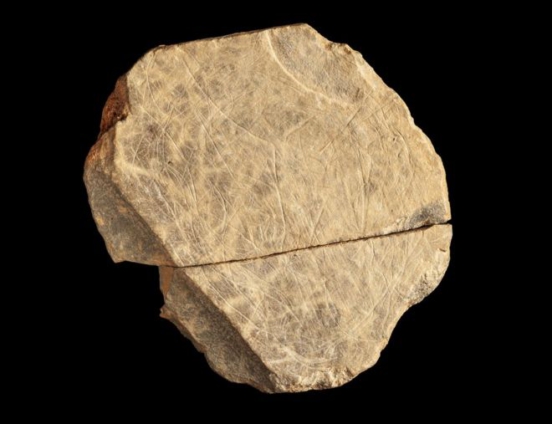
Fragments of stone engraved with abstract designs are the earliest known art in the British Isles, researchers say.
They were made by hunter-gatherers who lived between 23,000 and 14,000 years ago on what is now Jersey.
The designs were scratched into small ornamental tablets known as plaquettes; similar examples have been found in France, Spain and Portugal.
The 10 plaquettes were unearthed at Les Varines, Jersey, between 2014 and 2018.
Since the discoveries in the south-east of the island, scientists from London's Natural History Museum, the University of Newcastle and University of York have been analysing the prehistoric markings.
Went and stared at people working on this dig for a while as it was near my gaff. This is a class find! https://t.co/GCnVIhOn5e
— Ryan Burnouf (@ryanburnouf) August 20, 2020
The researchers, who have published their findings in the journal Plos One, now believe they represent the earliest evidence of artistic expression in the British Isles.
The plaquettes were made by the Magdalenians, a hunter-gatherer culture thought to have expanded out of Iberia (modern Spain and Portugal) and southern France after the peak of the last Ice Age.
The designs consist of straight lines more or less in parallel and longer, curved incisions. The two types of mark were probably produced by the same tools, in short succession - perhaps by the same engraver.
- Painted caves challenge art origins
- 'Oldest animal painting' discovered
- Neanderthals were capable of making art
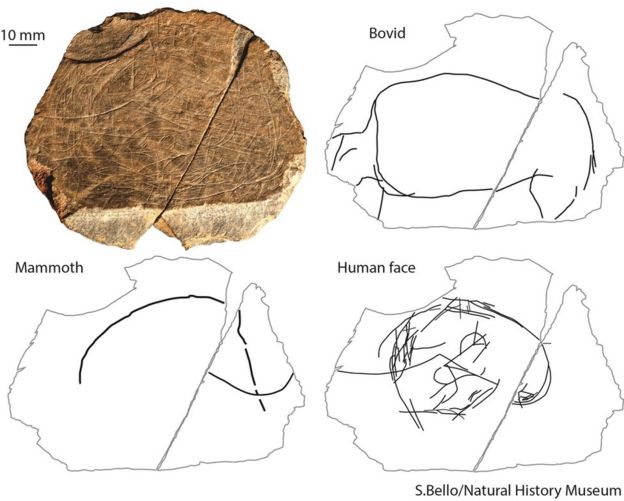
Co-author Dr Silvia Bello, from the Natural History Museum, said: "Many of the lines, including the curved, concentric designs, appear to have been made through layered or repeated incisions, suggesting that it is unlikely that they resulted from the stones being used for a functional purpose.
She told BBC News that most were "of abstract nature (simple intersecting lines), however, some fragments seem to depict zoomorphic representations (horses, mammoths, a bovid and possibly a human face)".
"On all the fragments, these potential representations appear imprecise and simplified in comparisons to other Magdalenian examples, supporting either the hypothesis these are chance arrangements amongst a system of representations, or that they were the product of inexperienced engravers," she explained.
The Magdalenian era saw a flourishing of early art, from cave paintings and drawings to the decoration of tools and weapons to engraving on stones and bones.
Although Magdalenian settlements are known to have existed as far north-west as Britain, no similar examples of artistic expression had previously been discovered in the British Isles from such an early time period.
Dr Chantal Conneller, a co-author from Newcastle University, said: "These engraved stone fragments provide exciting and rare evidence of artistic expression at what was the farthest edge of the Magdalenian world.
"The people at Les Varines are likely to have been pioneer colonisers of the region and creating engraved objects at new settlements may have been a way of creating symbolic relationships with new places."
Dr Bello said the artefacts may only have been of temporary significance, as they were made on soft stone. "The action of engraving probably created a powder within the incisions that makes them temporarily visible. This swiftly disperses, meaning that the engravings were only clearly visible at the moment of their making.
She added: "The act of engraving, possibly the context and the moment when the engraving occurred, were the meaningful components of the process rather than the object (the plaquette) that had been engraved."
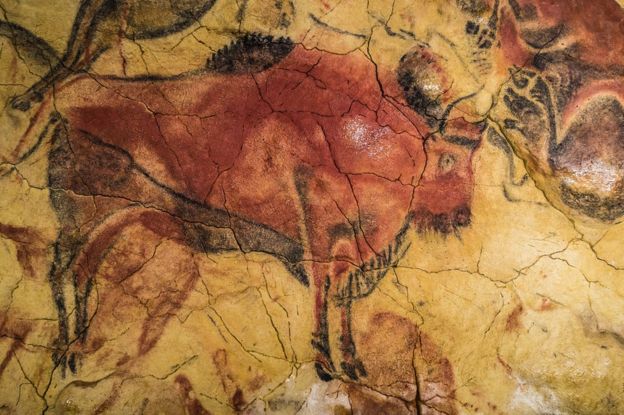
A more permanent form of artistic expression is found in the spectacular cave paintings created by Magdalenian people at Lascaux in southern France and Altamira in northern Spain.
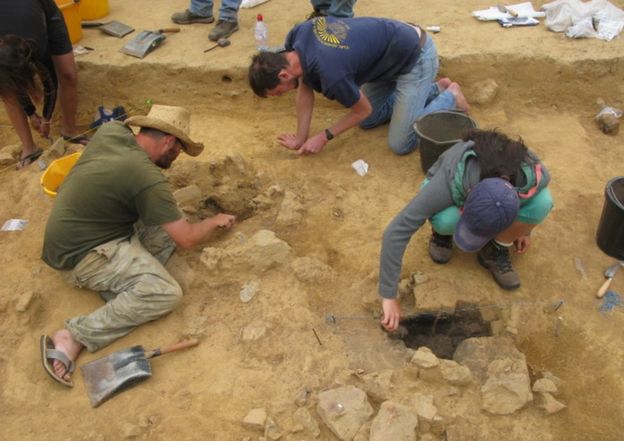
The excavation site at Les Varines on Jersey is located just north of St Helier, at the head of a dry valley that drops towards the sea.
Dr Ed Blinkhorn, a co-author from University College London (UCL), said: "The plaquettes were tricky to pick apart from the natural geology at the site - every stone needed turning. Their discovery amongst hearths, pits, paving, specialist tools, and thousands of flints shows that creating art was an important part of the Magdalenian pioneer toolkit, as much at camp as within caves."
Three of the stone fragments from Jersey had been recovered from an area of granite slabs which may have served as paving, highlighting that the plaquettes might have been engraved in a domestic context.
Dr Bello said it is possible that the Magdalenian people at Les Varines may have used a pigment called ochre to decorate some plaquettes. "One plaquette (LVE 4700), is not engraved, but presents a large stain (about 45x23mm) on its flat surface of a reddish colour.
"Microscopically, the stained surface area appears smooth, coated by some substance probably liquid in its original form which dried out. This area also has an elemental composition slightly richer in iron."
Though there is no unequivocal evidence, she said: "It is possible that drops from an ochre-rich liquid substance may have fallen on this stone during application on another plaquette."
Latest Stories
-
Ablakwa says Ghana could evacuate more citizens from South Africa if the situation worsens
8 seconds -
Violence against girls must be tackled through individual responsibility – Gender advocate
4 minutes -
Ghana’s BRICS bid must be guided by national interest – International Affairs Analyst
17 minutes -
Journalists look back on a decade of breast cancer reporting in Ghana
56 minutes -
President Mahama ends Resetting Ghana tour of Ahafo Region
3 hours -
African negotiators seek delivery of climate commitments at COP31
3 hours -
BoG develops AI rules for financial sector
3 hours -
‘Big Push’: Government assures contractors of prompt payments
3 hours -
Court fines miner for breaking into gold buying shop
3 hours -
Tarkwa court jails labourer for three years over GH¢123,000 theft
4 hours -
GAEC must retain nuclear scientists for Ghana’s nuclear ambitions – Minister
5 hours -
Man reportedly mistaken for game and shot by hunter dead in forest
5 hours -
19-year-old mason jailed 15 years for defiling seven-year-old pupil
5 hours -
Ghana’s banking sector assets rise 20.47% to GH¢500.2bn – BoG Governor
5 hours -
22 injured as Sprinter bus overturns at Sege after tyre burst
5 hours