

Audio By Carbonatix
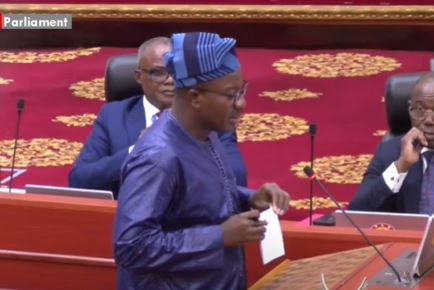
The Majority Leader, Mahama Ayariga, has defended the Public Utilities Regulatory Commission’s (PURC) recent decision to raise electricity tariffs by 2.45%, describing the move as a necessary measure to prevent the collapse of the Electricity Company of Ghana (ECG).
He asserted that the tariff increment forms part of a broader government strategy aimed at alleviating ECG’s mounting financial burden.
Addressing Parliament on Friday, 27 June, Mr Ayariga explained that while economic indicators such as inflation, the exchange rate, and fuel prices have remained relatively stable, the tariff adjustment is essential to enable ECG to generate sufficient revenue to sustain operations.
Without this intervention, he warned, the nation risks facing power outages due to ECG’s inability to meet its operational costs.
“Last year, there was an effort made to prevent the PURC from adjusting the tariff; due to that, there was no adjustment for the whole period. ECG is accumulating huge debt, and it has to be paid for, and if we do not adjust the tariff to enable ECG to pay, ECG will collapse,” he cautioned.
“They won’t be able to buy the input needed to keep the generators on, and we are going to have power outages.”
His defence came in response to concerns expressed by the minority caucus, who questioned the logic of a price increase amidst a relatively stable macroeconomic climate.
In response, Mr Ayariga maintained that economic progress alone does not erase ECG’s outstanding debts, which must ultimately be addressed, at least in part, through consumer contributions.
He assured the House that the Minister for Energy and Green Transition would appear before Parliament in the coming week to provide additional details on the review process. “The bill has to be paid,” he reiterated.
“So if PURC is doing its work, I do not think there is a basis for saying that because we have improved the economy, it doesn’t mean that the debt at ECG will just be whisked away. The bill has to be paid partly by consumers.”
The tariff increase, which comes into effect from 1 July 2025, has sparked mixed reactions from civil society groups, industry players, and consumer advocates.
Latest Stories
-
ITF World Tour : Patel Wins Boys’ Singles Final at J100 Accra
12 minutes -
Ghana must pursue BRICS partnership if it brings economic benefits – Kpebu
15 minutes -
Success and Wright Claims J100 Accra Girls’ Doubles Championship
15 minutes -
ITF J100: America’s Wright wins J100 Accra Girls’ Singles Title
22 minutes -
Expedition hopes to find aviator Amelia Earhart’s plane on remote island
23 minutes -
US seeks changes to rejected $109m health compact with Ghana – Mahama
53 minutes -
Nine dead in mass shooting at Pennsylvania home
1 hour -
‘Time for Ukraine to get new president,’ says Trump after Zelensky condemns diesel deal
1 hour -
Hincapie injury adds to Arsenal issues after Guimaraes rescue act
1 hour -
Henderson scores twice as Chelsea thumb Bournemouth
2 hours -
Photos: Mentapulse Africa convenes health and labour summit to address talent retention
2 hours -
Mahama inspects Nkokɔ Nketenkete plant, eyes Bechem as chicken capital
2 hours -
Ghana not seeking full BRICS membership, applying as Partner Country – Ablakwa
2 hours -
Woman injures three people in third Poland school knife attack in a week
2 hours -
Ghana should join BRICS as partner, not member – NPP Bono East Regional Secretary
2 hours