


Audio By Carbonatix
The proliferation of fake medicines in Africa is a public health crisis that can no longer be ignored, according to a UK charity.
There's a meeting of seven African countries, in Togo, this week, to combat the problem.
Congo, Niger, Senegal, Togo, Uganda, Ghana and The Gambia will discuss measures to clamp down on trafficking in fake medicines, says the Brazzaville Foundation.
But how big a problem is counterfeit medicine in Africa, and what impact does it have?
How many counterfeit drugs are there?
Globally, the trade-in counterfeit pharmaceuticals are worth up to $200bn (£150bn) annually, with Africa among the regions most affected, according to industry estimates.
The World Health Organization (WHO) says 42% of all fake medicines reported to them between 2013 and 2017 were from Africa.
The European region and the Americas (North and South) accounted for 21% each.
But how reliable are these figures?
The WHO has a reporting mechanism that relies on national or regional regulatory authorities around the world to notify it of seizures. So the data for 2013-17 is only as good as the surveillance and reporting systems in the countries or regions concerned.
Fake medicine seizures 2013-17
% reported
The WHO has itself noted that as more officers were trained and national regulators became more aware, the numbers of drug seizure reports went up. So it's possible areas with weak regulation and enforcement may be under-reporting the extent of the problem. Source: WHO data
Bright Simons, who set up a mobile system to verify drugs in Ghana, says it's not possible to produce a precise estimate, as the trade is underground.
But there've been several seizures in recent years, which give an indication of the size of the problem in West Africa:
- Ivory Coast, Guinea-Bissau, Liberia and Sierra Leone seized 19 tonnes of counterfeit medicines in 2018
- Smugglers in Ivory Coast were intercepted trying to bring in 12 tonnes of counterfeit pharmaceuticals from Ghana in 2019
- An Interpol-led operation in seven West African countries seized more than 420 tonnes of illicit pharmaceutical products in 2017
- Nearly 19.88 tonnes of fake medicines were seized in Mali between 2015-18
The accounting firm PwC says the proportion of fake pharmaceuticals in some countries can be as high as 70%, in developing regions such as Africa.
The WHO estimates one out of every 10 medical products in low- and middle-income countries, which includes most of Africa, is sub-standard or fake.
What harm do fake drugs do?
Analysis by the London School of Hygiene and Tropical Medicine for the WHO estimates substandard and fake anti-malarial drugs could be causing 116,000 extra deaths from the disease every year in sub-Saharan Africa at a cost to patients and health systems of on average $38.5m a year.
And in 2015, a study published in the American Society of Tropical Medicine and Hygiene estimated more than 122,000 children under the age of five died each year because of sub-standard anti-malarial drugs in sub-Saharan Africa.
Although these results are only estimates, the scientists say they suggest poor quality drugs are important contributors to under-five mortality rates.
Why is it hard to fight fake medicines?
Fake medicine can often be indistinguishable from the real products, with the packaging as good if not better than the original.
And weak or inconsistent legal frameworks and the lack of regulations to address sales, often carried out online or in informal locations, add to the problem, the UN says.
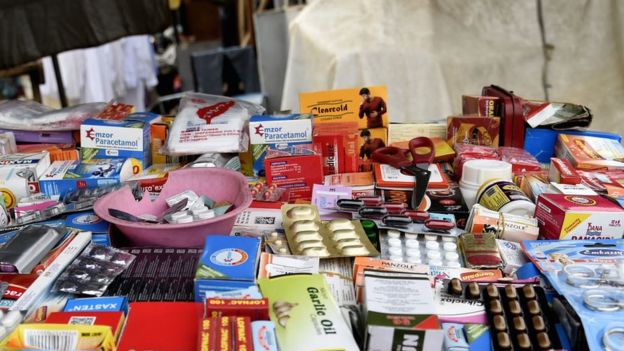 Drugs for sale at a roadside market in Lagos, Nigeria
There's also an issue with the cost of drugs in poorer countries.
"If a good quality medicine from a known supplier is too expensive, people may try a cheaper one from an unlicensed supplier," the WHO says.
- Can technology help tackle fake drugs?
Cutting prices for licensed drugs, however, does not guarantee a solution.
Even low priced medicines can make money for criminals, as long as the sales volume is high enough.
But there are some technological solutions being tried out to tackle the problem, including mobile apps to help users verify medicines, using scratch stickers, barcodes and other means of identification printed on the packaging.
Latest Stories
-
T-bills auction: Government exceeds target marginally; yield on 91-day bill remains unchanged
35 minutes -
GPL 2026/27: 10-man Aduana hand Kotoko defeat in Kumasi
46 minutes -
GPL 2026/27: Medeama ease past Basake Holy Stars
1 hour -
Appiah Adomako writes: Why DVLA must stop treating every expired licence holder as delinquent
1 hour -
Localization must transfer decision-making power, not just project responsibilities
2 hours -
Modernising Ghana’s traditional markets through the 24-Hour Economy markets initiative
2 hours -
New economy will boost local production and create jobs – Finance Minister
2 hours -
Real-Time VAT on cross-border digital services – not a new tax and does not violate double taxation principle
3 hours -
Digitalisation, AI key to Ghana’s tourism transformation – GHATOF
3 hours -
Stronger GTA-private sector partnership needed to grow tourism – GHATOF
3 hours -
Amazon eyes Ghana for broadband expansion after talks with Mahama
4 hours -
National Investment Quiz 2026: Six schools qualify for quarter-finals
4 hours -
‘Do not let Russia pay for its madness with lives of your people’ – Zelensky to Ghana, 46 other countries
4 hours -
6,079 promotion cases fully processed and paid – CAGD says amid nationwide teachers’ strike
5 hours -
Teacher unions to meet government Monday over nationwide strike
5 hours