

Audio By Carbonatix
In a collaborative effort to bolster food security and enhance the resilience of agrifood systems in Ghana, the Food and Agriculture Organization of the United Nations (FAO) and chef Fatmata Binta, with the support of the Government of Ghana’s Ministry of Food and Agriculture, have trained women fonio farmers on good agricultural practices to address the challenges of low yields and the labour-intensive nature of traditional fonio production methods.
Fonio is a nutrient-packed type of millet from West Africa known for its ability to thrive in harsh climates. In northern Ghana, it is predominantly grown by women. It is also one of the foods featured in an FAO publication on 100 ‘forgotten foods’ in Africa – meaning it is underutilised.
Chef Binta has recognised the potential of fonio both as an ingredient and a livelihood opportunity for women producers and is collaborating with FAO to promote fonio.
"Fonio is an ancient grain with an exciting future. It cooks quickly like porridge, can be turned into flour for bread, and is highly nutritious. It is also able to withstand the pressures of the climate crisis by thriving in tough climates. By improving its production we can unlock great dividends for nutrition, women’s livelihoods, and the environment while also preserving a vital part of culinary heritage,” she said.
The three-day intensive training, in Chereponi in Northern Ghana, was designed to equip the participants with essential knowledge and skills to boost fonio production.
Comfort Cobinaka, affectionately known in her community as “Mama Fonio,” has been a dedicated fonio farmer for over two decades, practising the farming methods she learned from her grandparents. "This training has been incredibly insightful. I now understand that sowing fonio seeds in rows is more effective than the broadcasting method I previously used," she said.
The program featured comprehensive hands-on sessions that covered every aspect of fonio production. Topics included site selection, land preparation, seed selection, germination tests, planting methods, fertilizer application, weed control, cropping systems, bird damage control, harvesting, threshing, winnowing, grain drying, hulling and whitening, packaging, and market access.
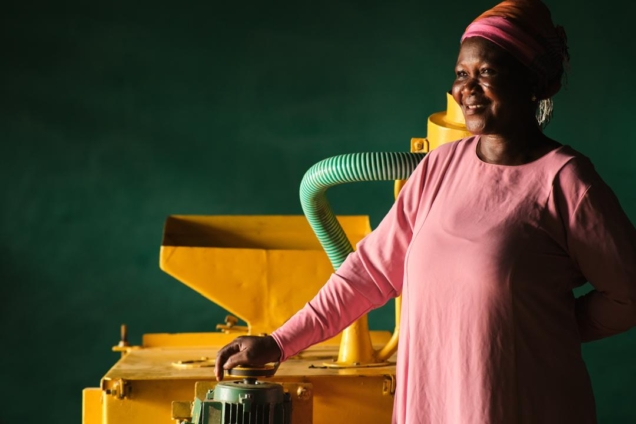
The fonio grain is small and encased in a tough husk that requires time-consuming pounding by hand to remove. This produces a fine powder that can be inhaled, potentially causing health issues. To overcome these hurdles, Chef Binta procured through her foundation four modern processing machines especially adapted for fonio, two for the Chereponi area where the training took place, and the training participants learned how to use them. The new machines not only reduces the labour burden, but allow the women to process their fonio to a high standard for sale on the market.
“By providing practical, field-based learning, the initiative aims to significantly enhance the capacity of women farmers to sustainably produce and process fonio,” said acting FAO Representative in Ghana Priya Gujadhur. "This training is a testament to the power of knowledge and skills transfer and the use of technological innovation to transform agricultural practices for better production,” she said.
Janet Agyeiwaa Mensah, an agronomist with the Ministry of Food and Agriculture’s Directorate of Crop Services who facilitated at the training, underscored the long-term benefits for the farmers. "This program will greatly enhance sustainable production and postharvest handling practices among the women fonio farmers. The introduction of the fonio processing machine will alleviate the labour-intensive nature of traditional processing methods, thereby improving the quality of life for these women," she said.
The training was funded by FAO through a Technical Cooperation Project modality. Better production is one of the four ‘betters’ in the FAO Strategic Framework 2022-2031, along with better nutrition, a better environment and a better life. The four betters aim to support countries to drive progress towards the Sustainable Development Goals.
Chef Binta won the 2022 Basque Culinary World Prize because of her work to promote Fulani cuisine, including fonio, through her Dine on a Mat concept. She is based in Ghana and is working through her foundation to support women fonio producers. She has been collaborating with FAO since the 2023 Year of Millets.
Latest Stories
-
I have no issue with John Boadu; we’ll work together – Justin Kodua
1 hour -
Adom FM Y2K Jam delivers a night of music, fashion and nostalgia
2 hours -
Lawrence Kobena Nsarko Otoo, Esq
3 hours -
Bel-Aqua intensifies mental well-being campaign ahead of 15th anniversary
3 hours -
From banking to party finances: Alfred Kwadwo Thompson elected NPP Treasurer
3 hours -
George Christian Papa Mends
3 hours -
Ali Suraj elected NPP NASARA Coordinator
3 hours -
Mustapha Hamid misses out on NPP Vice Chairmanship by 31 votes despite early poll lead
3 hours -
Kojo Bamba, Henry Nana Boakye and Nana Akomea elected NPP Vice Chairmen
4 hours -
From Delta Force to NPP First Vice Chairman – Kojo Bamba’s political journey
4 hours -
Police restore calm at Larteh following Odwira festival disturbance
5 hours -
‘All the camps will dissolve’ – Bawumia demands one NPP for 2028
5 hours -
There is no time to waste – Bawumia orders NPP to begin 2028 work
5 hours -
Sarkodie visits MobileMoney Fintech LTD
5 hours -
John Boadu unveils new NPP strategy to win back youth and modernise party
5 hours