

Audio By Carbonatix
With the growing use of artificial intelligence (AI), farmers, researchers, and industry leaders have underscored the critical role of the emerging technology in transforming Ghana’s livestock and poultry sectors.
They are calling for stronger investment in technology, data, and infrastructure to enhance production and competitiveness.
Poultry and cattle farmers in the country stressed that AI should not be seen as a threat to human labor but as a tool to complement and accelerate farm operations.
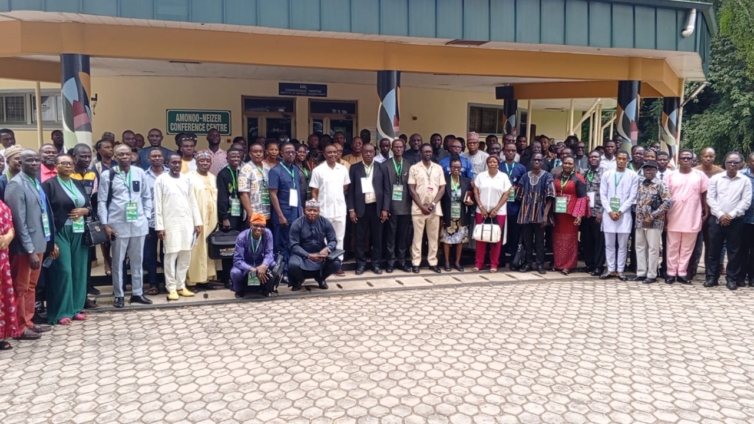
The third joint workshop of the Ghana Society of Animal Production (GSAP) and Ghana Animal Science Association (GASA) assembled stakeholders in the animal production sector of the country’s agricultural space.

The event highlighted “the role of animal agriculture in national development in an era of artificial intelligence” and exposed participants to the emerging use of artificial intelligence in bridging shortfalls in the animal production sector.
Vice Dean of the Faculty of Agriculture at KNUST, Prof Nana Ewusi Mensah, noted that while AI is widely applied in education, finance, and other industries, its potential in agriculture is often overlooked.
“I don’t define AI as artificial intelligence. I define AI as Africa’s innovation or inspiration. AI has come to stay, and it will help us overcome most of the challenges facing farmers,” he said.
Prof. Mensah explained that the technology could be adopted in various tasks required in animal production to optimize production and efficiency, alleviating the burden on farmers.
“From automated feeding systems and robotic milking to data collection on farm performance, he said the technology can optimize production and efficiency,” he noted.
Vice President of Ghana National Association of Poultry Farmers (GNAP), Borris Baidoo, highlighted the promise of AI in poultry production, particularly in feed management, broiler feeding, and logistics.
He stressed the need for preparation before adopting new technology, as he explained that poultry production must be properly structured to harness the benefits of AI.
“We need to organize our systems in a way that AI can fit into whatever we are doing. It has great potential in feed production, broiler feeding, and even packing. But these benefits can only be realized if we first address the internet challenges facing farmers in rural areas,” he said.
President of the cattle farmers association, Imam Hanah Sonde, echoed similar concerns, emphasizing the urgent need for accurate data collection in the livestock sector.
He criticized official statistics that underestimate cattle numbers, making it difficult for farmers to access support and investment.
“Investors and policymakers need credible data. Without it, decisions are flawed, and farmers lose out,” he said.
He also highlighted the concerns over food safety and veterinary practices, pointing out that weak monitoring of antibiotic use and slaughterhouse standards poses health risks to consumers.
“We need to know where our meat is coming from, how animals are fed, and whether veterinary protocols are followed. This is about public health as much as it is about productivity,” he noted.
While these key players highlighted the advantages of AI in transforming the sector, poor internet connectivity, lack of localized data, and inadequate infrastructure remain major barriers.
Participants urged the government to continue expanding STEM and digital programs, strengthen internet infrastructure in farming communities, and integrate AI tools into agricultural policy.
They also appealed for closer collaboration between farmers, academia, and policymakers to align strategies and build sustainable technology-driven food systems.
“The world is not going to wait for Ghana,” Mr. Mensah highlighted.
“We must organize our production systems so that AI fits into whatever we are doing, not the other way around”.
Latest Stories
-
‘Our missing players are more important’ – Gambia coach fires shot at Ghana
31 minutes -
Today’s front pages: Tuesday, September 29, 2026
34 minutes -
Ghana ‘showing up differently’ on global stage – Joyce Bawah Mogtari
1 hour -
Ghana’s tuna industry in crisis as 20 hook-and-line vessels collapse
2 hours -
South Tongu MP launches apprenticeship programme for 159 young people
2 hours -
The Pusiga connection behind Gertrude Atongi’s work in New York
2 hours -
Teachers took promotion exams in December to beat government clearance deadline – GNAT
2 hours -
NPA launches 2026 staff welfare week with focus on teamwork and employee wellbeing
2 hours -
Ghana, Saint Kitts and Nevis sign labour deal to strengthen protections for Ghanaian nurses
3 hours -
Delayed promotions put teachers’ retirement benefits at risk – GNAT
3 hours -
No ‘Bawumia candidates’ in NPP executive elections – Anthony Karbo
3 hours -
Over 3,000 displaced as flooding overwhelms Hohoe communities
3 hours -
Sunyani East NPP executives begin reconciliation drive ahead of 2028 polls
3 hours -
Agric Minister engages Ga Mantse on agriculture transformation agenda
3 hours -
Aayalolo expansion targets private car users, not trotro operators – Mahama Ayariga
3 hours