

Audio By Carbonatix
French President Emmanuel Macron has signed into law his government's highly unpopular pension reforms, which raise the state pension age from 62 to 64.
It happened hours after France's top constitutional body cleared the change.
The Constitutional Council rejected opposition calls for a referendum - but it also struck out some aspects of the reforms, citing legal flaws.
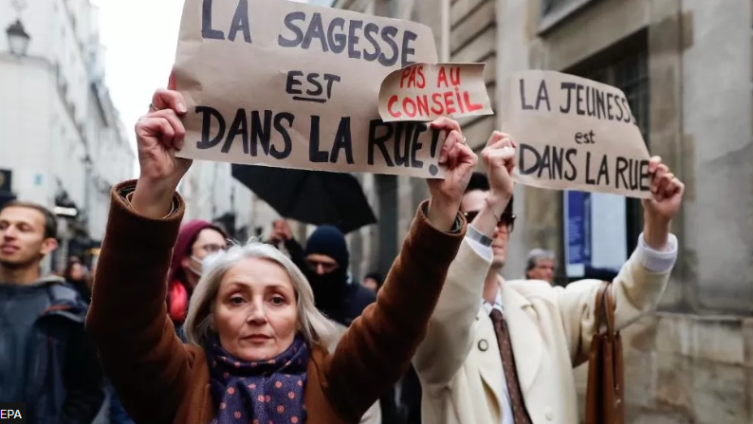
Following the council's ruling, protesters set fires across Paris and 112 people were arrested.
Twelve days of demonstrations have been held against the reforms since January.
Unions have vowed to continue opposing the reforms, and called on workers across France to return to the streets on 1 May.
President Macron argues the reforms are essential to prevent the pension system collapsing. In March, the government used a special constitutional power to force through the changes without a vote.
He signed the reforms into law in the early hours of Saturday morning.
The Labour Minister Olivier Dussopt has said he expects the reforms to come into effect by the start of September.
After the Friday ruling of the Constitutional Court, trade unions made an unsuccessful last-ditch appeal to the president not to sign the pension-age increase into law.
The unions pointed out that six concessions that had been added to the reforms were rejected by the court, so what was already unfair was now "even more unbalanced".
Among the reforms struck down by the nine members of the Constitutional Council was a so-called "senior index" aimed at urging companies with more than 1,000 workers to take on employees over 55.
Mr Dussopt has vowed to improve the employment rates of those aged over 50 in an effort to ease concerns about the financial impacts of the raised retirement age.
The authorities had banned demonstrations in front of the Constitutional Council building in Paris until Saturday morning, but crowds of protesters had gathered nearby on Friday and the ruling was met with jeers.
Some demonstrators chanted they would continue protesting until the changes were withdrawn.
Later, several fires were set across the city as riot police tried to contain the situation, sometimes using tear gas. A Paris police official said 112 people have been arrested.
Fires were also lit during demonstrations in Rennes and Nantes, while there were tense standoffs at times between protesters and police in Lyon.
Lucy, 21, was among the protesters who gathered outside the City Hall and told the BBC that she was disappointed "we don't have the power any more".
"Nobody is listening to us no matter how hard we are shouting," she added, vowing to keep on speaking out.
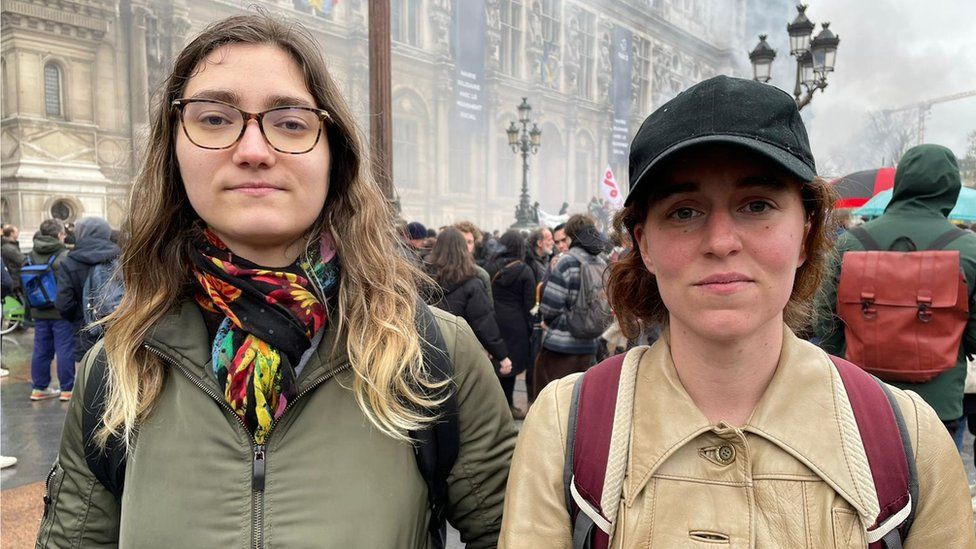
Raphaëlle, also 21, said she had hoped there would be something in the council's ruling that would reflect the huge consensus there has been on the streets against the reforms.
Barriers were erected in the streets near the court and riot police were deployed in case of further, potentially violent protests.
Lucas, 27, said he was worried about the future and what Mr Macron intended for the rest of his presidency.
The left-wing Nupes political alliance was one of the groups that lodged an appeal with the court over the reforms and its leader, Jean-Luc Mélenchon, said the "fight" would continue.
"The Constitutional Council's decision shows that it is more attentive to the needs of the presidential monarchy than to those of the sovereign people," he said.
Marine Le Pen of the far-right National Rally, which had also appealed to the court, responded on social media that "the political fate of the pension reform is not sealed".
Prime Minister Élisabeth Borne tweeted on Friday that "tonight there is no winner, no loser".
While the court rejected an initial bid for a referendum on the reforms, it will decide next month on a further proposal for a national vote by the left.
French political analyst Antoine Bristielle told the BBC he did not think there would soon be an end to the protests that have taken place across France for the past three months.
"A lot of people were saying that the reforms would pass and that the Constitutional Court would not avoid it so it's not a surprise," he said.
"But I think we will see in the upcoming hours and at the weekend a lot of riots and strikes in the country because there are still 70% of the French population against the reform."
Latest Stories
-
Tyson Fury dominates Makhmudov, calls out Joshua next
3 minutes -
I have supported highway authority financially to fix roads in my constituency – A Plus
1 hour -
US, Iran fail to reach peace agreement after marathon talks in Pakistan
2 hours -
ECG kicks off Phase Two of transformer upgrades at Lashibi; brief outages expected
2 hours -
Port crises loom as 11,000 drivers threaten four-day strike
3 hours -
A source of excellence across generations – Vice President Opoku-Agyemang lauds Mfantsipim
4 hours -
(Photos) Mfantsipim School launches historic 150th anniversary
4 hours -
Knights and Ladies of Marshall group backs Catholic Bishops’ stance on anti-LGBTQ+
5 hours -
Bright Simons writes: All the Filla in the Ibrahim Mahama/E&P – Gold Fields Saga
6 hours -
Monetise Idiocy In Ghana
6 hours -
The Ghanaian prophet and the mysterious death of his scottish wife Charmain Speirs
6 hours -
Nearly 400 sentenced in Nigeria for links to militant Islamists
7 hours -
Ghana’s recovery supported by gold strength despite global oil price pressures – Standard Bank Research
7 hours -
Methodist Church hails Mfantsipim@150; calls for “fresh consecration” to excellence
7 hours -
‘Excellence is our inheritance’ – Nana Sam Brew-Butler hails Mfantsipim’s 150-year reign in leadership
7 hours