

Audio By Carbonatix
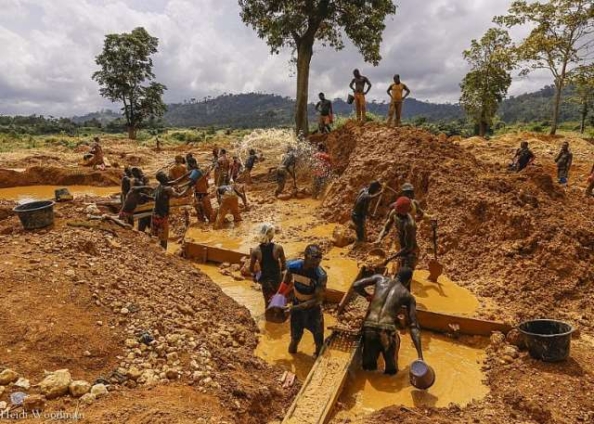
The Media Ministry Director of the Church of Pentecost, Pastor Dr Felix Klutse, has issued a strong warning over the growing impact of illegal mining, describing it as a serious threat not only to the environment but to Ghana’s long-term survival.
His remarks follow fresh concerns raised by the Chairman of the Church, Apostle Eric Nyamekye, who highlighted the worsening pollution of rivers and streams due to galamsey activities.
Delivering the State of the Church Address at the 48th General Conference on Wednesday, April 22, Apostle Nyamekye noted that the contamination of water bodies is already affecting key religious practices.
“The extensive pollution of water bodies due to illegal mining has hampered traditional water baptism in some mining communities, necessitating a shift to synthetic rubber pools in several districts to carry out the ordinance,” he stated.
Pastor Dr Klutse emphasised that the consequences of illegal mining extend far beyond environmental degradation, warning that the destruction of water resources poses a direct threat to the nation’s future.
“Galamsey is not just an evil canker but it is also an economic sabotage against the future generation. Because a nation that destroys its water bodies is digging its own grave. We believe strongly that water is Ghana’s real gold and once lost no policy can mine it back,” he said.
He further explained that the pollution of rivers has forced the Church to rethink how it administers water baptism, a central practice that traditionally involves full immersion in natural water bodies.
“Water baptism is one of the ordinances of the Church of Pentecost and other Pentecostal and charismatic churches, not just in Ghana but other parts of the world, and we believe strongly that when you win a soul, the soul has to be baptised by immersion.
“That doesn’t mean that what others do we are condemning it but we believe strongly in immersion, and it is worthy to note that when baptising these souls, that we’ve won their health is very paramount, so they don’t end up contracting any disease.
“So if you want to baptise these souls and then the river bodies are polluted, there is no way you could go ahead and baptise them. That is why we had to resort to other alternatives,” he said in an interview on Citi FM on Wednesday, April 22.
Latest Stories
-
Police blur the line between invitations and arrests – Reindorf Twumasi Ankrah
20 minutes -
Turning invitations into arrests is making citizens reluctant to assist police – Twumasi Ankrah
53 minutes -
The Traffitech-GH SMS spot-fine system: The good, the sad, and the funny – Bright Simons writes
1 hour -
Hawa Koomson pledges experienced and mature leadership of NPP women’s wing
2 hours -
Young woman found dead at Kasoa Peace Town
3 hours -
Playback: The Law examined lawful arrest in Ghana
3 hours -
Mahama urges African governments to treat healthcare as an investment, not budget cost
4 hours -
Bawumia congratulates John Boadu and new NPP executives, pledges support ahead of 2028
4 hours -
Aksa Energy delegation pays courtesy call on GRA Commissioner-General
4 hours -
‘No talent should be left out’ – Bawumia pledges inclusive NPP campaign for 2028
4 hours -
Prof. Mike Oquaye recounts how he blocked the Special Prosecutor’s attempt to arrest Bawku Central MP
4 hours -
Make health sovereignty a priority for Africa – Mahama
4 hours -
Dorimon Naa, Wa West DCE lead massive clean-up exercise; threaten sanctions against recalcitrant residents
5 hours -
Photos from Adom FM Y2K Jam
5 hours -
Praye Tiatia steals the show at Adom FM Y2K Jam [Watch]
5 hours