

Audio By Carbonatix
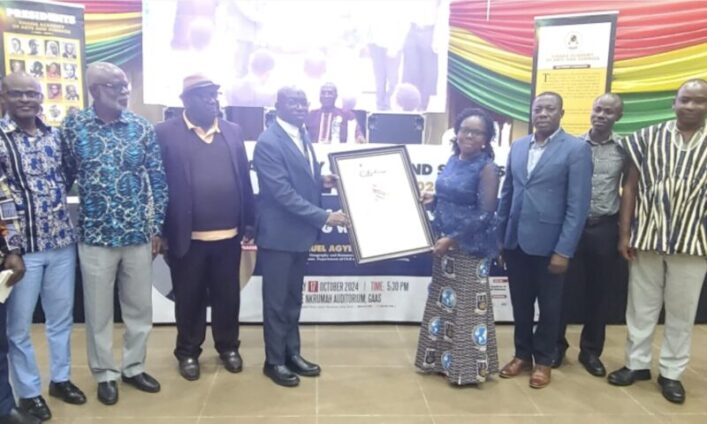
Professor Samuel Agyei-Mensah, Department of Geography and Resource Development, University of Ghana, says the country cannot meet the Sustainable Development Goal (SDG) 6.1 target.
The SDG focused on achieving universal and equitable access to safe and affordable drinking water for all by 2030.
Prof Agyei-Mensah said the country had performed poorly on the proportion of the population using safely managed drinking water service, ranking from 26 to 50 per cent.
He said the activities of illegal mining had compromised and contaminated the country’s water bodies, which calls for urgent action.
The Professor said this in Accra during a lecture on the topic “Flavours of Spatial Diversity in Drinking Water Access in Ghana.”
It is organised by the Ghana Academy of Arts and Sciences.
He said even though sachet water was the major source of drinking water in the cities, it was difficult to vouch for its safety.
Prof Agyei-Mensah said countries like Russia and the UK, among others, ranked from 70 to 99 per cent of safely managed drinking water service.
In Africa, Algeria leads with 51 to 75 per cent of safely managed drinking water service.
Figures from the Ghana Statistical Service revealed that in 2010, the main source of drinking water in Cape Coast was pipe born water, but in 2021, it is now sachet water.
In the Western Region, the source of drinking was a river in 2010, but transitioned to sachet water in 2021.
Illegal mining, he said, was profound, with footprints on the river Akobre around Bogoso and other mining communities, saying ” ‘galamsey’ activities are real.”
He mentioned population growth and urban expansion, climate change, and corroded water pipes laid during colonial times contributed to poor water quality.
He said illegal mining was a major threat to the quest of providing potable drinking water in the country, calling for strict enforcement of laws banning illegal mining in water bodies.
Prof Agyei-Mensah called for the revocation of LI 2462, which allowed in the nation’s forest reserves.
“There should be uniformity in terms of buffer zones for mining in waterbodies and forests. The current buffer zones by different organisations must be reviewed,” he said.
He said as the country’s population grew and its climate changed, water scarcity and inequality were likely to worsen at both national and local levels.
He called for a national summit to craft a medium to long-term plan on drinking water access in the country due to the multiplicity of issues in the water sector.
The goal, he stressed, was to provide every area in the country with affordable and safe drinking water.
Latest Stories
-
National Horticultural Seed Roadmap launched to strengthen Ghana’s vegetable seed sector
5 minutes -
NPP accuses Mahama government of allowing Ghana to become drug transit hub
7 minutes -
Wontumi Exim Bank case adjourned over amended charge
8 minutes -
‘Families are going hungry’ – Horse owners, jockeys raise alarm over Race Course demolition
11 minutes -
NPP demands dismisssal of officials over cocaine busts, accuses Mahama of weak leadership
25 minutes -
Fully mobilise back to Dome-Kitase road this week – Roads Minister directs First Sky Construction
28 minutes -
2027 AFCONQ: Baba Rahman latest to pull out of Black Stars squad
38 minutes -
CPP renews call for return of properties seized after Nkrumah’s overthrow
41 minutes -
Education Minister challenges universities to align programmes with job market needs
47 minutes -
Adequate provisions made for feeding in Senior High Schools —Education Minister
49 minutes -
Demonstrations don’t start road projects; resources do – Roads Minister tells Dome-Kitase residents
49 minutes -
Who is Ghana Jollof? The woman behind the viral TikTok account
56 minutes -
Sekou Nkrumah calls for democratic socialism and clear ideology to revive CPP
1 hour -
World Vision Ghana, Somoco Ghana partner to improve healthcare access in Agortime
1 hour -
Adopt scientific formula for setting transport fares – COPEC urges operators
1 hour