

Audio By Carbonatix
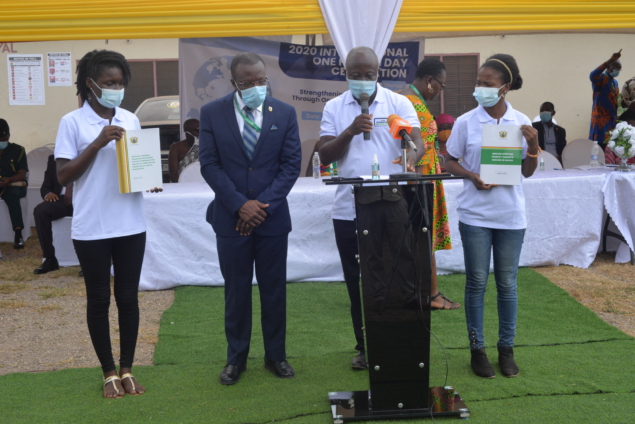
The Ghana Health Service, in partnership with the US Aid Agency, USAID, has launched two risk communication documents to improve communication and social mobilization during public health emergencies.
The first document is the National Standard Operating Procedures for Risk Communication and Social Mobilization During Public Health Emergencies.
It provides systematic guidelines on the processes to be followed for coordination and timely risk communication and social mobilization responses during the preparedness, active response and post response phases of all public health emergencies.
The second is the Message Guide for Priority Zoonotic Diseases in Ghana. This is a tool used as reference guide for designing and sharing accurate and standardized messages about the prioritized zoonotic diseases in Ghana requiring greater attention from all stakeholders.
Pro Vice-Chancellor at the KNUST, Prof Ellis Owusu-Dabo, says “the tools will propel Ghana towards achieving a number of core capacities needed to effectively detect, prevent, detect and respond to infectious disease threats as measures during the joint External Evaluation conducted by the WHO for Ghana in 2017.”
He has assured of KNUST’s preparedness to ensure effective utilization of the tools.
“KNUST will continue to engage with One Health partners to strengthen research on One Health and orient members of the University community to enhance understanding and application of these tools,” he said.
Prof. Owusu-Dabo was speaking at the 2020 International One Health day at Boadi in the Ashanti region.
The goal of this year’s One Health Day is to build the cultural will necessary for a change in how one health challenges are assessed and addressed.
The One Health Technical Working Group with support from the development partners including FAO, WHO and USAID are at the final stage of formulating the National One Health Policy.
This will formalize collaboration and coordination among the human, animal and environment sectors.
Regional Manager for the Emergency Centre for Transboundary Animal Disease West and Central Africa of the FAO, Baba Soumare pledged their commitment to continuous collaboration with KNUST.
His speech was read by Dr. Garba Ahmed, FAO country team leader.
“The school of veterinary medicine participated in the FAO training for veterinary meat inspectors and butchers on meat inspection to ensure meat safety to the public. FAO will continue to explore other areas for collaboration with KNUST,” he said.
Latest Stories
-
Banks NPL ratio of 16.1% is still too high – S&P
19 minutes -
Guidelines, regulations of cryptocurrency in Ghana fall short of comprehensive oversight – IMF
53 minutes -
COCOBOD’S GH¢16.3bn SPV: Real progress toward a sustainable cocoa sector
1 hour -
Ghana lose Morocco friendly as Atlas Lions turn to Mali
3 hours -
2026/2027 GPL: Kelvin Nkrumah strike sends Medeama top of league table
3 hours -
Punish Manchester City this season, say other club chiefs
3 hours -
Emmanuel City crowned champions of maiden Global Game Scouting Tournament
3 hours -
MPship should not shield anyone from arrest – Felix Ofosu-Kwakye
4 hours -
Thomas Partey loses father Jacob Teye Partey
4 hours -
Gov’t rejects Baffour Awuah ‘kidnap’ claims, says EOCO officer was lawfully executing arrest
4 hours -
Martin Kpebu explains when EOCO can arrest Manhyia South MP after securing court warrant
4 hours -
EOCO’s reasons for seeking Manhyia South MP arrest warrant not justified – Kpebu
4 hours -
MTN Ghana warns SMEs against sharing PINs amid digital fraud risks
4 hours -
Yendi nursing students warn restricted access to skills lab could affect their training
4 hours -
Minority awaits formal notice of arrest warrant for Manhyia South MP – Annoh-Dompreh
4 hours