

Audio By Carbonatix
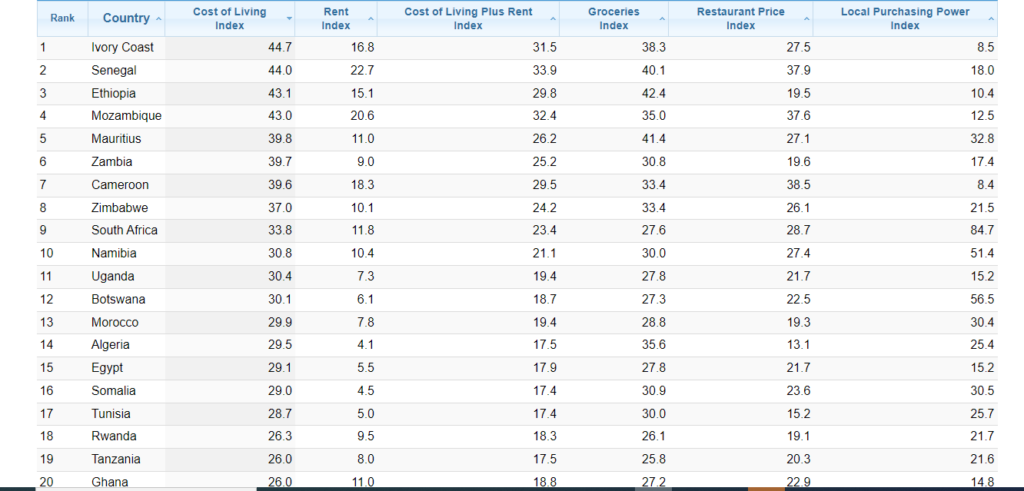
Ghana has been ranked 20th in Africa out of 24 countries with the lowest cost of living, a new data from Numbeo has revealed.
It is however ranked 3rd in West Africa with the highest cost of living.
The nation's overall Cost of Living Index was 26.0.
The ranking took into consideration Rent Index, Groceries Index, Restaurant Purchase Index and Local Purchasing Power Index.
For Rent Index, the nation scored 11.0.
In terms of Cost of Living Plus Rent Index, Ghana scored 18.8, whilst it obtained a score of 27.2 for Groceries Index.
With regard to Restaurant Purchase Index, it scored 22.9. However, it got a score of 14.8 for Local Purchasing Power Index.
Cote d'lvoire (44.7) was 1st in both Africa and West Africa with the highest cost of living. It was followed by Senegal with a score of 44.0.
Ethiopia placed 3rd with a score of 43.1, whilst Mozambique and Mauritius were 4th and 5th with scores of 43.0 and 39.8 respectively.
Ghana’s position, according to Numbeo, was largely due to a reduced inflation in 2023 and a slow down in the depreciation of the cedi.
The data revealed that cost of living in Ivory Coast is on average 72.3% higher than in Ghana. Similarly, rent in Ivory Coast is on average 53.6% higher than in Ghana.
However, cost of living in Nigeria is on average 53.5% lower than in Ghana. Similarly, rent in Nigeria is, on average, 8.5% lower than in Ghana.
Inflation ended 2023 at 23.2%
Ghana's end-of year inflation stood at 23.2% (December 2023).
Whilst food inflation rate stood at 28.7% in December 2023, non-food inflation recorded a rate of 18.7%. The Consumer Price Index data also revealed that inflation for locally produced items was slightly higher at 23.8%, while inflation for imported items remained at 21.9%.
The Ghana cedi also ended 2023 with a year-to-date depreciation of 15.57% to the US dollar in the retail market.
Currently, Ghana is under an International Monetary Fund programme with the need to improve its revenue outlook. This has led to the introduction of new taxes thereby burdening businesses subsequently.
This has the tendency to derail businesses and investor confidence in the medium to long-term.
Latest Stories
-
GTA sensitises taxi drivers in ‘Know Ghana’ tourism campaign
1 hour -
Archbishop Agyinasare calls for responsible speech amid growing social media abuse
1 hour -
‘It will be inexcusable for gov’t not to honour payment of teachers’ arrears by 30th October’ – Haruna Iddrisu
1 hour -
Forbes’ World’s Best Employers 2026: No Ghanaian firm ranked among 900 companies
1 hour -
Electronic processing of teachers’ data: ‘The decision is the Controller’s’ – GES boss
1 hour -
Teachers’ Strike: Haruna Iddrisu questions paper-based processing of promoted teachers’ data
2 hours -
Savannah Region: Kunfusi bridge collapses again, leaving nearly 4,000 residents cut off
2 hours -
Teachers’ strike: GES targets Monday deadline to submit promotion data to Controller
2 hours -
Inflation to average 11.3% in 2027 – Fitch Solutions
2 hours -
‘I didn’t campaign for NDC to come and do this nonsense’ – Kpebu on EOCO’s conduct
2 hours -
Fitch Solutions maintains policy rate forecast of 14% by December 2026
2 hours -
Diaspora Nasara Caucus congratulates Mohammed Ali Suraj, new NPP executives
4 hours -
Dr Antwi-Boasiako’s cybersecurity book showcased at UN crime prevention congress
4 hours -
We will empower the grassroots and protect every vote – NPP’s 1st Vice Chair Kojo Bamba
4 hours -
I do not see myself as better than anyone – NPP’s 1st Vice Chair Kojo Bamba
5 hours