

Audio By Carbonatix
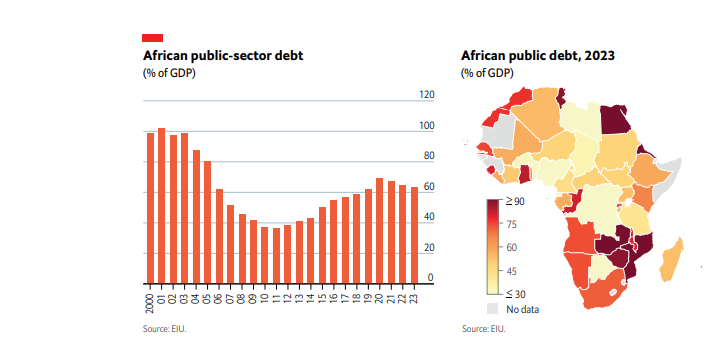
The Economist Intelligence Unit (EIU) says Ghana and six African countries have enormous amounts of debt relative to Gross Domestic Product (GDP) and their governments will grapple with debt-servicing burdens that would eat up a substantial share of their revenue in 2023.
Tunisia, Egypt, Congo-Brazzaville, Zambia, Zimbabwe and Mozambique are the other African countries.
In its Africa Outlook 2023 Report, the EIU said the public-sector debt/GDP ratio will remain above 60% for Africa in 2022 and 2023 and some African countries will far exceed this level.
“The need to service and roll over large amounts of debt at a time when domestic and international borrowing costs are on the rise will weigh heavily on some countries in 2023 and things could get even more painful in 2024 when more capital repayments fall due”, it mentioned.
“African governments have ramped up their borrowing—domestically and internationally — and public sector debt ratios (relative to GDP) have pushed back towards the highs, last seen in the early 2000s just before the enormous debt restructuring of 2005, implemented under the umbrella of the heavily indebted poor countries (HIPC) initiative”, it explained.
More African nations to head towards external debt distress
The EIU also said more African states will head towards external debt distress in 2023 and 2024.
“African states are required to repay about US$75bn of external borrowing (medium- and long-term capital repayments that fall due) in 2023 and a similar amount in 2024. Foreign creditors have offered pandemic-related debt relief and relatively low—by historical standards—interest rates in recent years, but these lines of international financial support have come to an end”.
It further said the debt-servicing burden will become more painful because of higher interest rates, weaker currencies against the US dollar and softer capital inflows, while rolling over existing debt or accruing new debt will become much more of a challenge.
Already, it added many African states have found it difficult to issue new Eurobonds in 2022 and yields in secondary markets—which indicate where future refinancing costs are headed—have risen sharply.
“A widespread external debt crisis across the continent seems unlikely, but some highly leveraged states will face acute financing difficulties and a very uncertain period”, it concluded.
Latest Stories
-
When the gold engine stutters: What Ghana’s Cedi and reserves are telling us about the new economic architecture
2 minutes -
Two reportedly die after being trapped in mining pit at Juaboso
12 minutes -
Petrosol cleans up Wa Municipal Hospital, to donate medical equipment
13 minutes -
KiDi brings the hits to London in sold-out UK headline concert
41 minutes -
The last goodbye of Ghanaian shot dead in the US
59 minutes -
MCC opens door to Ghana again as MiDA revives development partnership
1 hour -
CSIR moves to turn scientific research into jobs, national growth
1 hour -
More patrons troop in as 3rd Republic Bank-JoyNews Habitat Fair clinic enters final day stretch
1 hour -
German, Russian foreign ministers hold rare talks amid rising tensions
1 hour -
Gov’t to develop policy for Ghanaian Sign Language in education
2 hours -
Accra Academy defend ODADEƐ ’90 5-a-side title
2 hours -
Ghana risks EU gas market access over methane emissions – Expert warns
2 hours -
Salt Pond’s $200m warning: Why Ghana cannot afford to exclude Fisheries Commission from future decommissioning
2 hours -
Venezuela frees 39 political prisoners after post-Maduro talks
3 hours -
GoldBod financing model faces test as cedi, reserves come under pressure – Gideon Boako
3 hours