

Audio By Carbonatix
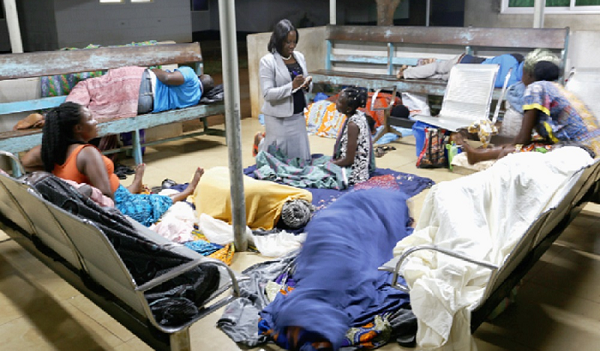
The General Secretary of the Ghana Medical Association (GMA), Dr Richard Selormey, has warned that there is a stark gap between Ghana’s emergency healthcare policies and what occurs in practice, describing the system as dangerously fragmented and in urgent need of reform.
Speaking on Joy FM’s Super Morning Show on Tuesday, 24 February 2026, Dr Selormey said that although policy documents outline clear standards for accident and emergency services, the reality in many hospitals falls far short.
“It is good that you are referencing the policy and the guidelines document,” he said in response to a question about emergency unit requirements. “But there is always a translation from policy into reality.”
According to him, Ghana has “many beautiful policies and guidelines”, yet implementation remains a major challenge.
“If you ask me directly, what happens on the ground is totally different from what exists,” he stressed.
The discussion followed a review of official guidelines requiring hospitals to have functional triage areas, resuscitation units for patient stabilisation, observation areas for up to 24 hours, procedure rooms for minor cases, and ambulance bays.
Dr Selormey challenged Ghanaians to assess the system for themselves.
“You can conduct a survey and visit the facilities to find out how many have these in place, how many even have standby oxygen and the necessary professionals to operate the equipment,” he said.
He identified multiple structural weaknesses, including logistical constraints, poor coordination between ambulances and hospitals, and a disjointed referral system.
Although the National Ambulance Service operates nationwide, he noted that it faces operational challenges, including limited ambulances and coordination gaps between facilities.
“There is no centralised point where we can know how many beds are available and where, in real time,” he explained, describing the system as lacking a proper capacity-tracking mechanism.
Dr Selormey also criticised the referral cycle, stating that patients are often transferred between facilities without proper communication or preparation at the receiving end.
Beyond infrastructure and logistics, he cited demotivated staff and poor health-seeking behaviour among sections of the public as contributing factors. Many patients, he noted, delay seeking care until emergencies arise.
“All these matters combine to give us a system that is very dangerous, which we must treat as a matter of urgency and cure,” he warned.
He called for a concerted effort involving government, the health sector, the public and the media to focus on solutions rather than repeatedly highlighting the problems.
Latest Stories
-
Sexual abuse in schools persists because perpetrators are not held accountable – Dr Nyarkoa
4 minutes -
Chief Justice has designated Achimota Court to handle petroleum diversion cases – NPA CEO
7 minutes -
Philip Nai and friends gear up for bigger seventh Christmas outreach
9 minutes -
GSA strengthens electricity meter testing to protect consumers and improve energy reliability
10 minutes -
‘Dismissed or suspended? Ghanaians deserve clarity’ – NPP demands clarity on Ampofo Ankrah’s fate
13 minutes -
Teach consent and sexual boundaries from pre-school to prevent abuse – Gender advocate
19 minutes -
Zonda Tec launches HOWO T3M truck to support agric and logistics
28 minutes -
Obuasi SHTS scandal: Eduwatch calls for sex offenders’ register and mandatory background checks for teachers
40 minutes -
GloMeF CEO urges intensified public education on new road traffic regulations
51 minutes -
‘Any tax on ChatGPT is an attack on education and innovation’- Akim Swedru, MP
55 minutes -
Obuasi SHTS sexual abuse scandal exposes systemic failure in child protection – Moving Masculinity
55 minutes -
Hubtel CEO calls for national data-sharing framework to boost AI development
58 minutes -
Twelve Golden Rules of real estate development in Ghana, Africa
1 hour -
Five new telephony cell sites in Ashanti Region to be activated in October 2026 – Sam George
1 hour -
Mahama cuts sod for Afienya Industrial Park, targets 120 enterprises
1 hour