

Audio By Carbonatix
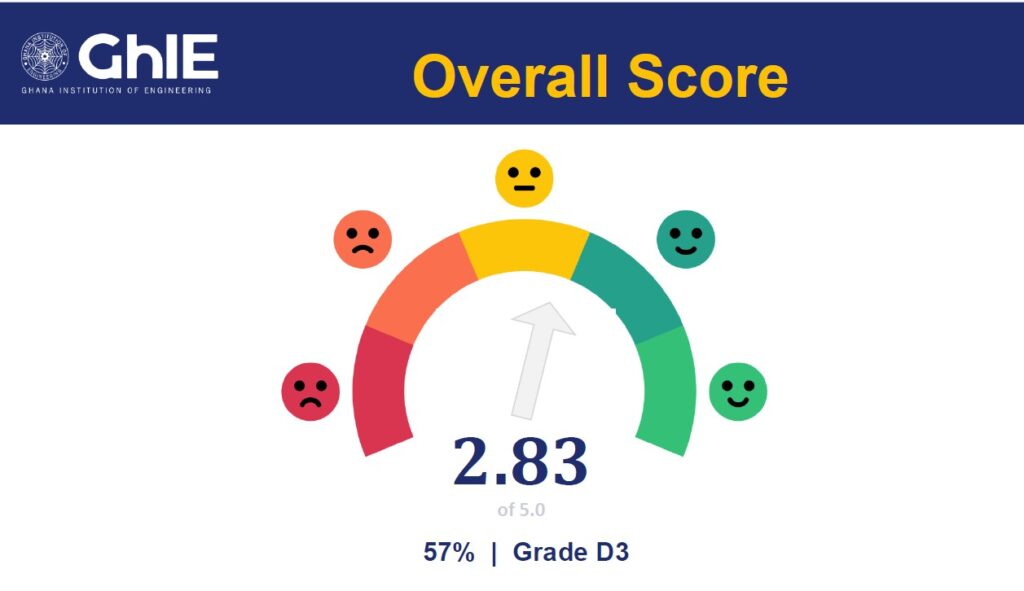
Ghana's infrastructure has received an overall D3 (57 per cent) rating in the 2026 Ghana Infrastructure Report Card, with the Ghana Institution of Engineering (GhIE) warning that chronic underfunding, weak maintenance culture and governance challenges continue to undermine the country's critical infrastructure.
The nationwide assessment, which evaluated eight key infrastructure sectors using internationally recognised engineering criteria, assigned Ghana an average score of 2.83 out of 5, describing the country's overall infrastructure condition as "Poor to Fair".
The 2026 Infrastructure Report Card is Ghana's second national infrastructure assessment, following the inaugural edition published in 2016.
Unlike the first report, which assessed three sectors, the latest edition expands coverage to eight sectors to provide what GhIE describes as the country's first holistic engineering audit of national infrastructure.
The assessment was designed to provide policymakers, Parliament and the public with an independent, evidence-based measure of infrastructure performance and to track progress over the past decade.
The report, compiled by GhIE's Public Accountability Committee, assessed aviation, electric power, telecommunications, potable water, education, roads and bridges, health, and railway infrastructure using eight indicators, namely capacity, condition, funding, future need, operation and maintenance, public safety, resilience and innovation.
More than 900 respondents drawn from all 16 regions, including engineers, infrastructure professionals, administrators and members of the public, participated in the exercise.
Aviation leads
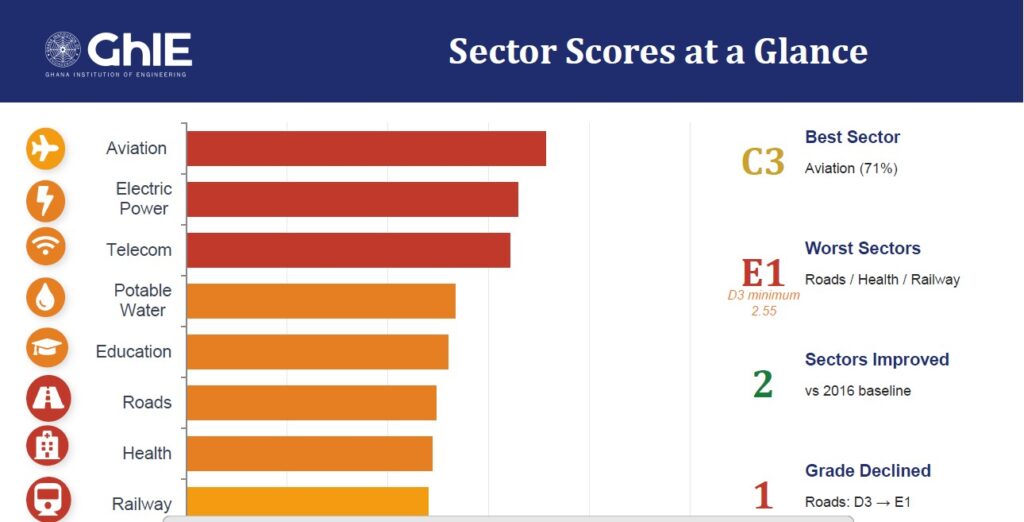
Aviation emerged as Ghana's best-performing infrastructure sector, earning a C3 (71 per cent) grade with a score of 3.57, largely due to sustained investment in Kotoka International Airport Terminal 3, Ghana's continued FAA Category 1 certification, strong aviation safety standards and the absence of major air accidents since 2018. However, the report warned that the sector still faces a 40 per cent medium-term funding gap and requires an estimated US$1.2 billion in investment by 2035.
Electric power ranked second with a D1 (66 per cent) score after improving from its 2016 rating. The report attributed the improvement to a 45 per cent increase in installed generation capacity, national electricity access of 88 per cent and strong operation and maintenance performance. Nevertheless, it cautioned that reserve margins remain below engineering standards and financial challenges within the sector persist.
Telecommunications also received a D1 (64 per cent) grade, reflecting rapid growth in mobile services but highlighting concerns over Ghana's extremely low fixed broadband penetration of 0.38 per cent and market concentration in mobile data services.
Roads among weakest sectors
Road infrastructure recorded the most significant deterioration over the past decade, dropping from a D3 rating in 2016 to E1 (50 per cent) in the latest assessment.
According to the report, contractor arrears have increased more than elevenfold to GH¢17.75 billion, only 27 per cent of the national road network is paved, while public safety received one of the lowest scores across all assessment criteria.
The railway sector recorded the lowest overall performance with an E1 (48 per cent) grade. The report noted that only 149 kilometres of Ghana's 947-kilometre rail network are operational, while the US$447 million Tema-Mpakadan railway, commissioned in November 2024, remains non-operational because of vandalism, incomplete terminal facilities and the absence of a private operator.
Health infrastructure also received an E1 (49 per cent) rating, with the report highlighting inadequate capital investment, shortages of essential facilities and growing financial burdens on households seeking healthcare.
Education infrastructure was graded D3 (52 per cent), with engineers pointing to a school desk deficit exceeding one million, inadequate sanitation and ICT facilities, and an estimated US$2 billion financing gap needed to meet Sustainable Development Goal 4.
Potable water also scored D3 (53 per cent) despite improvements in national coverage. The report observed that Ghana Water Limited currently meets only about 55 per cent of daily demand, while approximately 50 per cent of treated water is lost before reaching consumers through non-revenue water. Illegal mining activities were also identified as an increasing threat to water resources.
Funding challenge
A major finding of the report is that no infrastructure sector scored above D1 in funding, underscoring what engineers described as a national infrastructure financing crisis.
The report cited delayed budget releases, diversion of maintenance funds, mounting contractor arrears and inadequate capital investment as common problems affecting virtually every sector.
It further concluded that while Ghana has demonstrated its ability to deliver world-class infrastructure—as evidenced by the aviation sector—systemic reforms are needed to replicate similar successes across roads, health, education, water and rail.
Recommendations
Among its key recommendations, the Ghana Institution of Engineering called for the establishment of a National Infrastructure Council to coordinate planning and monitor performance, implementation of a national infrastructure asset management policy, settlement of road contractor arrears, increased capital investment in health and education, and the immediate operationalisation of the Tema-Mpakadan railway line.
Latest Stories
-
Ampofo Ankrah opens up on ‘constant and unrelenting’ pressure at NSA
52 seconds -
I expect to win NPP Vice Chairman race – Nana B
7 minutes -
NDC’s failed 24-Hour Economy has become 24-Hour demolition – Dr. Bawumia
19 minutes -
Stampede at NPP conference leaves three injured in Kumasi
30 minutes -
Use power to serve Ghanaians, not to intimidate – Okoe Boye to NDC
33 minutes -
“I’ll have no honour if your arrears are not paid by October 30,” Haruna Iddrisu tells teachers
35 minutes -
Billboard collapses at NPP delegates conference, 4 vehicles damaged
39 minutes -
NPP Delegates Congress: The 14 approved constitutional amendments
40 minutes -
EOCO’s handling of arrests could cost NDC power – Kpebu
59 minutes -
Health sovereignty a priority for 1.4b Africans – President Mahama declares
1 hour -
NACOC begins pre-screening checks at Accra International Airport
1 hour -
‘I was stepping up into an alliance’ – Sammy Crabbe clarifies John Boadu backing
1 hour -
Turn CSIR research into commercially viable products for national dev’t – Dr Agyeman-Rawlings
2 hours -
Baffour Awuah thanks Bawumia, NPP supporters after GH¢10m bail
2 hours -
Ghana gaining notoriety for drugs – Bawumia demands bipartisan probe
2 hours